
Surreal Numbers
What are real numbers?
The surreal numbers form a totally ordered field that contains the real numbers, together with infinite numbers and infinitesimals.
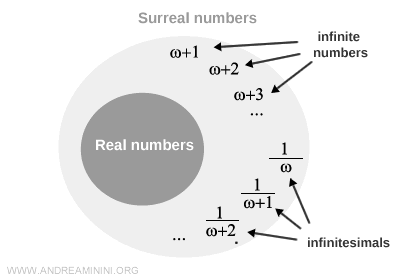
They are called "surreal" because they extend strictly beyond the real numbers.
Surreal numbers were introduced by John Horton Conway.
However, the term "surreal number" was coined in 1974 by Donald Knuth in the book "Surreal Numbers: How Two Ex-Students Turned on to Pure Mathematics and Found Total Happiness".
Note. This is an original and unconventional book that presents mathematics as a dialogue between two characters, while fully retaining standard mathematical notation. An Italian edition is also available.
The set of surreal numbers is larger than the set of real numbers because, in addition to the reals, it also contains
- infinite numbers
numbers whose absolute value exceeds that of every real number - infinitesimals
nonzero numbers whose absolute value is smaller than that of every positive real number
Each surreal number is associated with two sets, called the left set L and the right set R.
This simple idea is the basis of the entire construction of the surreal numbers.
Conway's rules
Surreal numbers are defined by following two fundamental principles known as Conway's rules.
- Every surreal number is associated with two sets L and R
No element of the left set L is greater than or equal to any element of the right set R. $$ x_L \ngeq x_R \ \ \ x_L \in X_L \ , \ x_R \in X_R $$ Conversely, no element of the right set R is less than or equal to any element of the left set L. $$ x_R \nleq x_L \ \ \ x_L \in X_L \ , \ x_R \in X_R $$Note. The set L (left) contains only numbers strictly smaller than the surreal number and is therefore called its left set. The set R (right) contains only numbers strictly larger than the surreal number and is called its right set. In general, a surreal number x is written as $$ x = \{ X_L | X_R \} $$ or equivalently as the ordered pair $$ x = (X_L, X_R) $$ or alternatively $$ x = < X_L \ | \ X_R > $$ where XL is the left set and XR is the right set of x.
- Comparison rule
Given two surreal numbers x = { XL | XR } and y = { YL | YR }, the order relation x ≤ y holds if and only if- no element of XL is greater than or equal to y $$ x_L \ngeq y \ \ \ x_L \in X_L $$
- no element of YR is less than or equal to x $$ y_R \nleq x \ \ \ y_R \in Y_R $$
With these two rules in place, the construction of numbers can begin.
How to construct the set of surreal numbers
At the outset, no numbers exist.
Accordingly, both the left set and the right set are empty sets.
$$ L = \{ \} $$ $$ R = \{ \} $$
To simplify notation and reduce the number of braces, the empty set will henceforth be denoted by the symbol Ø.
$$ L = Ø $$ $$ R = Ø $$
Note. Although L and R are empty, they still satisfy Conway's rules. Indeed, there are no elements in L that could violate the defining inequalities with elements of R. $$ x_L \ngeq x_R \ \ \ x_L \in X_L \ , \ x_R \in X_R $$
At this point, the first surreal number can be defined, namely zero.
At this stage, zero has no numbers on its left (L) and no numbers on its right (R).
It can therefore be written as a pair of empty sets.
$$ 0 = (Ø, Ø) $$
In this first iteration, exactly one number has been created: zero.
Using the number zero (0) together with the empty set Ø, two further numbers can now be generated.
The number 1 has zero {0} in its left set (L) and the empty set Ø in its right set (R).
$$ 1 = (\{ 0 \}, Ø) $$
Note. The sets L and R for the number 1 satisfy Conway's rules. No element of L={0} is greater than or equal to any element of R=Ø. $$ x_L \ngeq x_R \ \ \ x_L \in X_L \ , \ x_R \in X_R $$
The other number is -1, which has zero {0} in its right set (R) and the empty set Ø in its left set (L).
$$ -1 = (Ø, \{ 0 \}) $$
Note. The sets L and R for the number -1 also satisfy Conway's rules. No element of the right set R is less than or equal to any element of the left set L. $$ x_L \ngeq x_R \ \ \ x_L \in X_L \ , \ x_R \in X_R $$ In general, if either L or R is empty, the surreal-number rules are automatically satisfied.
In this second iteration, two additional numbers have been created.
The set of surreal numbers now consists of three elements: {-1, 0, 1}.
Each number is, in turn, associated with a left set L and a right set R.
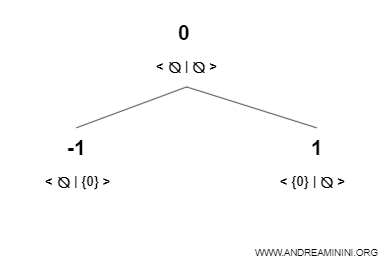
In a third iteration, the known numbers {-1, 0, 1} are used to generate further numbers.
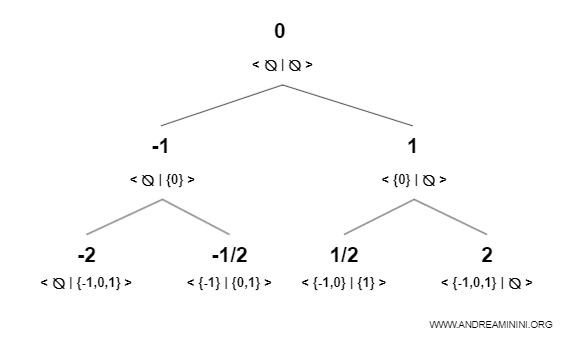
Note. The number -2 has the empty set Ø on the left (L) and the set {-1, 0, 1} on the right (R). $$ -2 = (Ø, \{ -1, 0, 1 \}) $$ The number -1/2 has the set {-1} on the left (L) and the set {0, 1} on the right (R). $$ -1/2 = (\{ -1 \} , \{ 0, 1 \}) $$ The number 1/2 has the set {-1, 0} on the left (L) and the set {1} on the right (R). $$ 1/2 = (\{ -1, 0 \} , \{ 1 \}) $$ The number 2 has the set {-1, 0, 1} on the left (L) and the empty set Ø on the right (R). $$ 2 = (\{ -1, 0, 1 \} , \{ Ø \}) $$
In this iteration, four additional numbers have been created.
The surreal numbers in the universe now number seven:
$$ \{-2 \ , \ -1 \ , \ - \frac{1}{2} \ , \ 0 \ , \ \frac{1}{2} \ , \ 1 \ , \ 2 \} $$
In a fourth iteration, the existing surreal numbers are used to generate still more.
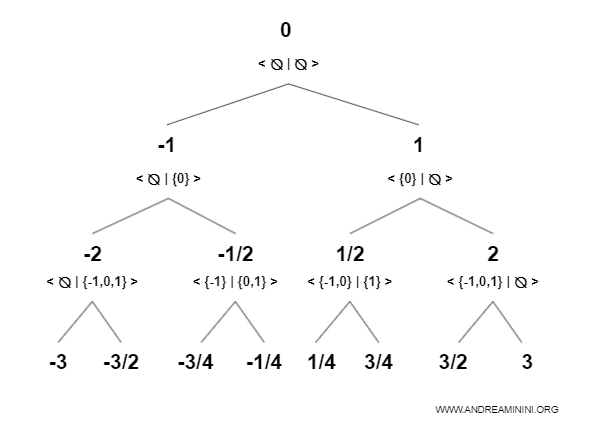
In the fourth iteration, eight additional numbers are created.
The total number of surreal numbers at this stage is fifteen.
Note. The construction of surreal numbers resembles a kind of Big Bang, starting from the empty set and expanding toward infinity, and beyond. In the first iteration, one number is created (0). In the second, two numbers (1 and -1). In the third, four numbers (-2, -1/2, 1/2, 2). In the fourth, eight numbers. This process defines a divergent sequence. Each k-th iteration generates 2k new numbers. $$ 2^k = 2^0 \ , \ 2^1 \ , \ 2^2 \ , \ 2^3 \ , \ 2^4 \ , .... $$ $$ 2^k = 1 \ , \ 2 \ , \ 4 \ , \ 8 \ , \ 16 \ , \ 32 \ , \ 64 \ , \ 128 \ , \ 256 \ , \ .... $$ After each iteration, the universe of surreal numbers grows according to a geometric series, which is itself divergent. $$ \sum_{k=0}^{\infty} 2^k = 1+2+2^2+...+2^k $$
By iterating this process indefinitely, one obtains all infinitely many rational numbers (Q), that is, numbers expressible as the ratio of two integers (m/n).
$$ 0 \ , \ \pm 1 \,\ \pm \frac{1}{2} \,\ \pm \frac{1}{3} \,\ \pm \frac{1}{4} \,\ \pm \frac{1}{5} \,\ ... \,\ \pm \infty $$
Since the surreal numbers include the rational numbers, they also include the irrational numbers (I), because every irrational number can be specified by placing it between two sets L and R of rational numbers.
$$ \sqrt{2} \ , \ \sqrt{3} \ , \ \sqrt{4} \ , \ \pi \ ... $$
For example, the square root of 2 and π can be represented as surreal numbers as follows:
$$ \sqrt{2} = ( \{ 1 \, \ 1.4 \ , \ 1.41 \ , \ 1.414 \ , \ ... \} \ , \{ 2 \, \ 1.5 \ , \ 1.42 \ , \ 1.415 \ , \ ... \} ) $$
$$ \pi = ( \{ 3 \ , \ 3.1 \ , \ 3.14 \ , \ 3.141 \ , \ 3.1415 \ , \ ... \} \ , \{ 4 \, \ 3.2 \ , \ 3.15 \ , \ 3.142 \ , \ 3.1416 \ , \ ... \} ) $$
At this point, since the surreal numbers include both rational numbers (Q) and irrational numbers (I), they also contain the set of real numbers (R).
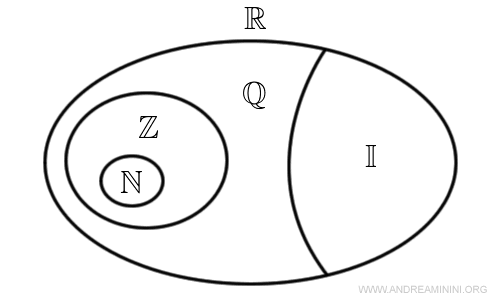
One can now define the infinity of the real numbers (∞), which in the surreal number system is denoted by the symbol omega, ω.
$$ \omega = (\{ 0,1, 2, ... \} \ | \ Ø ) $$
The surreal number ω has the set of real numbers as its left set (L) and the empty set Ø as its right set (R).
$$ \omega = ( \ R \ | \ Ø \ ) $$
Note. In the same way, minus infinity for the real numbers (-∞) can be defined. This is the surreal number -ω, which has the empty set Ø on the left (L) and the set of real numbers on the right (R). $$ - \omega = ( \ Ø \ | \ R \ ) $$
At this point, something genuinely interesting occurs.
By following Conway's rules, one can perform another iteration using the infinite element ω.
The next iteration produces additional surreal numbers, among which two are particularly important:
- Infinity plus one
Infinity plus one is the surreal number with ω in its left set (L) and the empty set Ø in its right set (R). It is therefore strictly larger than infinity itself.
$$ \omega + 1 = ( \omega \ | \ Ø \ ) $$ - Infinitesimal
An infinitesimal (ε) is a surreal number with zero in its left set (L) and 1/ω in its right set (R). It is greater than zero and smaller than any positive real number.
$$ \epsilon = ( 0 \ | \ \frac{1}{ \omega } ) $$
Therefore, the set of surreal numbers is strictly larger than the set of real numbers (R), because it also contains infinite numbers and infinitesimals.
Of course, the construction does not end here.
By iterating further, one also obtains larger infinite numbers such as (ω+2) and smaller infinitesimals such as 1/(ω+1).
$$ \omega + 2 = ( \omega + 1 \ | \ Ø \ ) $$
$$ \omega + 3 = ( \omega + 2 \ | \ Ø \ ) $$
$$ \omega + 4 = ( \omega + 3 \ | \ Ø \ ) $$
$$ \vdots $$
In conclusion, surreal numbers make it possible to define and rigorously compare different kinds of infinities and infinitesimals, including entire hierarchies of infinite magnitude.
These ideas are well established in modern mathematical theory, but they are not easily captured using only the real number system.
And so on.


