Pencil of Planes
A pencil of planes is an infinite collection of planes defined by a real parameter. Depending on the context, the planes may either share a common line of intersection or be parallel throughout.
Proper pencil of planes
Given a line r, a proper pencil of planes consists of all planes that contain the line r. $$ \lambda_1 ( a_1x+b_1y+c_1z+d_1 ) + \lambda_2 ( a_2x+b_2y+c_2z+d_2 ) = 0 $$ $$ ( a_1x+b_1y+c_1z+d_1 ) + \frac{\lambda_2}{\lambda_1} ( a_2x+b_2y+c_2z+d_2 ) = 0 $$
These two equations define two distinct planes.
Their intersection is the line r.
$$ \begin{cases} \lambda_1 ( a_1x+b_1y+c_1z+d_1 ) \\ \lambda_2 ( a_2x+b_2y+c_2z+d_2 ) \end{cases} $$
Example
Suppose we are given the equation of a line in space, defined by the intersection of two planes:
$$ \begin{cases} 2x+3y+8z+2=0 \\ -4x-6y+6z-12=0 \end{cases} $$
The set of points lying at the intersection of these two planes forms the line.
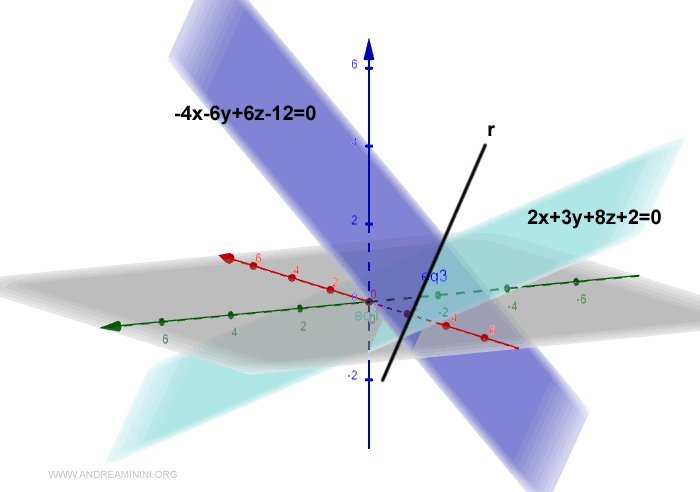
In this case, the proper pencil of planes passing through the line is expressed as:
$$ ( 2x+3y+8z+2 ) + \frac{\lambda_2}{\lambda_1} ( -4x-6y+6z-12 ) = 0 $$
where \(\lambda_1\) and \(\lambda_2\) are arbitrary scalars, with \(\lambda_2 \neq 0\).
For simplicity, we can write \( k = \lambda_2 / \lambda_1 \), so the equation becomes:
$$ ( 2x+3y+8z+2 ) + k ( -4x-6y+6z-12 ) = 0 $$
By varying \( k \), we obtain all planes in the pencil that contain the line r - that is, all planes "rotating" about the line.
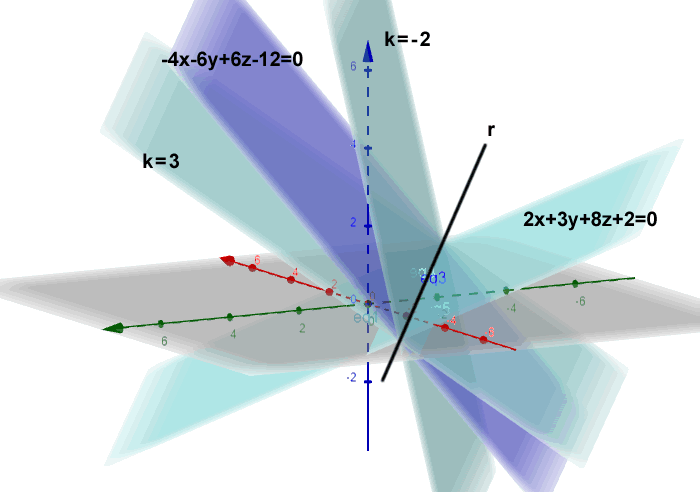
This is the proper pencil of planes associated with the line r.
Improper pencil of planes
Given a plane A, an improper pencil of planes consists of all planes parallel to A. $$ ax+by+cz+d=0 $$
To generate the parallel planes, simply vary the constant term \( d \).
The coefficients \( a, b, c \) must not all be zero at the same time.
Example
Consider the equation of a plane in space:
$$ 2x+3y+8z+2=0 $$
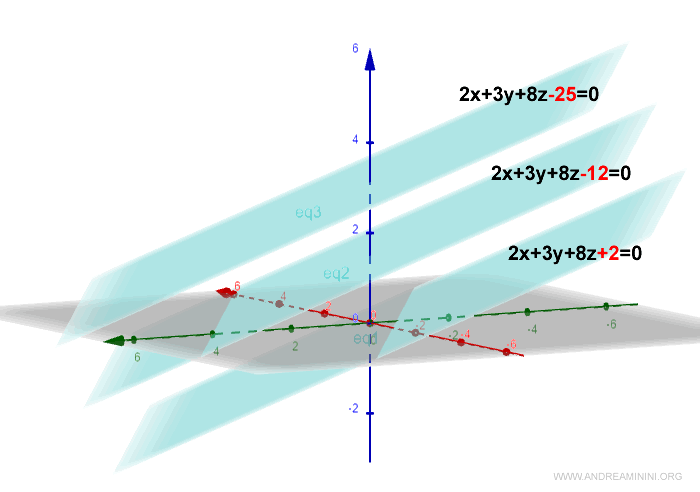
By varying the constant term \( k \), we obtain the family of planes parallel to the given plane:
$$ 2x+3y+8z+k=0 $$
For instance, with \( k = -12 \) and \( k = -25 \), the graphical representation is as follows:
And so on.