
Theorem of Tangential Quadrilaterals
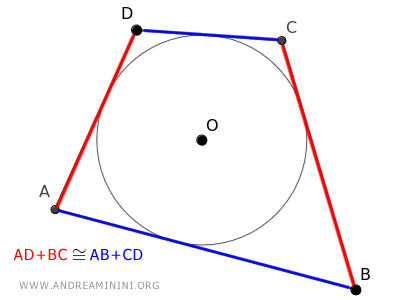
In a tangential quadrilateral - that is, one circumscribed about a circle - the sums of the lengths of opposite sides are equal: $$ \overline{AB} + \overline{CD} \cong \overline{AD} + \overline{BC} $$. The converse is also true.
When a quadrilateral is circumscribed around a circle, each of its sides is tangent to the circle.
In such a figure, the sum of one pair of opposite sides, AD + BC, is equal to the sum of the other pair, AB + CD.
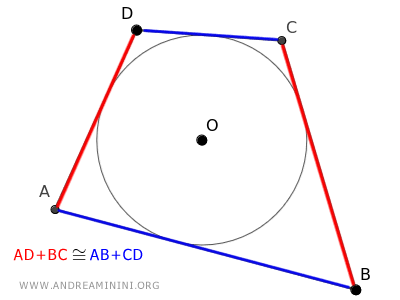
The converse theorem also holds true.
If, in a quadrilateral, the sums of the lengths of opposite sides are equal, then the quadrilateral can be circumscribed about a circle.
Therefore, the equality of the sums of opposite sides is both a necessary and sufficient condition for a quadrilateral to be tangential.
Proof
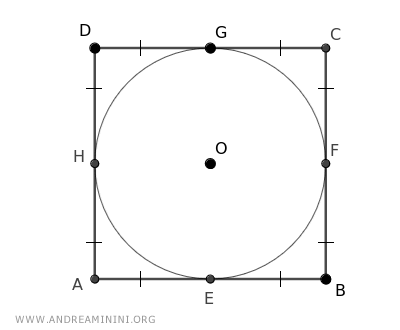
Consider a quadrilateral ABCD circumscribed around a circle with center O.
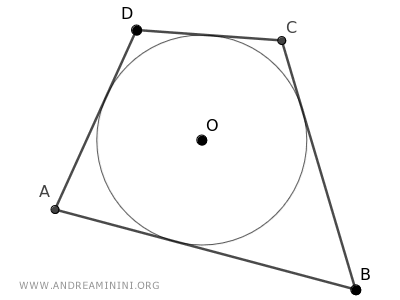
The points where the circle is tangent to the sides of the quadrilateral are labeled E, F, G, and H.
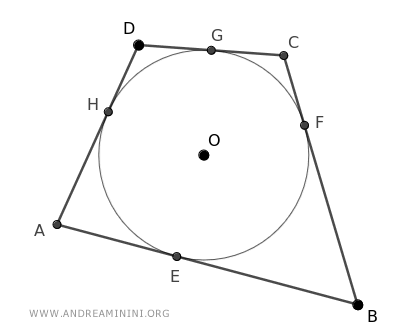
According to the Tangent-Segment Theorem, the segments AE ≅ AH are congruent because point A lies outside the circle and is the endpoint of two tangent segments.
$$ \overline{AE} \cong \overline{AH} $$
For the same reason, the following segments are congruent:
$$ \overline{BE} \cong \overline{BF} $$
$$ \overline{CG} \cong \overline{CF} $$
$$ \overline{DG} \cong \overline{DH} $$
These congruences can be indicated on the quadrilateral.
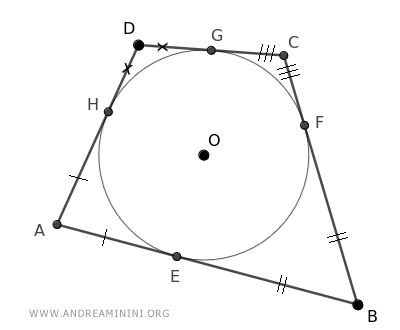
Since the sums of congruent segments are themselves congruent, we can add the corresponding segments on both sides:
$$ \overline{AE} + \overline{BE} + \overline{CG} + \overline{DG} \cong \overline{AH} + \overline{BF} + \overline{CF} + \overline{DH} $$
Applying the associative property of addition, we regroup the terms as follows:
$$ (\overline{AE} + \overline{BE}) + (\overline{CG} + \overline{DG}) \cong (\overline{AH} + \overline{DH}) + (\overline{BF} + \overline{CF}) $$
Since AB = AE + BE:
$$ \overline{AB} + (\overline{CG} + \overline{DG}) \cong (\overline{AH} + \overline{DH}) + (\overline{BF} + \overline{CF}) $$
And because CD = CG + DG:
$$ \overline{AB} + \overline{CD} \cong (\overline{AH} + \overline{DH}) + (\overline{BF} + \overline{CF}) $$
Knowing that AD = AH + DH:
$$ \overline{AB} + \overline{CD} \cong \overline{AD} + (\overline{BF} + \overline{CF}) $$
Finally, since BC = BF + CF:
$$ \overline{AB} + \overline{CD} \cong \overline{AD} + \overline{BC} $$
This proves that the sums of the lengths of opposite sides in a tangential quadrilateral are equal.
Remarks
Here are some additional observations and notes regarding this theorem:
- Both the square and the rhombus are examples of quadrilaterals that can always be circumscribed about a circle.
- In a square, the points of tangency with the circle coincide with the midpoints of its sides.
And so on.


