Theorem of Cyclic Quadrilaterals
In a cyclic quadrilateral - a quadrilateral inscribed in a circle - the opposite angles are supplementary, and the converse is true as well.

When a quadrilateral is inscribed in a circle, its opposite angles are supplementary - that is, they add up to a straight angle measuring 180°.
$$ \alpha + \gamma \cong 180° $$
$$ \beta + \delta \cong 180° $$
The converse of this theorem also holds.
If a quadrilateral has supplementary opposite angles, then it can be inscribed in a circle.
Thus, having supplementary opposite angles is both a necessary and sufficient condition for a quadrilateral to be cyclic.
Proof
Let’s examine a quadrilateral inscribed in a circle.
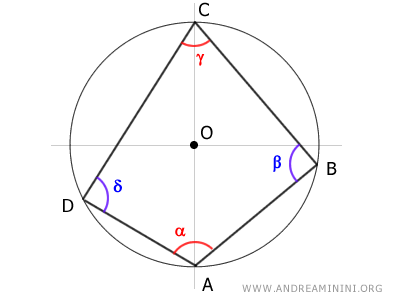
Draw radii OB and OD, which divide the full angle at the center into two central angles, α' and γ'.

It’s worth noting here that the sum of these two central angles equals a full rotation (360°), a fact that will be crucial in the steps ahead.
$$ \alpha' + \gamma' = 360° $$
The angle α is an inscribed angle subtending arc BCD.
According to the Theorem of Central and Inscribed Angles, an inscribed angle α measures half the central angle γ' that subtends the same arc BCD.
$$ \alpha = \frac{1}{2} \cdot \gamma' $$
$$ \gamma' = 2 \cdot \alpha $$
Similarly, angle γ is an inscribed angle subtending arc BAD.
Again, by the Theorem of Central and Inscribed Angles, the inscribed angle γ is half the measure of the central angle α' that subtends the same arc BAD.
$$ \gamma = \frac{1}{2} \cdot \alpha' $$
$$ \alpha' = 2 \cdot \gamma $$
Since we know the sum of the central angles equals a full rotation:
$$ \alpha' + \gamma' = 360° $$
Substituting α' = 2γ and γ' = 2α gives:
$$ 2 \cdot \gamma + 2 \cdot \alpha = 360° $$
Dividing both sides of the equation by two simplifies the expression:
$$ \frac{2 \cdot \gamma + 2 \cdot \alpha}{2} = \frac{360°}{2} $$
$$ \gamma + \alpha = 180° $$
Thus, we’ve demonstrated that the sum of the opposite angles α and γ in the quadrilateral is 180°.
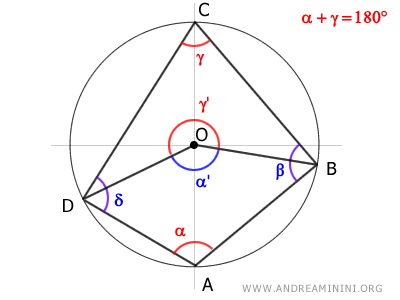
Once we’ve established that the opposite angles α and γ are supplementary (α + γ = 180°), it’s straightforward to deduce that the other pair of opposite angles must also be supplementary.
We could prove this by repeating the same reasoning, this time drawing radii OA and OC and analyzing angles β and δ in the same way.
However, it’s far more efficient to recall that the sum of the interior angles of any quadrilateral is always 360°.
$$ \alpha + \beta + \gamma + \delta = 360° $$
Applying the associative property allows us to regroup the terms:
$$ (\alpha + \gamma) + (\beta + \delta) = 360° $$
Since we already know that one pair of opposite angles sums to 180°:
$$ 180° + (\beta + \delta) = 360° $$
$$ \beta + \delta = 360° - 180° $$
$$ \beta + \delta = 180° $$
Therefore, the other pair of opposite angles, β and δ, also sums to 180°.
This completes the proof that in any cyclic quadrilateral, both pairs of opposite angles are supplementary.
Proof of the Converse Theorem
In this case, we begin with a different set of assumptions.
Consider a quadrilateral ABCD
whose opposite angles are supplementary.
$$ \alpha + \gamma = 180° $$
$$ \beta + \delta = 180° $$
We aim to prove that this quadrilateral can indeed be inscribed in a circle.
To prove this, we use a proof by contradiction. Assume instead that “the quadrilateral is not cyclic because the circle does not pass through one of its vertices.”
Suppose, for instance, that the circle does not pass through point D.
Given any three points, it’s always possible to draw a circle passing through them, so there certainly exists a circle through vertices A, B, and C of the quadrilateral.
In that case, point D must either lie inside or outside the circle.
Let’s consider both scenarios:
A] Vertex D lies outside the circle
Here, vertex D lies outside the circle.
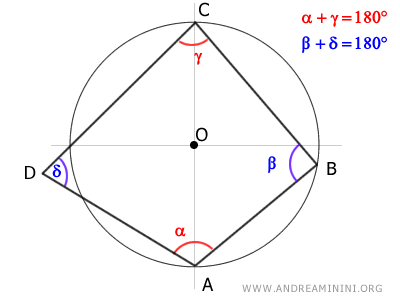
Since vertex C is on the circle, segment CD necessarily intersects the circle at some intermediate point E.
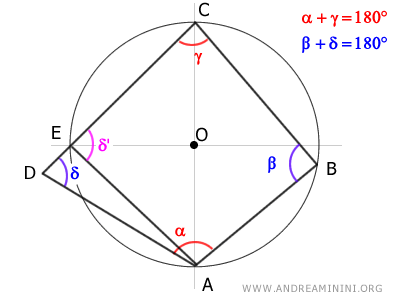
By our initial assumption, quadrilateral ABCD is cyclic and therefore has supplementary opposite angles.
In particular, we have β + δ = 180°.
$$ \beta + \delta = 180° $$
However, angles β and δ' are also opposite angles of quadrilateral AECD, and so they, too, must be supplementary: β + δ' = 180°.
$$ \beta + \delta' = 180° $$
It follows that angles δ and δ' are congruent, because they’re both supplementary to the same angle β.
Moreover, angles δ and δ' are corresponding angles formed by lines AD and AE cut by the transversal DE.
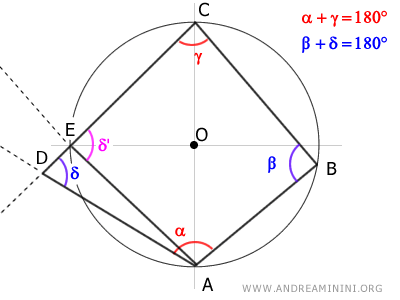
By the Parallel Lines Theorem, if corresponding angles δ and δ' are congruent, then lines AD and AE must be parallel.
But this leads to a contradiction, since segments AD and AE share the common endpoint A, and thus lie on intersecting lines, not parallel lines.
Hence, our initial assumption must be false.
B] Vertex D lies inside the circle
In this case, vertex D lies inside the circle.
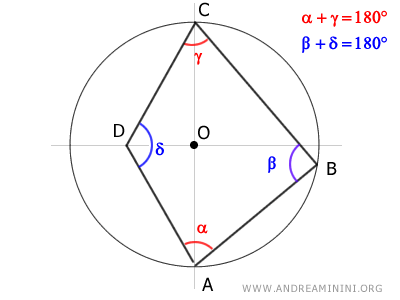
Since vertex C lies on the circle, extending segment CD intersects the circle at a point E.
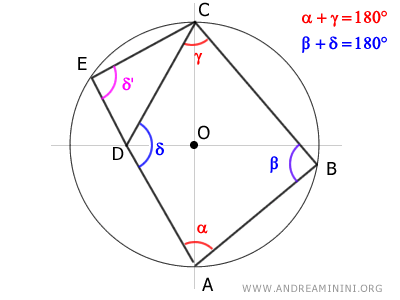
Again, by our initial assumption, quadrilateral ABCD is cyclic and therefore has supplementary opposite angles.
Specifically, β + δ = 180°.
$$ \beta + \delta = 180° $$
However, angles β and δ' are also opposite angles in quadrilateral AECD and thus are supplementary: β + δ' = 180°.
$$ \beta + \delta' = 180° $$
Therefore, angles δ and δ' are congruent because they’re both supplementary to the same angle β.
Moreover, angles δ and δ' are corresponding angles formed by lines CD and CE cut by the transversal DE.
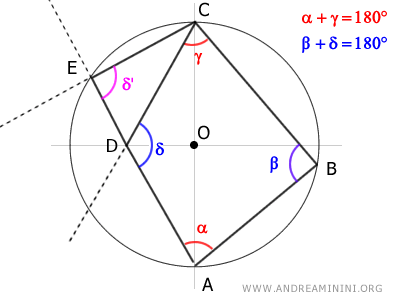
By the Parallel Lines Theorem, if corresponding angles δ and δ' are congruent, then lines CD and CE must be parallel.
But this contradicts the fact that segments CD and CE share a common endpoint at C and therefore lie on intersecting lines.
Thus, our initial assumption is again false.
In conclusion, the initial assumption is false whether point D lies outside or inside the circle.
Consequently, the opposite must be true: point D lies on the circle.
This proves that “a quadrilateral can be inscribed in a circle if and only if the circle passes through all four of its vertices.”
Remarks
Here are some additional notes and observations:
- A convex quadrilateral can be inscribed in a circle if the sums of its pairs of opposite angles are equal: $$ \alpha + \gamma \cong \beta + \delta $$ since both sums equal a straight angle (180°).
- Every rectangle, square, and isosceles trapezoid can be inscribed in a circle because, in all these figures, opposite angles are always supplementary.
And so on.