
Biquadratic Inequalities
A biquadratic inequality is a fourth degree inequality of the form $$ ax^4 \pm bx^2 \pm c \gt 0 $$ or $$ ax^4 \pm bx^2 \pm c \lt 0 $$ where the coefficient a is nonzero a<>0.
To tackle a biquadratic inequality, we introduce an auxiliary variable that streamlines the expression.
$$ t = x^2 $$
This substitution converts the original inequality into a standard quadratic inequality, which is far more straightforward to analyze.
$$ at^2 \pm bt + c \gt 0 $$
Once the quadratic inequality is solved, we revert to the original variable by replacing t with x.
A worked example
Consider the inequality
$$ 2x^4 - 7x^2 - 4 \lt 0 $$
This is a biquadratic inequality with a≠0.
We begin by introducing the auxiliary variable t.
$$ t = x^2 $$
Substituting t for x2 gives the equivalent quadratic inequality
$$ 2t^2 - 7t - 4 \lt 0 $$
To solve it, we first examine the associated quadratic equation.
$$ 2t^2 - 7t - 4 = 0 $$
The graph of this equation is an upward opening parabola.
The discriminant is positive Δ = (-7)2 - 4⋅2⋅(-4) = 81, which confirms that the equation 2t2 - 7t - 4 = 0 has two distinct real solutions.
$$ t = \frac{-(-7) \pm \sqrt{(-7)^2 - 4 \cdot 2 \cdot (-4)}}{2 \cdot 2} $$
$$ t = \frac{7 \pm \sqrt{49 + 32}}{4} $$
$$ t = \frac{7 \pm \sqrt{81}}{4} $$
$$ t = \frac{7 \pm 9}{4} = \begin{cases} t_1 = \frac{7 - 9}{4} = -\frac{1}{2} \\ \\ t_2 = \frac{7 + 9}{4} = 4 \end{cases} $$
The two real roots are t1 = -1/2 and t2 = 4, ordered so that t1 < t2.
Since the parabola opens upward, the quadratic expression is negative within the open interval (t1, t2) = (-1/2, 4) and positive outside it.
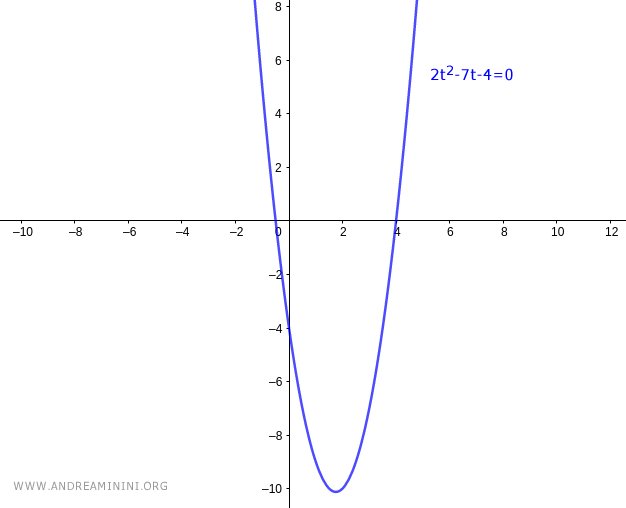
It follows that the inequality 2t2 - 7t - 4 < 0 is satisfied for t ∈ (-1/2, 4).
$$ -\frac{1}{2} < t < 4 $$
We now return to the original variable, recalling that t = x2.
$$ -\frac{1}{2} < x^2 < 4 $$
Note. Once we substitute back, it becomes immediately evident that the lower bound cannot hold, because x2 is never negative over the set of real numbers. For this reason, we can ignore the inequality x2 > -1/2 and focus solely on x2 < 4.
We now extract the square roots.
$$ \sqrt{-\frac{1}{2}} < \sqrt{x^2} < \sqrt{4} $$
The left side does not yield real values, so it contributes no constraints.
Thus x must lie within the interval x ∈ (-2, 2).
$$ x < \pm 2 $$
or equivalently
$$ -2 < x < 2 $$
This is the complete solution to the original biquadratic inequality 2x4 - 7x2 - 4 < 0.
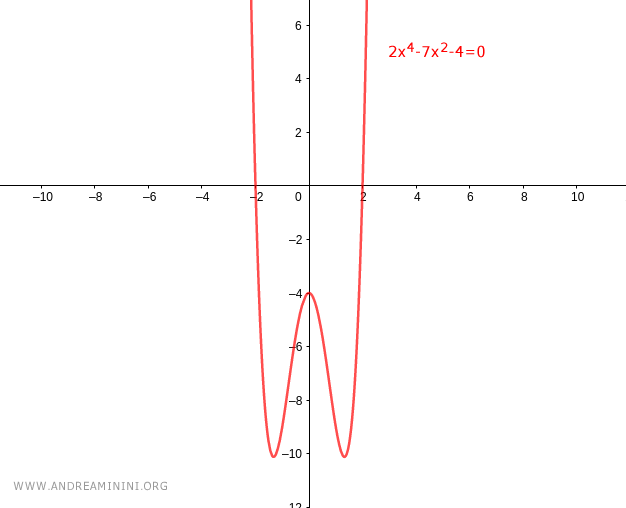
And the same method can be applied systematically to any biquadratic inequality.


