Basic Operations on Series
The fundamental operations on regular series are addition and multiplication by a constant, also known as scalar multiplication.
Sum of Two Series
Let the series with general terms ak and bk be regular series. If the expression $$ \sum_{k=1}^{\infty} a_k + \sum_{k=1}^{\infty} b_k $$ is well-defined in the extended real numbers \( \mathbb{R} \cup \{\pm \infty\} \), then the series with general term ak+bk is also a regular series, and $$ \sum_{k=1}^{\infty} (a_k+b_k) = \sum_{k=1}^{\infty} a_k + \sum_{k=1}^{\infty} b_k $$
A worked example
Consider the following two series
$$ a_n = \sum_{k=1}^{n} \frac{2}{2^k} $$
$$ b_n = \sum_{k=1}^{n} \frac{3}{3^k} $$
Both are regular series, since they are convergent
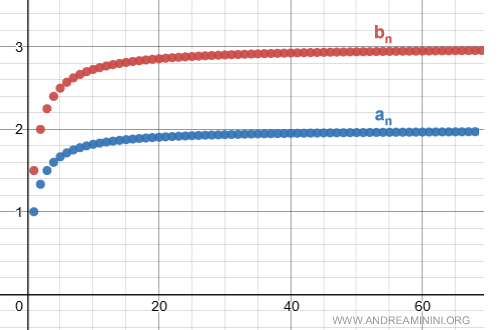
$$ \lim_{ n \rightarrow \infty } \sum_{k=1}^{n} \frac{2}{2^k} = 2 $$
$$ \lim_{ n \rightarrow \infty } \sum_{k=1}^{n} \frac{3}{3^k} = 3 $$
Note. A series is called regular if it is either convergent or divergent, that is, if the limit of the sequence of partial sums exists in the extended real numbers, either as a finite real number or as \( \pm \infty \).
The following figure shows the graphical representation of the two series in the Cartesian plane
Their sum is well-defined in the extended real numbers
Note. The sum must be well-defined in the extended real numbers. For instance, the sum of two finite numbers (l1+l2) is always defined. The sum of a finite number and infinity is also defined (l1+∞). By contrast, the expression (∞-∞) is indeterminate and therefore not defined.
It follows that the series obtained by adding the two series term by term is also a regular series
$$ (a_n + b_n) = \sum_{k=1}^{n} \left( \frac{2}{2^k} + \frac{3}{3^k} \right) $$
$$ (a_n + b_n) = \sum_{k=1}^{n} \left( \frac{2}{2^k} + \frac{3}{3^k} \right) $$
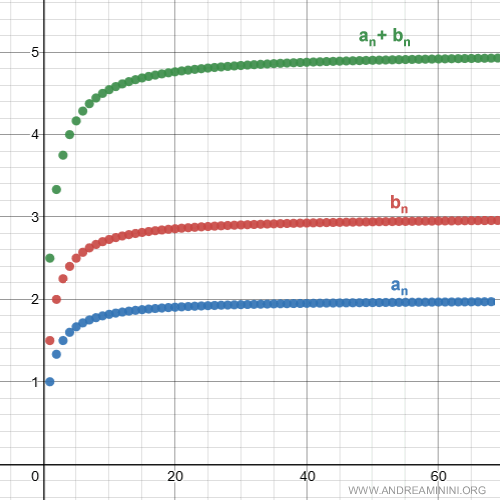
Moreover, this series is convergent and its sum is equal to 5
$$ \lim_{ n \rightarrow \infty } (a_n + b_n) $$
$$ \lim_{ n \rightarrow \infty } \sum_{k=1}^{n} \left( \frac{2}{2^k} + \frac{3}{3^k} \right) = 5 $$
From a graphical perspective
Scalar Multiplication of a Series
Let c be a real constant. If the series with general term ak is a regular series, then the series with general term c·ak is also a regular series, and $$ \sum_{k=1}^{\infty} c \cdot a_k = c \cdot \sum_{k=1}^{\infty} a_k $$
A worked example
Consider the series
$$ s_n = \sum_{k=1}^{n} \frac{1}{2^k} $$
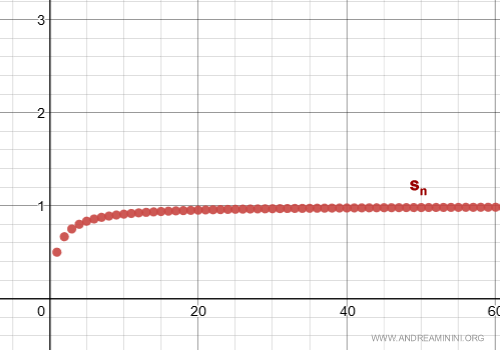
This is a convergent series, since as n→∞ it converges to 1
$$ \lim_{ n \rightarrow \infty } \sum_{k=1}^{n} \frac{1}{2^k} = 1 $$
The graph of the series is shown below
Now multiply the series by c = 2
$$ s_n = \sum_{k=1}^{n} 2 \cdot \frac{1}{2^k} $$
Since the series is regular, because it is convergent, we can apply the rule of scalar multiplication
$$ s_n = 2 \cdot \sum_{k=1}^{n} \frac{1}{2^k} $$
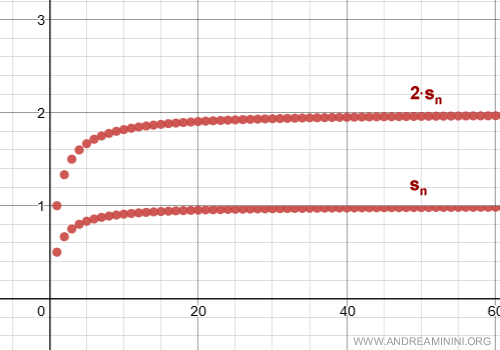
The series 2·sn is also regular and convergent
$$ \lim_{ n \rightarrow \infty } 2 \cdot \sum_{k=1}^{n} \frac{1}{2^k} = 2 $$
Thus, the series 2·sn converges to 2
And so on.