Ratio Test for Series Convergence
Let (an) be a sequence of positive terms, and suppose the limit of the ratio exists $$ l = \lim_{n \rightarrow \infty} \frac{a_{n+1}}{a_n} $$ If the limit is less than 1, the series is convergent $$ l<1 \Rightarrow \sum_{k=1}^{\infty} a_k < + \infty $$ If the limit is greater than 1, the series is divergent $$ l>1 \Rightarrow \sum_{k=1}^{\infty} a_k = + \infty $$
Throughout this theorem, the sequence is assumed to consist of positive terms.
What is this theorem used for?
It is one of the standard tools for determining whether a numerical series converges or diverges.
Warning. If the limit is equal to 1, the ratio test is inconclusive. In that case, a different convergence test must be applied.
A practical example
Example 1
Consider the series
$$ \sum_{n=1}^{ \infty } \frac{n^2}{2^n} $$
The associated sequence has positive terms.
Apply the ratio test by evaluating the limit of the ratio of two consecutive terms
$$ \lim_{n \rightarrow \infty} \frac{a_{n+1}}{a_n} $$
where
$$ a_n = \frac{n^2}{2^n} $$
$$ a_{n+1} = \frac{(n+1)^2}{2^{n+1}} $$
Thus, the limit becomes
$$ \lim_{n \rightarrow \infty} \frac{ \frac{(n+1)^2}{2^{n+1}} }{ \frac{n^2}{2^n} } $$
$$ \lim_{n \rightarrow \infty} \frac{(n+1)^2}{2^{n+1}} \cdot \frac{2^n}{n^2} $$
$$ \lim_{n \rightarrow \infty} \frac{(n+1)^2}{ 2 \cdot 2^n} \cdot \frac{2^n}{n^2} $$
$$ \lim_{n \rightarrow \infty} \frac{(n+1)^2}{ 2 } \cdot \frac{1}{n^2} $$
$$ \frac{1}{2} \cdot \lim_{n \rightarrow \infty} \frac{(n+1)^2}{ n^2 } $$
This limit has the indeterminate form ∞/∞.
To evaluate it, apply L'Hopital's rule.
$$ \frac{1}{2} \cdot \lim_{n \rightarrow \infty} \frac{2n+2}{ 2n } $$
$$ \frac{1}{2} \cdot \lim_{n \rightarrow \infty} \frac{2}{ 2 } $$
$$ \frac{1}{2} \cdot 1 $$
The limit of the ratio exists and is a finite number less than one.
$$ \lim_{n \rightarrow \infty} \frac{a_{n+1}}{a_n} = \frac{1}{2} < 1 $$
Therefore, by the ratio test, the series is convergent.
$$ \sum_{n=1}^{ \infty } \frac{n^2}{2^n} $$
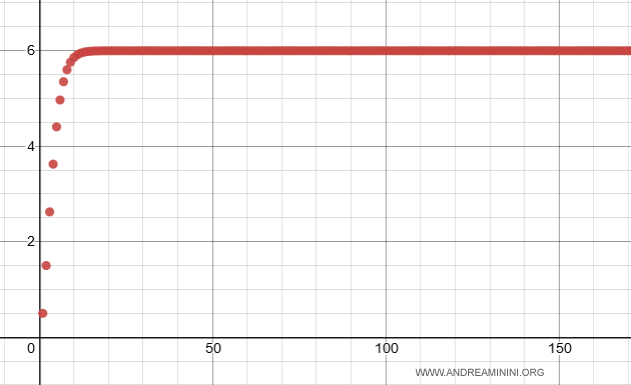
Here is the graphical representation of the series
Example 2
Consider the series
$$ \sum_{n=1}^{ \infty } \frac{2^n}{n^5} $$
The associated sequence has positive terms.
Apply the ratio test
$$ \lim_{n \rightarrow \infty} \frac{a_{n+1}}{a_n} $$
where
$$ a_n = \frac{2^n}{n^5} $$
$$ a_{n+1} = \frac{2^{n+1}}{(n+1)^5} $$
Thus, the limit of the ratio is
$$ \lim_{n \rightarrow \infty} \frac{2^{n+1}}{(n+1)^5} \cdot \frac{n^5}{2^n} $$
$$ \lim_{n \rightarrow \infty} \frac{2 \cdot n^5 }{(n+1)^5} $$
$$ 2 \cdot \lim_{n \rightarrow \infty} \frac{ n^5 }{(n+1)^5} $$
This limit has the indeterminate form ∞/∞.
To evaluate it, apply L'Hopital's rule.
$$ 2 \cdot \lim_{n \rightarrow \infty} \frac{ 5n^4 }{5(n+1)^4} $$
$$ 2 \cdot \lim_{n \rightarrow \infty} \frac{ 4n^3 }{4(n+1)^3} $$
$$ 2 \cdot \lim_{n \rightarrow \infty} \frac{ 3n^2 }{3(n+1)^2} $$
$$ 2 \cdot \lim_{n \rightarrow \infty} \frac{ 2n }{2(n+1)} $$
$$ 2 \cdot \lim_{n \rightarrow \infty} \frac{ 1 }{1} $$
$$ 2 \cdot 1 $$
The limit of the ratio exists and is a finite number greater than one.
$$ \lim_{n \rightarrow \infty} \frac{a_{n+1}}{a_n} = 2 > 1 $$
Therefore, by the ratio test, the series is divergent.
$$ \sum_{n=1}^{ \infty } \frac{2^n}{n^5} = + \infty $$
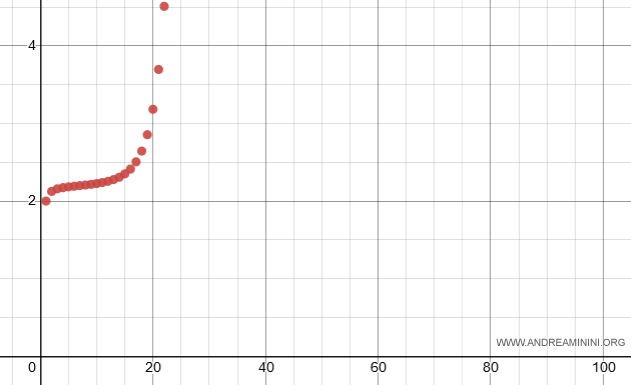
Here is the graphical representation of the series
Proof of the theorem
Consider a general series ak
$$ \sum_{k=1}^{\infty} a_k $$
The sequence ak consists of positive terms.
$$ a_k < a_{k+1} $$
We now analyze the convergence and divergence cases, using the ratio test as the starting point.
Case 1 (convergence)
Assume that the limit of the ratio exists and is less than 1.
$$ l = \lim_{n \rightarrow \infty} \frac{a_{n+1}}{a_n} < 1 $$
Choose a number x in the interval (l,1) such that
$$ l < x < 1 $$
Then there exists an index v such that, for every n>v, the ratio between consecutive terms is less than x
$$ \frac{a_{n+1}}{a_n} < x $$
which is equivalent to
$$ a_{n+1} < x \cdot a_n $$
Assume v=1
It follows that, for every n>v (that is, n>1)
$$ a_2 < x \cdot a_1 \\ a_3 < x \cdot a_2 \\ a_4 < x \cdot a_3 \\ \vdots $$
Since a2 < x a1, we can rewrite the sequence in an equivalent form
$$ a_2 < x \cdot a_1 \\ a_3 < x \cdot ( x \cdot a_1 ) \\ a_4 < x \cdot a_3 \\ \vdots $$
Then substitute a3 with x·(x·a1), and continue iteratively
$$ a_2 < x \cdot a_1 \\ a_3 < x \cdot ( x \cdot a_1 ) \\ a_4 < x \cdot ( x \cdot ( x \cdot a_1 ) ) \\ \vdots $$
which yields
$$ a_2 < x \cdot a_1 \\ a_3 < x^2 \cdot a_1 \\ a_4 < x^3 \cdot a_1 \\ \vdots $$
In general, each term satisfies
$$ a_n < x^{n-1} \cdot a_1 $$
Summing both sides of the inequality, we obtain
$$ \sum_{n=1}^{ \infty } a_n < \sum_{n=1}^{ \infty } x^{n-1} \cdot a_1 $$
The series on the right is a geometric series, which converges when 0<x<1.
$$ \sum_{n=1}^{ \infty } a_n < l' $$
By the comparison test, the series an on the left must also be convergent.
This establishes convergence.
Case 2 (divergence)
Assume that the limit of the ratio exists and is greater than 1.
$$ l = \lim_{n \rightarrow \infty} \frac{a_{n+1}}{a_n} > 1 $$
Then there exists an index v such that, for every n>v
$$ \frac{a_{n+1}}{a_n} > 1 $$
which is equivalent to
$$ a_{n+1} > a_n $$
Therefore, the sequence an is strictly increasing.
A strictly increasing sequence cannot converge to zero as n→∞.
$$ \lim_{n \rightarrow \infty} a_n \ne 0 $$
If the sequence does not converge to zero, the necessary condition for series convergence is not satisfied.
Hence, the associated series must be divergent.
$$ \sum_{n=1}^{\infty} a_n = + \infty $$
This establishes divergence.
And so on