
The p-series (Generalized Harmonic Series)
The p-series is defined by $$ \sum_{k=1}^{\infty} \frac{1}{k^p} $$ where p is any positive real number.
The p-series is a fundamental example in analysis because its convergence depends entirely on the value of the exponent p.
- For p≤1 the series diverges
- For p>1 the series converges
A practical example
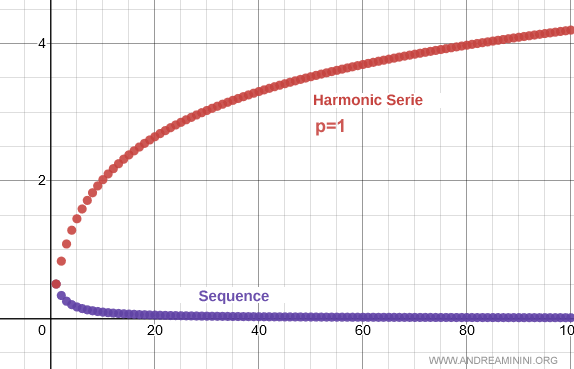
Consider the p-series when p=1.
This reduces to the harmonic series, which is known to diverge.
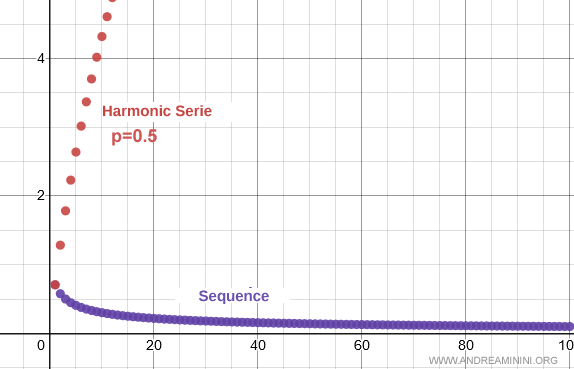
For 0<p<1 the p-series still diverges.
For instance, when p=0.5 the graph of the associated function is shown below.
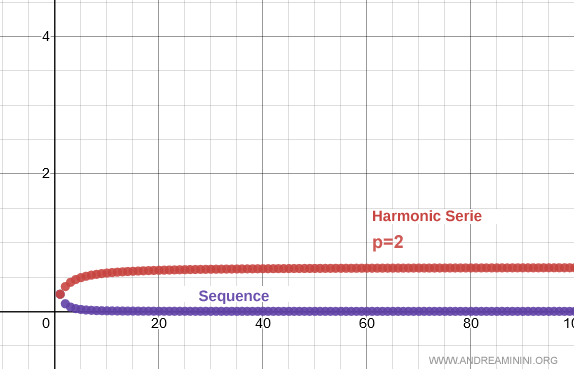
By contrast, when p>1 the p-series becomes convergent.
For example, when p=2 the graph of the associated function is shown below.
The proof
We distinguish three cases:
- p=1
- p>1
- p<1
The case p=1 (harmonic series)
Consider the interval [k, k+1].
For every x in the interval [k, k+1], we have
$$ k \le x \le k+1 $$
It follows that
$$ \frac{1}{(k+1)^p} \le \frac{1}{x^p} \le \frac{1}{k^p} \:\:\: \forall x \in [k,k+1] $$
In particular, for every x>k we have
$$ \frac{1}{x^p} \le \frac{1}{k^p} $$
Integrating both sides over the interval [k,k+1], we obtain
$$ \int_k^{k+1} \frac{1}{x^p} \:dx \le \int_k^{k+1} \frac{1}{k^p} \:dx $$
Since 1/kp is constant with respect to x, it can be factored out of the integral:
$$ \int_k^{k+1} \frac{1}{x^p} \:dx \le \frac{1}{k^p} \int_k^{k+1} \:dx $$
The integral on the right-hand side is equal to 1, hence
$$ \int_k^{k+1} \frac{1}{x^p} \:dx \le \frac{1}{k^p} $$
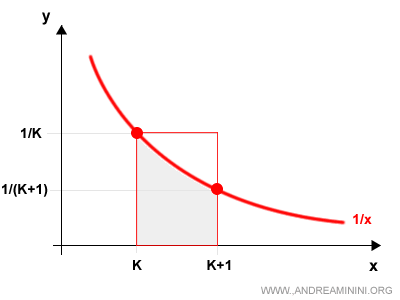
This inequality compares the area under the curve y=1/x over the interval [k,k+1] with the area of a rectangle of width 1 and height 1/k.
Summing both sides for k from 1 to n gives
$$ \sum_{k=1}^n \int_k^{k+1} \frac{1}{x^p} \:dx \le \sum_{k=1}^n \frac{1}{k^p} $$
For p=1, this becomes
$$ \sum_{k=1}^n \int_k^{k+1} \frac{1}{x} \:dx \le \sum_{k=1}^n \frac{1}{k} $$
The sum of the integrals can be written as a single integral:
$$ \int_1^{n+1} \frac{1}{x} \:dx \le \sum_{k=1}^n \frac{1}{k} $$
Evaluating the integral yields
$$ \log (n+1) - \log(1) \le \sum_{k=1}^n \frac{1}{k} $$
Since log(1)=0, we obtain
$$ \log (n+1) \le \sum_{k=1}^n \frac{1}{k} $$
The right-hand side is the n-th partial sum of the harmonic series.
Taking the limit as n tends to infinity on both sides, we get
$$ \lim_{n \rightarrow \infty} \log (n+1) \le \lim_{n \rightarrow \infty} \sum_{k=1}^n \frac{1}{k} $$
Since the logarithm diverges to infinity, it follows that
$$ \infty \le \lim_{n \rightarrow \infty} \sum_{k=1}^n \frac{1}{k} $$
Therefore, the harmonic series diverges.
The case p>1 (convergent series)
Consider the interval [k, k+1].
For every x in the interval [k, k+1], we have
$$ k \le x \le k+1 $$
It follows that
$$ \frac{1}{(k+1)^p} \le \frac{1}{x^p} \le \frac{1}{k^p} \:\:\: \forall x \in [k,k+1] $$
Integrating each term of the inequality over [k,k+1], we obtain
$$ \int_k^{k+1} \frac{1}{(k+1)^p} \: dx \le \int_k^{k+1} \frac{1}{x^p} \: dx \le \int_k^{k+1} \frac{1}{k^p} \: dx $$
$$ \frac{1}{(k+1)^p} \int_k^{k+1} \: dx \le \int_k^{k+1} \frac{1}{x^p} \: dx \le \frac{1}{k^p} \int_k^{k+1} \: dx $$
Evaluating the outer integrals gives
$$ \frac{1}{(k+1)^p} \cdot [(k+1)-k] \le \int_k^{k+1} \frac{1}{x^p} \: dx \le \frac{1}{k^p} \cdot [(k+1)-k] $$
$$ \frac{1}{(k+1)^p} \le \int_k^{k+1} \frac{1}{x^p} \: dx \le \frac{1}{k^p} $$
Summing all three terms for k from 1 to n yields
$$ \sum_{k=1}^n \frac{1}{(k+1)^p} \le \sum_{k=1}^n \int_k^{k+1} \frac{1}{x^p} \: dx \le \sum_{k=1}^n \frac{1}{k^p} $$
By the additivity of definite integrals, the middle term can be rewritten in compact form as
$$ \sum_{k=1}^n \frac{1}{(k+1)^p} \le \int_1^{n+1} \frac{1}{x^p} \: dx \le \sum_{k=1}^n \frac{1}{k^p} $$
Explanation. Expanding the sum of integrals, we obtain $$ \sum_{k=1}^n \int_{k}^{k+1} \frac{1}{x^p} \: dx = \int_{1}^{2} \frac{1}{x^p} \: dx + \int_{2}^{3} \frac{1}{x^p} \: dx + \cdots + \int_{n}^{n+1} \frac{1}{x^p} \: dx $$ which represents the total area under the curve y=1/xp from 1 to n+1. Therefore, $$ \sum_{k=1}^n \int_{k}^{k+1} \frac{1}{x^p} \: dx = \int_{1}^{n+1} \frac{1}{x^p} \: dx $$
Let sn denote the n-th partial sum of the harmonic series:
$$ s_n = \sum_{k=1}^{n} \frac{1}{k} $$
Then the left-hand summation can be written as
$$ \sum_{k=1}^{n} \frac{1}{k+1} = s_{n+1} - 1 $$
Substituting into the inequality gives
$$ s_{n+1} - 1 \le \int_1^{n+1} \frac{1}{x^p} \: dx \le \sum_{k=1}^n \frac{1}{k^p} $$
The right-hand term is the n-th partial sum of the p-series:
$$ \sum_{k=1}^{n} \frac{1}{k^p} $$
Thus, we obtain
$$ s_{n+1} - 1 \le \int_1^{n+1} \frac{1}{x^p} \: dx \le s_n $$
Evaluating the integral yields
$$ s_{n+1} - 1 \le \begin{bmatrix} \frac{x^{1-p}}{1-p} \end{bmatrix}_1^{n+1} \le s_n $$
$$ s_{n+1} - 1 \le \frac{(n+1)^{1-p}}{1-p} - \frac{1}{1-p} \le s_n $$
Rearranging gives
$$ s_{n+1} \le 1 + \frac{(n+1)^{1-p}}{1-p} - \frac{1}{1-p} \le s_n $$
Taking the limit as n tends to infinity, we obtain
$$ \lim_{n \to \infty} s_{n+1} \le \lim_{n \to \infty} \left( 1 + \frac{(n+1)^{1-p}}{1-p} - \frac{1}{1-p} \right) \le \lim_{n \to \infty} s_n $$
Since p>1, we have 1-p<0, hence (n+1)1-p → 0 as n → ∞. It follows that the middle limit is finite.
By the comparison test, the sequence of partial sums is bounded, and therefore the p-series converges for p>1.
$$ \sum_{k=1}^{\infty} \frac{1}{k^p} \text{ converges for } p>1 $$
The case p<1 (divergent series)
Starting from the inequality
$$ s_{n+1} - 1 \le \frac{(n+1)^{1-p}}{1-p} - \frac{1}{1-p} \le s_n $$
and taking limits as n → ∞, we obtain
$$ \lim_{n \to \infty} \frac{(n+1)^{1-p}}{1-p} = \infty $$
since 1-p>0. Hence, the right-hand side diverges, and by the comparison test, the p-series diverges for p<1.
$$ \sum_{k=1}^{\infty} \frac{1}{k^p} \text{ diverges for } p<1 $$
The case p≤0 (divergent series)
If p≤0, the general term does not tend to zero:
$$ \lim_{k \to \infty} \frac{1}{k^p} \ne 0 $$
Therefore, the necessary condition for convergence is not satisfied, and the series diverges.
$$ \sum_{k=1}^{\infty} \frac{1}{k^p} \text{ diverges for } p \le 0 $$


