Series of Nonnegative Terms
A series is said to have nonnegative terms if each term satisfies $$ a_k \ge 0 \:\:\:\:\:\: \forall k \in \mathbb{N} $$
If all terms are strictly greater than zero, the series is called a series with positive terms.
An example
The following is a series with nonnegative terms
$$ \sum_{k=1}^{\infty} \frac{1}{k} $$
since each term is nonnegative
$$ a_1 = 1 \\ a_2 = 1 + \frac{1}{2} \\ a_3 = 1 + \frac{1}{2} + \frac{1}{3} \\ a_4 = 1 + \frac{1}{2} + \frac{1}{3} + \frac{1}{4} \\ \vdots $$
Below is a graphical representation of the series in the Cartesian plane
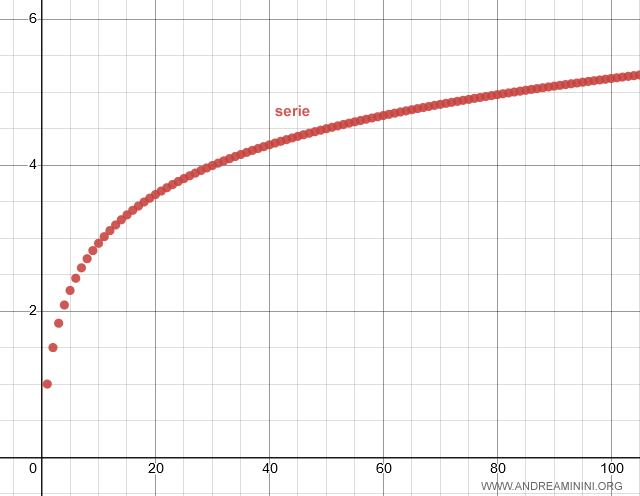
Convergence of series with nonnegative terms
A series with nonnegative terms is either convergent or divergent. It cannot be indeterminate
Proof
Since each term is nonnegative (an ≥ 0), the sequence of partial sums is monotonically increasing.
$$ s_{n+1} = s_n + a_{n+1} \ge s_n $$
By the monotone convergence theorem, every monotone increasing sequence admits a limit, either finite or infinite.
It follows that the series is either convergent or divergent, and cannot be indeterminate.
An example
Example 1
The following series has nonnegative terms
$$ \sum_{k=1}^{\infty} \frac{1}{k} $$
Thus, the sequence of partial sums admits a limit as n tends to infinity
$$ \lim_{n \rightarrow \infty} \sum_{k=1}^{n} \frac{1}{k} $$
To determine whether the series converges or diverges, consider the limit of its general term
$$ \lim_{n \rightarrow \infty} \frac{1}{n} = 0 $$
The fact that the general term tends to zero is a necessary but not sufficient condition for the convergence of the series.
Therefore, a different convergence test is required.
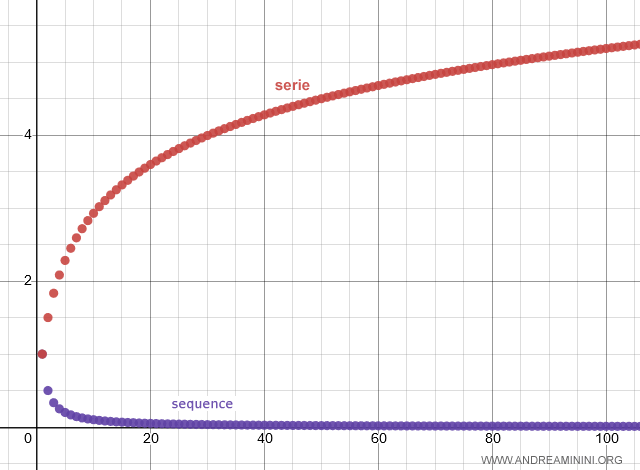
Note. In this case, the series is divergent (the harmonic series).
Example 2
The following series also has nonnegative terms
$$ \sum_{k=1}^{\infty} \frac{k}{k+1} $$
Hence, the sequence of partial sums admits either a finite or an infinite limit
$$ \lim_{n \rightarrow \infty} \sum_{k=1}^{n} \frac{k}{k+1} $$
To determine whether the series converges or diverges, consider the limit of its general term
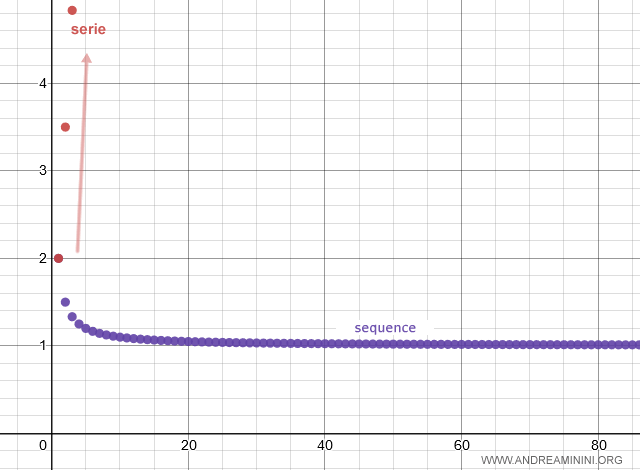
$$ \lim_{n \rightarrow \infty} \frac{n}{n+1} = 1 $$
In this case, the general term does not tend to zero.
Therefore, the series does not converge and, since it cannot be indeterminate, it must be a divergent series.
$$ \lim_{n \rightarrow \infty} \sum_{k=1}^{n} \frac{k}{k+1} = +\infty $$
Below is the graphical representation
And so on.