Exponential Power Series
The exponential function admits the following power series expansion: $$ \sum_{n = 0 }^{ \infty } \frac{x^n}{n!} $$ where x is a real number.
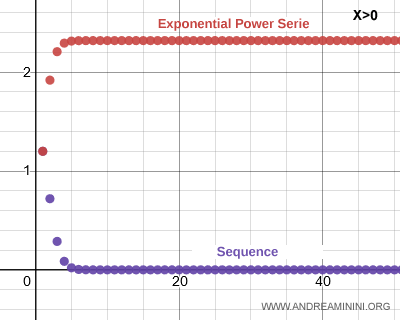
The graph of the series for x>0.
The graph of the series for x<0.
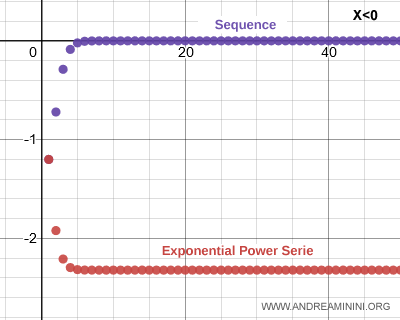
In both cases, the series converges as n tends to infinity.
Note. If x=0, the series reduces to its first term, and its value is 1. The expression 00 is generally regarded as an indeterminate form in mathematics, since it can lead to contradictory interpretations. $$ 0^0 = 1 = 0^{1-1} = \frac{0}{0} $$ where 0/0 is undefined. For this reason, the rule n0=1 applies only when n is different from zero. In some calculators or software systems, the value 00=1 is returned for practical purposes, but this should be understood as a convention rather than a mathematically rigorous definition.
Convergence of the Power Series
The series converges for every real value of x.
$$ \sum_{n=0}^{\infty} \frac{x^n}{n!} $$
Proof
To establish convergence, I apply the ratio test.
Consider two consecutive terms of the sequence an and evaluate the limit of their ratio as n→∞
$$ \lim_{n \rightarrow \infty} \frac{a_{n+1}}{a_n} $$
In this case
$$ a_n = \frac{x^n}{n!} $$
$$ a_{n+1} = \frac{x^{n+1}}{(n+1)!} $$
Thus, the ratio becomes
$$ \lim_{n \rightarrow \infty} \frac{x^{n+1}}{(n+1)!} \cdot \frac{n!}{x^n} $$
which simplifies to
$$ \lim_{n \rightarrow \infty} \frac{x}{n+1} $$
For any real x, this limit is equal to zero.
$$ \lim_{n \rightarrow \infty} \frac{x}{n+1} = 0 $$
Therefore, by the ratio test, the series converges for all real values of x.