
Remainder (Tail) of a Series
The n-th remainder, or tail, of a series is the series obtained by discarding the first n terms of the original series. $$ R_n = \sum_{k=n+1}^{\infty} a_k \:\:\:\:\:\: n \in \mathbb{N} $$
A practical example
Consider the series
$$ \sum_{k=1}^{\infty} \frac{1}{k(k+1)} $$
The first partial sums are
$$ a_1 = \frac{1}{2} \\ a_2 = \frac{1}{2} + \frac{1}{6} \\ a_3 = \frac{1}{2} + \frac{1}{6} + \frac{1}{12} \\ a_4 = \frac{1}{2} + \frac{1}{6} + \frac{1}{12} + \frac{1}{20} \\ a_5 = \frac{1}{2} + \frac{1}{6} + \frac{1}{12} + \frac{1}{20} + \frac{1}{30} \\ \vdots $$
The remainder R3 is the tail of the series starting from k=4.
$$ R_n = \sum_{k=n+1}^{\infty} \frac{1}{k(k+1)} $$
$$ R_3 = \sum_{k=4}^{\infty} \frac{1}{k(k+1)} $$
The first terms of the tail are:
$$ b_1=0 \\ b_2=0 \\ b_3=0 \\ b_4 = \frac{1}{20} \\ b_5 = \frac{1}{20} + \frac{1}{30} \\ b_6 = \frac{1}{20} + \frac{1}{30} + \frac{1}{42} \\ \vdots $$
From a graphical perspective
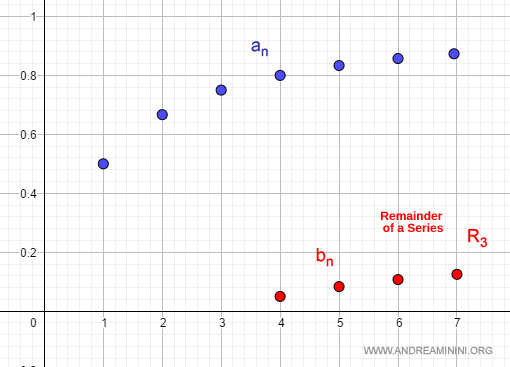
Convergence of the remainder (tail)
If the series $$ \sum_{k=1}^{\infty} a_k $$ converges, then its remainder (tail) $$ R_n = \sum_{k=n+1}^{\infty} a_k $$ also converges.
Proof
Let $$ \sum_{k=1}^{\infty} a_k $$ be a convergent series, and define its n-th remainder as $$ R_n = \sum_{k=n+1}^{\infty} b_k $$
For every m>n, the terms of the two series coincide.
$$ a_m = b_m \:\:\: \forall m>n $$
Explanation. The remainder series Rn has its first n terms equal to zero. For k>n, its terms coincide with those of the original series. Hence, bk=0 for k=1,\dots,n and bk=ak for k>n.
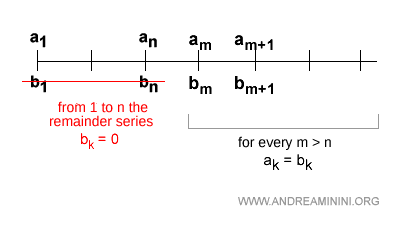
Therefore, for every m>n, the difference between corresponding terms is zero.
$$ b_m - a_m = 0 $$
Consequently, for every m>n, the partial sums of the difference series satisfy
$$ \sum_{k=1}^{m} (b_k - a_k) = \sum_{k=1}^{n} (b_k - a_k) $$
In other words, the sequence of partial sums of the series $$ \sum (b_k - a_k) $$ stabilizes for m>n.
Explanation. For k=1,\dots,n we have bk=0, hence bk-ak=-ak. For k>n, since ak=bk, we have bk-ak=0. Thus, adding further terms does not change the partial sum.
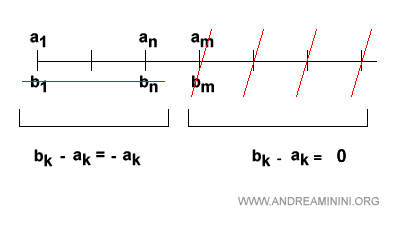
It follows that the series $$ \sum_{k=1}^{\infty} (b_k - a_k) $$ converges.
We now have two convergent series
$$ \sum_{k=1}^{\infty} a_k $$
$$ \sum_{k=1}^{\infty} (b_k - a_k) $$
By standard results on convergent series, their sum is also convergent and equals the series formed by summing the corresponding terms:
$$ \sum_{k=1}^{\infty} a_k + \sum_{k=1}^{\infty} (b_k - a_k) $$
$$ \sum_{k=1}^{\infty} \big(a_k + b_k - a_k \big) $$
$$ \sum_{k=1}^{\infty} b_k $$
This shows that the remainder (tail) Rn is convergent.
Example
Returning to the initial example
$$ \sum_{k=1}^{\infty} \frac{1}{k(k+1)} $$
$$ R_3 = \sum_{k=4}^{\infty} \frac{1}{k(k+1)} $$
Both series converge
$$ \lim_{n \rightarrow \infty} \sum_{k=1}^{n} \frac{1}{k(k+1)} = 1 $$
$$ \lim_{n \rightarrow \infty} \sum_{k=4}^{n} \frac{1}{k(k+1)} = 0.25 $$
Graphical representation
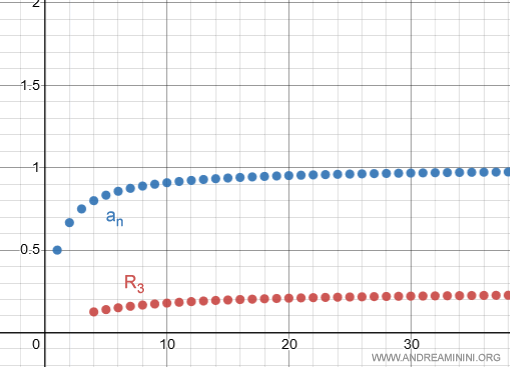
Corollary
If the series $$ \sum_{k=1}^{\infty} a_k $$ converges, then $$ \lim_{n \rightarrow \infty} R_n = 0 $$ where $$ R_n = \sum_{k=n+1}^{\infty} a_k $$
Proof
Let $$ \sum_{k=1}^{\infty} a_k $$ be a convergent series, and let $$ R_n = \sum_{k=n+1}^{\infty} b_k $$ be its remainder.
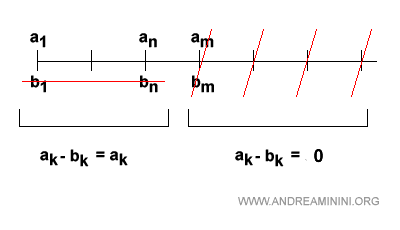
For every m>n, we have ak=bk for k>n, hence
$$ \sum_{k=1}^m (a_k - b_k) = \sum_{k=1}^n a_k $$
Explanation. For k=1,\dots,n we have bk=0, so ak-bk=ak. For k>n, ak=bk, so the difference is zero. Thus, the partial sums remain constant beyond n.
Taking the limit as m→∞
$$ \sum_{k=1}^{\infty} (a_k - b_k) = \sum_{k=1}^n a_k $$
Hence
$$ \sum_{k=1}^{\infty} a_k - \sum_{k=1}^{\infty} b_k = \sum_{k=1}^n a_k $$
Since $$ \sum b_k = R_n $$
$$ \left( \sum_{k=1}^{\infty} a_k \right) - R_n = \sum_{k=1}^n a_k $$
Taking the limit as n→∞
$$ \sum_{k=1}^{\infty} a_k - \lim_{n \rightarrow \infty} R_n = \sum_{k=1}^{\infty} a_k $$
Therefore
$$ \lim_{n \rightarrow \infty} R_n = 0 $$
This completes the proof.
Example
Returning to the initial example
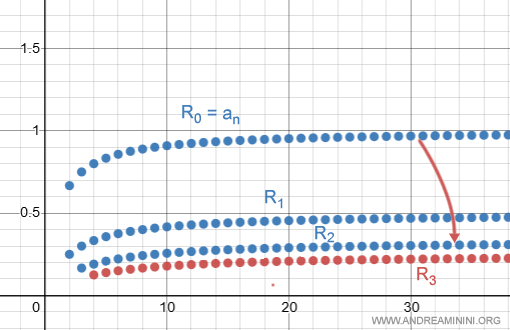
$$ \lim_{n \rightarrow \infty} R_0 = \sum_{k=1}^{\infty} \frac{1}{k(k+1)} = 1 $$
$$ \lim_{n \rightarrow \infty} R_1 = \sum_{k=2}^{\infty} \frac{1}{k(k+1)} = 0.5 $$
$$ \lim_{n \rightarrow \infty} R_2 = \sum_{k=3}^{\infty} \frac{1}{k(k+1)} \approx 0.33 $$
$$ \lim_{n \rightarrow \infty} R_3 = \sum_{k=4}^{\infty} \frac{1}{k(k+1)} = 0.25 $$
As more initial terms are removed, the remainder Rn approaches zero.
$$ \lim_{n \rightarrow \infty} R_n = 0 $$
Graphical representation
And so on.


