
Exercises on Numerical Series
A selection of worked examples involving infinite series:
| exercise | $ \sum_{n=2}^{\infty} \frac{n+1}{n-1} $ |
| exercise | $ \sum_{n=1}^{\infty} \frac{n}{2n+1} $ |
| exercise | $ \sum_{n=1}^{\infty} \frac{2^n - 1}{2^n} $ |
| exercise | $ \sum_{n=1}^\infty \frac{2n + 1}{n} $ |
| exercise | $ \sum_{k=1}^{+\infty} \sqrt[k]{3} $ |
| exercise |
$ \sum_{k=1}^{\infty} \frac{(-1)^k}{k(k+1)} $ |
- Step-by-step solution: Analysis of the series $ \sum_{n=2}^{\infty} \frac{n+1}{n-1} $
- Exploring the convergence of the series $ \frac{n}{2n+1} $ step-by-step
- Exercise: Analysis of the Numerical Series $ \sum_{n=1}^{\infty} \frac{2^n - 1}{2^n} $
- Analyzing the Convergence of the Series \( \sum_{n=1}^\infty \frac{2n + 1}{n} \)
- Analyzing the Series $ \sum_{k=1}^{+\infty} \sqrt[k]{3} $
- Analysis of the Series $ \sum_{k=1}^{\infty} \frac{(-1)^k}{k(k+1)} $
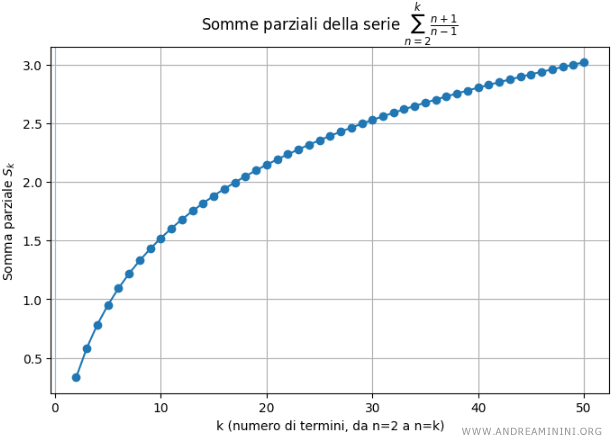
Step-by-step solution: Analysis of the series $ \sum_{n=2}^{\infty} \frac{n+1}{n-1} $
In this exercise, I’m analyzing the series
\[ \sum_{n=2}^{\infty} \frac{n+1}{n-1} \]
The index starts at 2 to avoid division by zero.
By inspecting the general term, it becomes clear that it can be rewritten in a more manageable form to facilitate the analysis.
I express the numerator $ n+1 $ as $ n - 1 + 2 $, which yields:
$$ \frac{n+1}{n-1} = \frac{n - 1 + 2}{n - 1} $$
$$ \frac{n+1}{n-1} = \frac{(n - 1) + 2}{n - 1} $$
$$ \frac{n+1}{n-1} = \frac{n-1}{n-1} + \frac{2}{n - 1} $$
$$ \frac{n+1}{n-1} = 1 + \frac{2}{n - 1} $$
This allows us to rewrite the original series as:
$$ \sum_{n=2}^{\infty} \left(1 + \frac{2}{n - 1}\right) $$
Now, applying the linearity of summation, we have:
$$ \sum_{n=2}^{\infty} 1 + \sum_{n=2}^{\infty} \frac{2}{n - 1} $$
$$ = \sum_{n=2}^{\infty} 1 + 2 \cdot \sum_{n=2}^{\infty} \frac{1}{n - 1} $$
This representation is more convenient for determining the convergence of the series.
The first sum, \( \sum_{n=2}^{\infty} 1 \), is the infinite sum of the constant 1, which clearly diverges. The second sum, \( \sum_{n=2}^{\infty} \frac{1}{n - 1} \), is the harmonic series shifted by one index (with $ k = n - 1 $), starting at 2 - and it, too, diverges.
Therefore, we conclude that the series diverges.
$$ \sum_{n=2}^{\infty} \frac{n+1}{n-1} = \underbrace{ \sum_{n=2}^{\infty} 1}_{\text{divergent}} + 2 \cdot \underbrace{ \sum_{n=2}^{\infty} \frac{1}{n - 1} }_{\text{divergent}} $$
Hence, the series $ \sum_{n=2}^{\infty} \frac{n+1}{n-1} $ diverges.
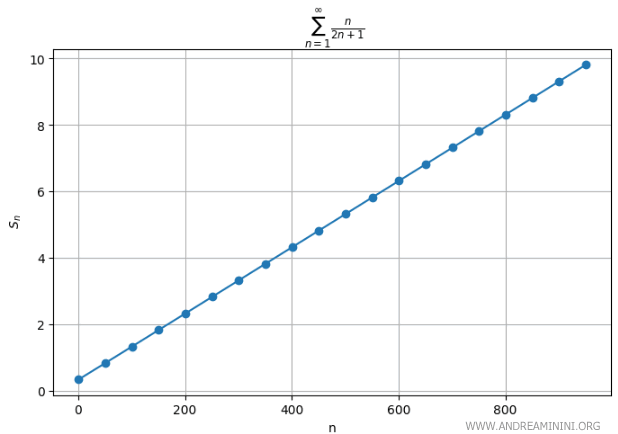
Exploring the convergence of the series $ \frac{n}{2n+1} $ step-by-step
In this exercise, the goal is to determine the behavior of the series
\[ \sum_{n=1}^{\infty} \frac{n}{2n+1} \]
Determining the behavior of a series means establishing whether it converges - that is, whether it approaches a finite sum - or diverges, meaning the sum is either infinite or undefined.
The first step is to analyze the general term of the series:
\[ a_n = \frac{n}{2n+1} \]
To assess convergence, we need to examine whether the general term tends to zero as \( n \to \infty \). This is a necessary condition for convergence.
So we compute the limit of the general term:
\[ \lim_{n \to \infty} \frac{n}{2n+1} \]
According to the necessary condition for convergence, if the series \( \sum a_n \) converges, then it must be that \( \lim_{n \to \infty} a_n = 0 \). If this limit is not zero, the series diverges automatically.
To evaluate the limit, we divide both the numerator and denominator by \( n \) to simplify the expression:
\[ \lim_{n \to \infty} \frac{1}{2 + \frac{1}{n}} = \frac{1}{2 + 0} = \frac{1}{2} \]
The limit of the general term is not zero, but rather \( \frac{1}{2} \):
\[ \lim_{n \to \infty} a_n = \frac{1}{2} \neq 0 \]
This implies that although the terms are positive, they do not approach zero.
Therefore, the series $ \sum_{n=1}^{\infty} \frac{n}{2n+1} $ is divergent.
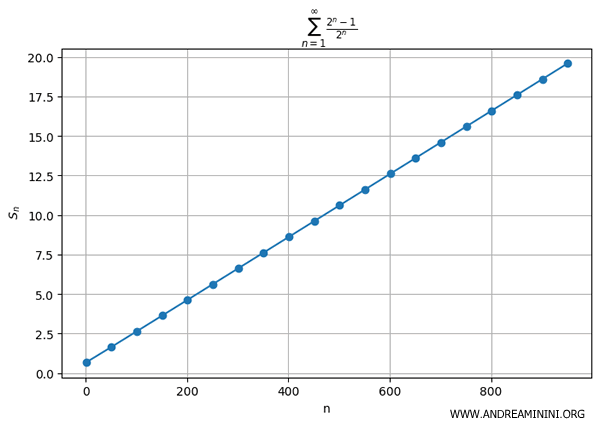
Exercise: Analysis of the Numerical Series $ \sum_{n=1}^{\infty} \frac{2^n - 1}{2^n} $
We are tasked with analyzing the behavior of the series:
$$ \sum_{n=1}^{\infty} \frac{2^n - 1}{2^n} $$
The general term of the series is given by:
$$ a_n = \frac{2^n - 1}{2^n} $$
This expression can be simplified as follows:
$$ a_n = \frac{2^n - 1}{2^n} = \frac{2^n}{2^n} - \frac{1}{2^n} = 1 - \frac{1}{2^n} $$
Let’s now evaluate the limit of the sequence \( a_n \) as \( n \) approaches infinity:
$$ \lim_{n \to \infty} a_n $$
$$ \lim_{n \to \infty} \left(1 - \frac{1}{2^n}\right) $$
$$ \lim_{n \to \infty} 1 - \lim_{n \to \infty} \frac{1}{2^n} = 1 - 0 = 1 $$
Since the limit of the general term is not zero, the necessary condition for convergence fails. As a result, the series diverges.
Indeed, we can rewrite the original series as the difference of two known series:
$$ \sum_{n=1}^{\infty} a_n = \sum_{n=1}^{\infty} \left(1 - \frac{1}{2^n}\right) = \sum_{n=1}^{\infty} 1 - \sum_{n=1}^{\infty} \frac{1}{2^n} $$
The first series on the right-hand side clearly diverges (being a sum of infinitely many ones), while the second is a convergent geometric series. The divergence of the first term dominates, hence:
The series is divergent.
Analyzing the Convergence of the Series \( \sum_{n=1}^\infty \frac{2n + 1}{n} \)
We are asked to determine whether the series
\[ \sum_{n=1}^\infty \frac{2n + 1}{n} \]
converges or diverges.
Let’s begin by examining the general term of the series:
\[ a_n = \frac{2n + 1}{n} \]
We can simplify the expression as follows:
\[ a_n = \frac{2n}{n} + \frac{1}{n} = 2 + \frac{1}{n} \]
So each term of the series takes the form:
\[ a_n = 2 + \frac{1}{n} \]
To assess convergence, we consider the limit of the general term as \( n \to \infty \). A necessary condition for the convergence of an infinite series \( \sum a_n \) is that its general term tends to zero:
\[ \lim_{n \to \infty} a_n = \lim_{n \to \infty} \left(2 + \frac{1}{n} \right) = 2 \]
Since the general term does not approach zero, but instead tends to 2, this condition is not satisfied:
\[ \lim_{n \to \infty} a_n = 2 \ne 0 \]
Therefore, the series diverges by the divergence (or nth-term) test.
Analyzing the Series $ \sum_{k=1}^{+\infty} \sqrt[k]{3} $
We consider the infinite series
$$ \sum_{k=1}^{+\infty} \sqrt[k]{3} $$
To begin, we examine the general term:
$$ a_k = \sqrt[k]{3} = 3^{1/k} $$
This expression can be rewritten as:
$$ a_k = 3^{1/k} $$
We now study the behavior of the general term as \( k \to \infty \):
$$ \lim_{k \to \infty} 3^{1/k} $$
To evaluate this limit, we express it in logarithmic form:
$$ \lim_{k \to \infty} e^{\ln(3^{1/k})} $$
Applying the logarithmic identity \( \ln(a^b) = b \ln a \), we get:
$$ \lim_{k \to \infty} e^{\frac{1}{k} \ln 3} $$
Since \( \ln 3 \) is a constant and \( \frac{1}{k} \to 0 \) as \( k \to \infty \), the exponent tends to zero. Hence,
$$ \lim_{k \to \infty} e^{\frac{1}{k} \ln 3} = e^0 = 1 $$
This tells us that the general term does not approach zero:
$$ \lim_{k \to \infty} a_k = 1 $$
This is a crucial observation. According to the convergence criterion, a necessary (though not sufficient) condition for the convergence of an infinite series \( \sum a_k \) is that the general term tends to zero:
$$ \lim_{k \to \infty} a_k = 0 $$
Since this condition is not met, we conclude that the series diverges:
$$ \lim_{k \to \infty} \sqrt[k]{3} = 1 \ne 0 $$
Therefore, the series is divergent:
$$ \sum_{k=1}^{+\infty} \sqrt[k]{3} \quad \text{diverges} $$
That completes the analysis.
Analysis of the Series $ \sum_{k=1}^{\infty} \frac{(-1)^k}{k(k+1)} $
We’re asked to determine the convergence behavior of the series:
$$ \sum_{k=1}^{\infty} \frac{(-1)^k}{k(k+1)} $$
The general term is given by:
$$ a_k = \frac{(-1)^k}{k(k+1)} $$
This is an alternating series since the sign of each term changes with $k$, due to the factor $(-1)^k$.
The Leibniz criterion for alternating series states that a series of the form
$$ \sum_{k=1}^\infty (-1)^k b_k $$
with $b_k \ge 0$, converges if both of the following conditions are met:
- $b_k$ is eventually decreasing, that is, $b_{k+1} \le b_k$ for all $k \ge k_0$,
- $\lim_{k \to \infty} b_k = 0$.
In our case, the positive part of the term is $ b_k = \frac{1}{k(k+1)} $, and clearly:
$$ \lim_{k \to \infty} \frac{1}{k(k+1)} = 0 $$
To verify the monotonicity, let’s compare $ b_k $ and $ b_{k+1} $:
$$ b_k = \frac{1}{k(k+1)} \quad \text{and} \quad b_{k+1} = \frac{1}{(k+1)(k+2)} $$
We observe that:
$$ \frac{1}{k(k+1)} > \frac{1}{(k+1)(k+2)} $$
which holds for all $k \ge 1$, so $\{b_k\}$ is decreasing.
Since both conditions of the Leibniz test are satisfied, the series converges.
Does the series converge absolutely?
To determine whether the series is absolutely convergent, we examine the series of absolute values:
$$ \sum_{k=1}^{\infty} \left| \frac{(-1)^k}{k(k+1)} \right| = \sum_{k=1}^{\infty} \frac{1}{k(k+1)} $$
We can simplify this by using a partial fraction decomposition:
$$ \frac{1}{k(k+1)} = \frac{A}{k} + \frac{B}{k+1} $$
To determine $A$ and $B$, we write:
$$ \frac{1}{k(k+1)} = \frac{A(k+1) + Bk}{k(k+1)} $$
Matching numerators:
$$ 1 = A(k+1) + Bk = Ak + A + Bk = k(A + B) + A $$
This identity must hold for all $k$, so we equate coefficients:
$$ \begin{cases} A + B = 0 \\ A = 1 \end{cases} \quad \Rightarrow \quad \begin{cases} A = 1 \\ B = -1 \end{cases} $$
Thus,
$$ \frac{1}{k(k+1)} = \frac{1}{k} - \frac{1}{k+1} $$
Substituting back into the series, we get:
$$ \sum_{k=1}^{\infty} \left( \frac{1}{k} - \frac{1}{k+1} \right) $$
This is a classic telescoping series, which simplifies as follows:
$$ \left( \frac{1}{1} - \frac{1}{2} \right) + \left( \frac{1}{2} - \frac{1}{3} \right) + \left( \frac{1}{3} - \frac{1}{4} \right) + \cdots \\ = 1 - \frac{1}{2} + \frac{1}{2} - \frac{1}{3} + \frac{1}{3} - \cdots = 1 $$
Since the sum of the absolute values converges, the original series is absolutely convergent.
And so on.


