
Integral Test for Series Convergence
The integral test is a practical tool for determining whether a series with positive or eventually positive terms converges or diverges. It applies when the general term forms a decreasing sequence that approaches zero.
How it works
Start by checking that the series has positive or eventually positive terms:
$$ \sum_{k=0}^{\infty} a_k $$
Note. A series is eventually positive if there exists an index k0 such that all terms are positive for every k ≥ k0. The first few terms may still be zero or negative.
Next, verify that the general term defines a decreasing sequence {ak} that tends to zero:
$$ \lim_{k \rightarrow \infty} a_k = 0 $$
If both conditions are satisfied, the integral test can be applied.
Associate the sequence {ak} with a continuous function f(x):
$$ \{ a_k \} \rightarrow f(x) $$
Then compute the integral of the associated function from k0 to k, and define the auxiliary sequence {tk}:
$$ \{ t_k \} = \int_{k_0}^k f(x) \, dx $$
Note. Here, k0 is the starting index of the series. For example, if the series begins at k = 0, then k0 = 0; if it begins at k = 1, then k0 = 1.
The key idea is simple: the auxiliary sequence {tk} and the original series share the same behavior.
- If {tk} diverges, the series diverges.
- If {tk} converges, the series converges.
Note. Since the series has positive terms, it cannot oscillate. It either converges or diverges.
An example
Consider the series
$$ \sum_{k=1}^{\infty} \frac{1}{\sqrt{k}} $$
This is a series with positive terms.
Note. The series satisfies the necessary condition for convergence, since $$ \lim_{k \rightarrow \infty} \frac{1}{\sqrt{k}} = 0 $$ However, this condition alone is not enough to determine whether the series converges.
The sequence {ak} is decreasing:
$$ \left\{ \frac{1}{\sqrt{k}} \right\} \downarrow $$
It also approaches zero:
$$ \lim_{k \rightarrow \infty} \frac{1}{\sqrt{k}} = 0 $$
Both conditions required for the integral test are satisfied.
Now define the associated function:
$$ \left\{ \frac{1}{\sqrt{k}} \right\} \rightarrow f(x) = \frac{1}{\sqrt{x}} $$
Compute the integral from 1 to k to obtain the auxiliary sequence:
$$ \{ t_k \} = \int_1^k \frac{1}{\sqrt{x}} \, dx $$
Rewrite the integrand:
$$ \{ t_k \} = \int_1^k x^{-\frac{1}{2}} \, dx $$
Now integrate:
$$ \{ t_k \} = \int_1^k x^{-\frac{1}{2}} \, dx = \left[ \frac{x^{1-\frac{1}{2}}}{1-\frac{1}{2}} \right]_1^k $$
$$ \{ t_k \} = \frac{k^{1-\frac{1}{2}}}{1-\frac{1}{2}} - \frac{1^{1-\frac{1}{2}}}{1-\frac{1}{2}} $$
$$ \{ t_k \} = \frac{k^{1-\frac{1}{2}} - 1^{1-\frac{1}{2}}}{1-\frac{1}{2}} $$
$$ \{ t_k \} = \frac{k^{\frac{2-1}{2}} - 1^{\frac{2-1}{2}}}{\frac{2-1}{2}} $$
$$ \{ t_k \} = \frac{k^{\frac{1}{2}} - 1^{\frac{1}{2}}}{\frac{1}{2}} $$
$$ \{ t_k \} = \frac{\sqrt{k} - \sqrt{1}}{\frac{1}{2}} $$
$$ \{ t_k \} = 2 \cdot (\sqrt{k} - 1) $$
This is the auxiliary sequence {tk}.
Now analyze its behavior as k → ∞.
The auxiliary sequence diverges:
$$ \lim_{k \rightarrow \infty} 2 \cdot (\sqrt{k} - 1) = +\infty $$
Therefore, by the integral test, the original series also diverges:
$$ \sum_{k=1}^{\infty} \frac{1}{\sqrt{k}} = +\infty $$
From a graphical point of view, the series shows a clear divergent trend:
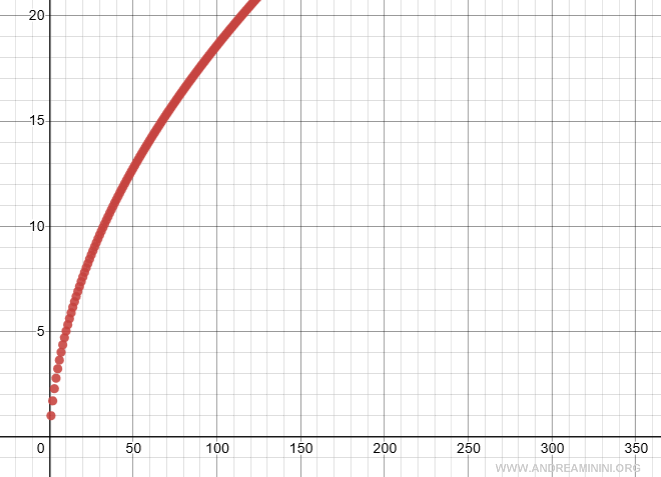
Note. This is consistent with the fact that the series is a generalized harmonic series with exponent between 0 and 1, which is known to diverge.
And so on.


