
Direct Comparison Test for Series
Let an and bn be two sequences such that $$ 0 \le a_n \le b_n \:\:\: \forall n $$ If the series with general term bn converges, then the series with general term an also converges $$ \sum_{k=1}^{\infty} b_k < +\infty \Rightarrow \sum_{k=1}^{\infty} a_k < + \infty $$ If the series with general term an diverges, then the series with general term bn also diverges $$ \sum_{k=1}^{\infty} a_k = +\infty \Rightarrow \sum_{k=1}^{\infty} b_k = + \infty $$
This test applies to series with non-negative terms.
What is it used for?
The direct comparison test provides a straightforward way to determine whether a series with non-negative terms converges or diverges by comparing it with another series whose behavior is already known.
It is one of the fundamental convergence tests for numerical series.
How do we establish the inequality between sequences? It is sufficient to verify that the inequality an≤bn holds for all sufficiently large n.
A practical example
Example 1
Consider the sequences
$$ a_n = \frac{n}{n+1} $$
$$ b_n = \frac{n+2}{n} $$
For sufficiently large n, the inequality holds
$$ a_n \le b_n $$
Example. For n=100 the sequences take the following values: $$ a_{100} = \frac{100}{101} $$ $$ b_{100} = \frac{102}{100} $$
This inequality extends to the corresponding partial sums, since summing from 1 to n yields
$$ \sum_{k=1}^n a_k \le \sum_{k=1}^n b_k $$
Both are series with non-negative terms, so the direct comparison test applies.
Now consider the limits as n tends to infinity
$$ \lim_{n \rightarrow \infty} \sum_{k=1}^n a_k \le \lim_{n \rightarrow \infty} \sum_{k=1}^n b_k $$
$$ \lim_{n \rightarrow \infty} \sum_{k=1}^n \frac{n}{n+1} \le \lim_{n \rightarrow \infty} \sum_{k=1}^n \frac{n+2}{n} $$
The series with general term an diverges to +∞
$$ \lim_{n \rightarrow \infty} \sum_{k=1}^n \frac{n}{n+1} = +∞$$
Note. This divergence follows from the failure of the necessary condition for convergence. Indeed, $$ \lim_{n \rightarrow \infty} a_n = \lim_{n \rightarrow \infty} \frac{n}{n+1} = 1 \ne 0 $$ A necessary condition for a series to converge is that its general term tends to zero. Since this condition is not satisfied, the series diverges. Moreover, because it is a series with non-negative terms, it diverges to +∞.
By the comparison inequality, the series with general term bn must also diverge to +∞.
$$ +∞ \le \lim_{n \rightarrow \infty} \sum_{k=1}^n \frac{n+2}{n} $$
$$ \lim_{n \rightarrow \infty} \sum_{k=1}^n \frac{n+2}{n} = +\infty $$
Therefore, the series with general term bn is also divergent.
Example 2
Consider the sequences
$$ a_n = \frac{1}{n^3+1} $$
$$ b_n = \frac{1}{n(n+1)} $$
For sufficiently large n, the inequality holds
$$ a_n \le b_n $$
Example. For n=100 the sequences take the following values: $$ a_{100} = \frac{1}{100001} $$ $$ b_{100} = \frac{1}{10100} $$
The inequality extends to the corresponding partial sums
$$ \sum_{k=1}^n a_k \le \sum_{k=1}^n b_k $$
$$ \sum_{k=1}^n \frac{1}{n^3+1} \le \sum_{k=1}^n \frac{1}{n(n+1)} $$
Now consider the limits as n tends to infinity
$$ \lim_{n \rightarrow \infty} \sum_{k=1}^n \frac{1}{n^3+1} \le \lim_{n \rightarrow \infty} \sum_{k=1}^n \frac{1}{n(n+1)} $$
The series with general term bn is the telescoping series known as the Mengoli series.
It is known that
$$ \lim_{n \rightarrow \infty} \sum_{k=1}^n \frac{1}{n(n+1)} = 1 $$
By the inequality an≤bn, the series with general term an also converges.
$$ \lim_{n \rightarrow \infty} \sum_{k=1}^n \frac{1}{n^3+1} \le 1 $$
Therefore, the series with general term an is convergent.
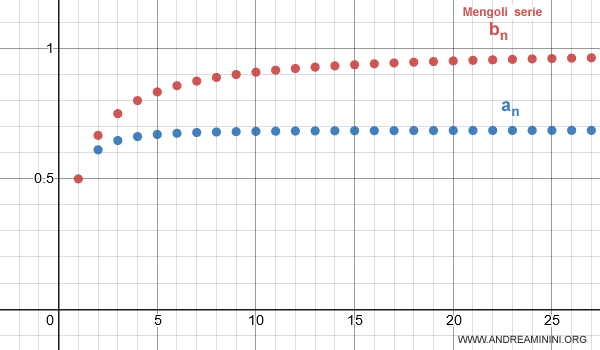
Note. Since the series with general term bn has non-negative terms and converges to 1, it follows that $$ 0 \le \lim_{n \rightarrow \infty} \sum_{k=1}^n \frac{1}{n^3+1} \le 1 $$
Proof and explanation
Let an and bn be two sequences, and consider their corresponding sequences of partial sums un and tn defined by
$$ u_n = \sum_{k=1}^n a_k $$
$$ t_n = \sum_{k=1}^n b_k $$
Assume that both are series with non-negative terms, that is
$$ 0 \le a_k \le b_k $$
Since the terms are non-negative, the sequences of partial sums are monotone increasing and therefore admit a limit, possibly infinite
$$ \lim_{n \rightarrow \infty } u_n \in \{ l , +\infty \} $$
$$ \lim_{n \rightarrow \infty } t_n \in \{ l , +\infty \} $$
Moreover, from ak≤bk it follows that
$$ u_n \le t_n \:\:\: \forall n $$
Taking limits, we obtain
$$ \lim_{n \rightarrow \infty } u_n \le \lim_{n \rightarrow \infty } t_n $$
If the limit of tn is finite, that is $$ \lim_{n \rightarrow \infty } t_n = l < + \infty $$ then the series converges, and by the inequality the sequence un also has a finite limit
$$ \lim_{n \rightarrow \infty } u_n \le l < + \infty $$
Hence, the series with general term an is convergent.
Conversely, if
$$ \lim_{n \rightarrow \infty } u_n = +\infty $$
then, from
$$ u_n \le t_n $$
we deduce
$$ +\infty \le \lim_{n \rightarrow \infty } t_n $$
and therefore
$$ \lim_{n \rightarrow \infty } t_n = +\infty $$
Thus, the series with general term bn is also divergent.
The direct comparison test for series with non-negative terms is therefore proved.


