
Root Test for Series
Let (an) be a sequence of nonnegative terms. If the limit of the nth root exists $$ l = \lim_{n \rightarrow \infty} \sqrt[n]{a_n} $$ then the series is convergent if l<1 $$ l<1 \Rightarrow \sum_{k=1}^{\infty} a_k < + \infty $$ and the series is divergent if l>1 $$ l>1 \Rightarrow \sum_{k=1}^{\infty} a_k = + \infty $$
This is a standard test used to determine whether a series converges or diverges.
If the limit equals one, the root test is inconclusive and does not determine the behavior of the series.
Note. When the limit equals one, a different convergence test must be used.
A practical example
Example 1
Determine the nature of the series
$$ \sum_{n=1}^{\infty} \frac{1}{2^n } $$
This is a series with nonnegative terms, so the root test applies.
Compute the limit of the nth root of the general term.
$$ \lim_{n \rightarrow \infty } \sqrt[n]{ \frac{1}{2^n } } $$
$$ \lim_{n \rightarrow \infty } \frac{\sqrt[n]{1}}{\sqrt[n]{2^n} } $$
$$ \lim_{n \rightarrow \infty } \frac{1}{2} = \frac{1}{2} < 1$$
The limit is less than 1.
Therefore, by the root test, the series Σ 1/2n is a convergent series.
Note that convergence does not imply that the sum equals 1/2.
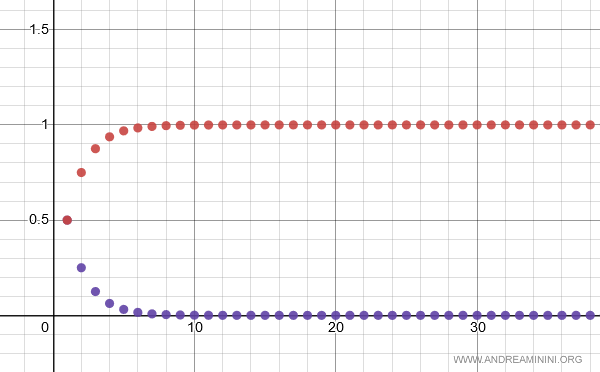
Verification. The behavior of the series Σ 1/2n shows that it converges asymptotically to 1.
Example 2
Determine the nature of the following series:
$$ \sum_{n=1}^{\infty} \frac{1}{ ( \log n )^{\frac{n}{2} } } $$
Apply the root test.
Compute the limit of the nth root of the general term.
$$ \lim_{n \rightarrow \infty} \sqrt[n]{ \frac{1}{ ( \log n )^{\frac{n}{2} } } } $$
that is
$$ \lim_{n \rightarrow \infty} \left[ \frac{1}{ ( \log n )^{\frac{n}{2} } } \right]^{\frac{1}{n}} $$
After algebraic simplification, this becomes
$$ \lim_{n \rightarrow \infty} \frac{1}{ ( \log n )^{\frac{1}{2} } } $$
$$ \lim_{n \rightarrow \infty} ( \log n )^{ - \frac{1}{2} } $$
The limit tends to zero as n→∞
$$ \lim_{n \rightarrow \infty} ( \log n )^{ - \frac{1}{2} } = 0 < 1 $$
Therefore, by the root test, the series is a convergent series, since the limit is less than 1.
$$ \sum_{n=1}^{\infty} \frac{1}{ ( \log n )^{\frac{n}{2} } } = \text{convergent} $$
Here is a graphical representation of the series
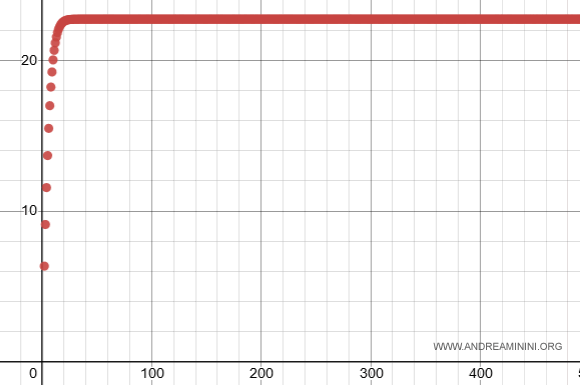
As expected, the series is indeed convergent.
Proof
1] Convergent case
If the limit is less than 1,
$$ l = \lim_{n \rightarrow \infty} \sqrt[n]{a_n} < 1 $$
choose ε>0 such that
$$ l+ε < 1 $$
By the definition of convergence of a sequence, there exists an index v such that for all n>v
$$ \sqrt[n]{a_n} < l+ε $$
that is
$$ a_n < (l+ε)^n $$
This yields two comparable sequences.
Summing both sides gives the corresponding series
$$ \sum_{n=1}^{\infty} a_n < \sum_{n=1}^{\infty} (l+ε)^n $$
The series on the right is a geometric series.
A geometric series converges when its ratio is less than 1, which holds here since l+ε<1.
If the series on the right converges to l', then by the comparison test for series the series on the left is also convergent.
$$ \sum_{n=1}^{\infty} a_n < l' $$
This proves the convergence of the series.
2] Divergent case
If the limit is greater than 1,
$$ l = \lim_{n \rightarrow \infty} \sqrt[n]{a_n} > 1 $$
there exists an index v such that for all n>v
$$ \forall n>v \in N \: : \: \sqrt[n]{a_n} > 1 $$
that is
$$ \forall n>v \in N \: : \: (\sqrt[n]{a_n})^n > 1 $$
$$ \forall n>v \in N \: : \: a_n > 1 $$
Therefore, the sequence an does not tend to zero.
$$ \lim_{n \rightarrow \infty} a_n \ne 0 $$
The necessary condition for convergence of a series is violated.
Hence, the series is divergent.
Note. Since the sequence an has nonnegative terms, the series also has nonnegative terms and therefore always admits a finite or infinite limit. Thus, the series either converges or diverges. It cannot be indeterminate. If it does not converge, then it must diverge.
And so on.


