
Asymptotic Limit Test for Series
Let \( a_n \) be a sequence of nonnegative terms, and let \( p \in \mathbb{R} \). Suppose the limit $$ l = \lim_{n \rightarrow \infty} n^p \cdot a_n $$ exists, possibly infinite. Then the series \( \sum a_n \) is convergent if $$ l < +\infty \:\:\text{and}\:\: p>1 $$ and divergent if $$ l > 0 \:\:\text{and}\:\: p \le 1 $$
This test characterizes convergence through the asymptotic behavior of the sequence.
A practical example
Example 1
Consider the series
$$ \sum_{n=1}^{ \infty } \frac{n+1}{2n^3-1} $$
To analyze its behavior, consider the associated sequence
$$ a_n = \frac{n+1}{2n^3-1} $$
We compute the limit of \( n^p a_n \) with \( p=2 \)
$$ \lim_{n \rightarrow \infty} n^2 \cdot a_n $$
$$ \lim_{n \rightarrow \infty} n^2 \cdot \frac{n+1}{2n^3-1} $$
$$ \lim_{n \rightarrow \infty} \frac{n^3+n^2}{2n^3-1} = \frac{ \infty }{ \infty } $$
This is an indeterminate form of type \( \infty/\infty \).
Applying L'Hôpital's rule, we obtain
$$ \lim_{n \rightarrow \infty} \frac{3n^2+2n}{6n^2} = \frac{ \infty }{ \infty } $$
$$ \lim_{n \rightarrow \infty} \frac{6n+2}{12n} = \frac{ \infty }{ \infty } $$
$$ \lim_{n \rightarrow \infty} \frac{6}{12} = \frac{1}{2} $$
The limit exists and is finite.
Since \( p>1 \) and \( l<\infty \), the asymptotic limit test implies that the series is convergent.
$$ \sum_{n=1}^{ \infty } \frac{n+1}{2n^3-1} $$
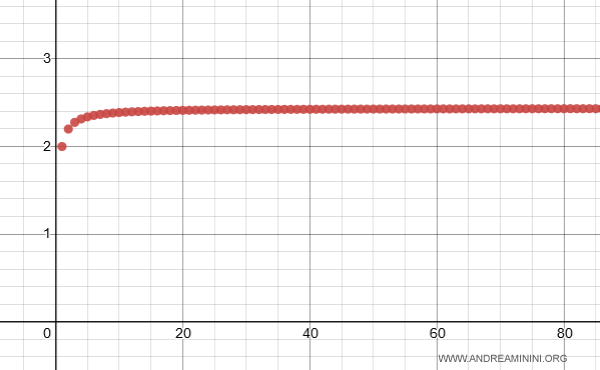
The following figure shows a graphical representation.
Example 2
Consider the series
$$ \sum_{n=1}^{ \infty } \frac{n-1}{n+1} $$
Consider the associated sequence
$$ a_n = \frac{n-1}{n+1} $$
We compute the limit of \( n^p a_n \) with \( p=2 \)
$$ \lim_{n \rightarrow \infty} n^2 \cdot a_n $$
$$ \lim_{n \rightarrow \infty} n^2 \cdot \frac{n-1}{n+1} $$
$$ \lim_{n \rightarrow \infty} \frac{n^3-n^2}{n+1} = \frac{ \infty }{ \infty } $$
This is again an indeterminate form of type \( \infty/\infty \), so we apply L'Hôpital's rule
$$ \lim_{n \rightarrow \infty} \frac{3n^2-2n}{1} = \infty $$
The limit diverges to infinity. Since \( p>1 \), this does not allow us to conclude convergence.
We therefore test the case \( p=1 \) to establish divergence.
$$ \lim_{n \rightarrow \infty} n \cdot a_n $$
$$ \lim_{n \rightarrow \infty} n \cdot \frac{n-1}{n+1} $$
$$ \lim_{n \rightarrow \infty} \frac{n^2-n}{n+1} = \frac{ \infty }{ \infty } $$
Applying L'Hôpital's rule again, we obtain
$$ \lim_{n \rightarrow \infty} \frac{2n-1}{1} = +\infty $$
The limit is infinite and \( p \le 1 \).
Therefore, the asymptotic limit test shows that the series is divergent.
$$ \sum_{n=1}^{ \infty } \frac{n-1}{n+1} = + \infty $$
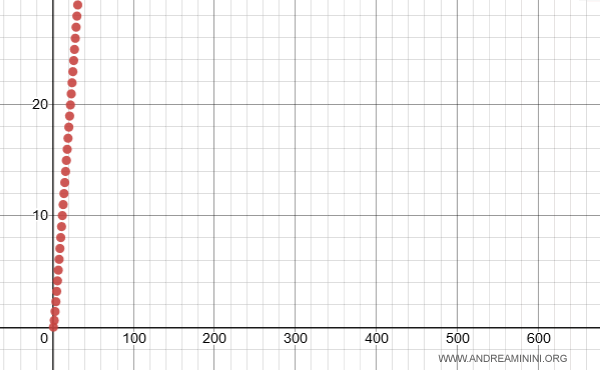
The following figure shows a graphical representation of the series.
The proof
A] Convergent series
Assume that \( l = \lim_{n \rightarrow \infty} n^p a_n \) exists and is finite, with \( p>1 \).
Then, for every \( \varepsilon > 0 \), there exists an index \( N \) such that for all \( n > N \)
$$ n^p \cdot a_n < l + \varepsilon $$
Fix \( \varepsilon = 1 \). Then
$$ n^p \cdot a_n < l + 1 $$
Hence, for all \( n > N \)
$$ 0 \le a_n < \frac{l+1}{n^p} $$
Summing both sides yields
$$ 0 \le \sum_{n=1}^{\infty} a_n < \sum_{n=1}^{\infty} \frac{l+1}{n^p} $$
The series on the right-hand side is a p-series, which converges for \( p>1 \).
By the comparison test, the series \( \sum a_n \) is therefore convergent.
B] Divergent series
Assume that \( l = \lim_{n \rightarrow \infty} n^p a_n \ne 0 \), with \( p \le 1 \).
Then there exists an index \( N \) such that for all \( n > N \)
$$ n^p \cdot a_n > \frac{l}{2} $$
which implies
$$ a_n > \frac{l}{2} \cdot \frac{1}{n^p} $$
Summing both sides yields
$$ \sum_{n=1}^{\infty} a_n > \sum_{n=1}^{\infty} \frac{l}{2} \cdot \frac{1}{n^p} $$
The series on the right-hand side is a p-series, which diverges for \( p \le 1 \).
$$ \sum_{n=1}^{\infty} a_n = +\infty $$
Therefore, the series \( \sum a_n \) diverges.


