
Absolute Convergence
A series is said to be absolutely convergent if the series formed by taking the absolute values of its terms an converges. $$ \sum_{n=1}^{\infty} |a_n| = |a_1|+|a_2|+...+|a_n| = s $$
This is a key idea in the study of infinite series. It gives us a strong and reliable way to determine whether a series behaves well.
Every absolutely convergent series is also convergent.
$$ \sum_{n=1}^{\infty } |a_n| = \text{absolutely convergent} \ \Rightarrow \sum_{n=1}^{\infty } a_n = \text{convergent} $$
However, the converse is not true. A series may converge without being absolutely convergent.
Why is absolute convergence important? If a series Σak is absolutely convergent, then it automatically converges in the usual sense. This makes absolute convergence a powerful tool. It is especially useful when dealing with alternating series or series whose terms can be both positive and negative.
A practical example
Consider the following alternating series
$$ \sum_{n=1}^{\infty} \frac{(-1)^n}{n^2} $$
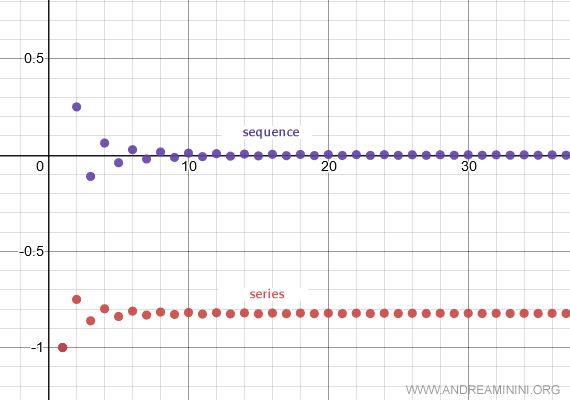
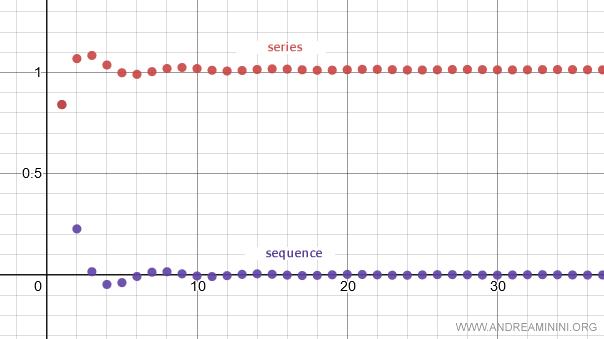
This series converges.
Here is its graphical representation
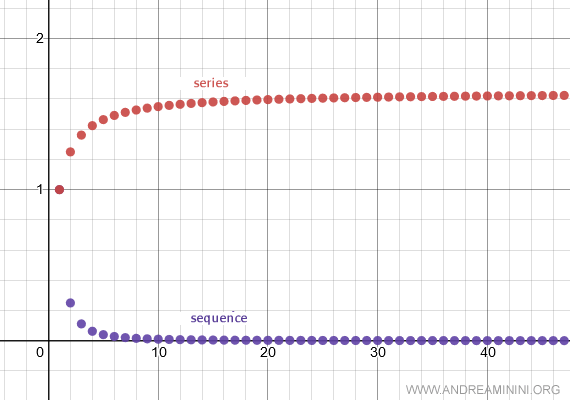
To check whether it is also absolutely convergent, we look at the series of absolute values.
$$ \sum_{n=1}^{\infty} \left| \frac{(-1)^n}{n^2} \right| $$
This new series also converges.
Therefore, the original series is absolutely convergent.
Example 2
Now consider the alternating harmonic series
$$ \sum_{n=1}^{\infty} \frac{(-1)^{n-1}}{n} $$
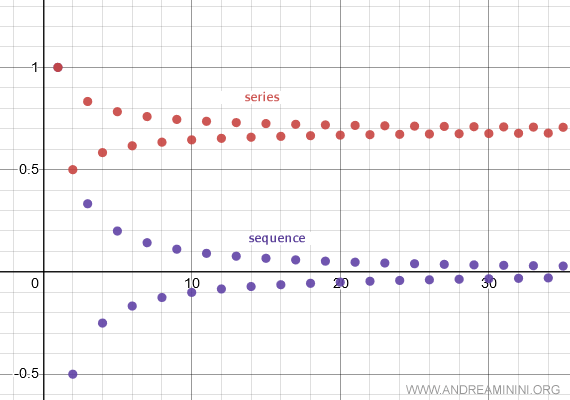
This series is convergent.
Here is its graphical representation
But if we take the absolute value of its terms, we obtain
$$ \sum_{n=1}^{\infty} \left| \frac{(-1)^{n-1}}{n} \right| $$
This series diverges.
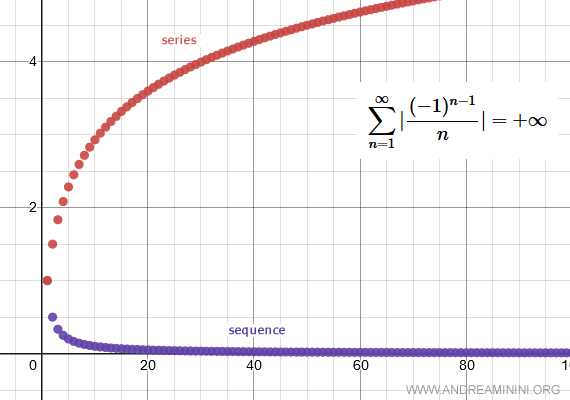
So, even though the original series converges, it is not absolutely convergent.
This example clearly shows the difference between simple convergence and absolute convergence.
The Absolute Convergence Test
If a series is absolutely convergent, then it is convergent.
The converse is false. A convergent series does not have to be absolutely convergent.
This test is especially useful when studying alternating series.
Example
Consider the series
$$ \sum_{n=1}^{\infty} \frac{\sin n}{n^2} $$
This is not a series with non-negative terms, since sin(n) takes values between -1 and 1.
To understand its behavior, we test for absolute convergence.
$$ \sum_{n=1}^{\infty} \left| \frac{\sin n}{n^2} \right| $$
We can compare this series with
$$ \sum_{n=1}^{\infty} \frac{1}{n^2} $$
Since
$$ \sum_{n=1}^{\infty} \left| \frac{\sin n}{n^2} \right| \le \sum_{n=1}^{\infty} \frac{1}{n^2} $$
and the series Σ 1/n2 is convergent, it follows that the series of absolute values also converges.
Therefore, the series is absolutely convergent, and hence convergent.
Proof of the Absolute Convergence Test
Consider the series
$$ \sum_{k=1}^{\infty} |a_k| $$
Assume that it converges.
By the Cauchy criterion, for every ε>0 there exists an index v such that for all n>v
$$ \sum_{k=n+1}^{\infty} |a_k| < ε $$
Note. Graphical interpretation.
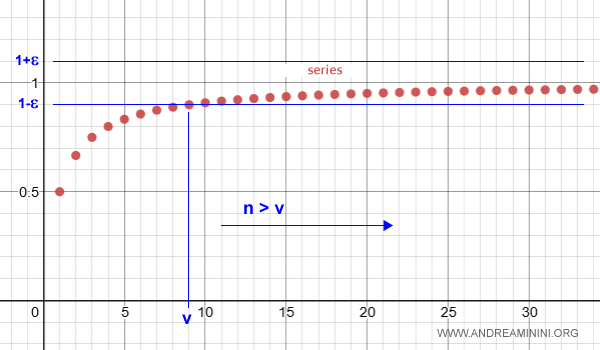
This means that the "tail" of the series can be made arbitrarily small.
In general, for any p>0 we also have
$$ \sum_{k=n+1}^{n+p} |a_k| < ε $$
Now compare the absolute value of a sum with the sum of absolute values
$$ \left| \sum_{k=n+1}^{n+p} a_k \right| \le \sum_{k=n+1}^{n+p} |a_k| $$
by the triangle inequality.
Since the right-hand side is smaller than ε, we obtain
$$ \left| \sum_{k=n+1}^{n+p} a_k \right| < ε $$
This shows that the series Σ ak satisfies the Cauchy criterion, and therefore converges.
Alternative proof
Assume that the series
$$ \sum_{k=1}^{\infty} |a_k| $$
converges. Then
$$ \sum_{k=1}^{\infty} (|a_k| + a_k) \le \sum_{k=1}^{\infty} 2 |a_k| $$
since 2|ak| is always greater than or equal to |ak| + ak.
The series Σ |ak| converges, so the series Σ 2|ak| also converges.
By the comparison test, the series Σ (|ak| + ak) converges as well.
Therefore
$$ \sum_{k=1}^{\infty} a_k = \sum_{k=1}^{\infty} (|a_k| + a_k) - \sum_{k=1}^{\infty} |a_k| $$
and both series on the right-hand side are convergent. Hence, the series Σ ak converges.
This completes the proof.


