
Mengoli's Series
Mengoli's series is defined by the following sum
$$ \sum_{k=1}^n \frac{1}{k(k+1)} $$
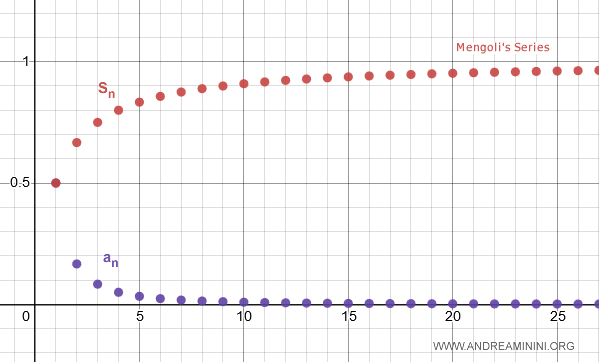
The general term of the series approaches zero as n tends to infinity.
Therefore, the necessary condition for the convergence of a series is satisfied. This condition alone does not guarantee convergence, but it tells us that the series may converge.
To better understand the behavior of the series, let us compute its first few partial sums.
| k | ak | sn |
| 1 | $$ \frac{1}{2} $$ | $$ \frac{1}{2} $$ |
| 2 | $$ \frac{1}{6} $$ | $$ \frac{2}{3} $$ |
| 3 | $$ \frac{1}{12} $$ | $$ \frac{3}{4} $$ |
| 4 | $$ \frac{1}{20} $$ | $$ \frac{4}{5} $$ |
The sequence of partial sums is therefore
$$ \frac{1}{2} , \frac{2}{3} , \frac{3}{4} , \frac{4}{5} , ... $$
A clear pattern begins to emerge. The nth partial sum appears to be
$$ s_n = \frac{n}{n+1} $$
We now prove that this formula is correct for every positive integer n.
$$ \sum_{k=1}^n \frac{1}{k(k+1)} = \frac{n}{n+1} $$
To do this, we use the principle of mathematical induction.
The base case P(1), corresponding to k=1, is immediately verified:
$$ P(1) : \: \sum_{k=1}^1 \frac{1}{k(k+1)} = \frac{k}{k+1} $$
$$ P(1) : \: \frac{1}{1(1+1)} = \frac{1}{1+1} $$
$$ P(1) : \: \frac{1}{2} = \frac{1}{2} $$
Now assume that the proposition is true for an arbitrary positive integer n:
$$ P(n) : \: \sum_{k=1}^n \frac{1}{k(k+1)} = \frac{n}{n+1} $$
We must verify that the same result also holds for n+1.
$$ P(n+1) : \: \sum_{k=1}^{n+1} \frac{1}{k(k+1)} = \frac{n+1}{n+2} $$
Starting from the left-hand side, we obtain
$$ P(n+1) : \: \sum_{k=1}^{n+1} \frac{1}{k(k+1)} $$
We can rewrite the sum as
$$ P(n+1) : \: [ \sum_{k=1}^{n} \frac{1}{k(k+1)} ] + \frac{1}{(n+1)((n+1)+1)} $$
which simplifies to
$$ P(n+1) : \: [ \sum_{k=1}^{n} \frac{1}{k(k+1)} ] + \frac{1}{(n+1)(n+2)} $$
The first term is exactly the proposition P(n).
$$ P(n+1) : \: P(n) + \frac{1}{(n+1)(n+2)} $$
Since P(n) is assumed to be true, we substitute
$$ P(n+1) : \: \frac{n}{n+1} + \frac{1}{(n+1)(n+2)} $$
Now combine the two fractions:
$$ P(n+1) : \: \frac{n(n+2)+1}{(n+1)(n+2)} $$
$$ P(n+1) : \: \frac{n^2+2n+1}{(n+1)(n+2)} $$
$$ P(n+1) : \: \frac{(n+1)^2}{(n+1)(n+2)} $$
Finally, simplify:
$$ P(n+1) : \: \frac{n+1}{n+2} $$
This is exactly the expression we wanted to prove.
Therefore, by mathematical induction,
$$ \sum_{k=1}^n \frac{1}{k(k+1)} = \frac{n}{n+1} $$
for every positive integer n.
We can now study the convergence of the series by computing the limit of the partial sums.
$$ s = \lim_{n \rightarrow \infty} s_n $$
$$ s = \lim_{n \rightarrow \infty} \sum_{k=1}^n \frac{1}{k(k+1)} $$
Since
$$ s_n = \frac{n}{n+1} $$
we have
$$ s = \lim_{n \rightarrow \infty} \frac{n}{n+1} $$
This is an indeterminate form of type ∞/∞
$$ s= \lim_{n \rightarrow \infty} \frac{n}{n+1} = \frac{∞}{∞} $$
which can be evaluated using L'Hôpital's rule.
$$ s= \lim_{n \rightarrow \infty} \frac{D[n]}{D[n+1]} $$
$$ s= \lim_{n \rightarrow \infty} \frac{1}{1} = 1 $$
The limit exists and is finite.
Therefore, Mengoli's series is convergent, and its partial sums approach the value 1 as n→∞.
And so on.


