
Comparison Test for Improper Integrals
- Let \( f(x) \) and \( g(x) \) be two functions defined on the interval \([0, \infty)\), with $$ 0 \le f(x) \le g(x). $$ According to the comparison test, their integrals satisfy the inequality $$ 0 \le \int_a^b f(x) \:dx \le \int_a^b g(x) \: dx. $$
- If the improper integral of \( g(x) \) converges, then the improper integral of \( f(x) \) also converges.
- If the improper integral of \( f(x) \) diverges, then the improper integral of \( g(x) \) must diverge as well.
Proof and Explanation
Assume \( f(x) \) and \( g(x) \) are defined over the interval \([a, b]\).
$$ f(x) \le g(x) $$
Then, by the comparison property of definite integrals:
$$ \int_a^b f(x) \:dx \le \int_a^b g(x) \: dx $$
Case 1
If the limit of the second integral exists as \( b \to \infty \) and equals a finite number \( l \), that is, the integral of \( g(x) \) converges,
$$ l = \lim_{b \rightarrow \infty} \int_a^b g(x) \: dx $$
then the first limit must be less than or equal to \( l \):
$$ \lim_{b \rightarrow \infty} \int_a^b f(x) \: dx \le l $$
Therefore, the integral of \( f(x) \) also converges.
Case 2
If the limit of the first integral is infinite - meaning that the integral of \( f(x) \) diverges - then, since \( g(x) \ge f(x) \), the second integral must also diverge:
$$ \lim_{b \rightarrow \infty} \int_a^b f(x) \: dx = \infty $$
implies
$$ \lim_{b \rightarrow \infty} \int_a^b g(x) \: dx \ge \infty $$
and hence:
$$ \lim_{b \rightarrow \infty} \int_a^b g(x) \: dx = \infty $$
A Practical Example
Let’s determine whether the improper integral of the function \( f(x) = e^{-x^2} \) converges over the interval \([0, \infty)\):
$$ \int_0^{\infty} e^{-x^2} \: dx $$
Note: Computing the limit directly is not straightforward: $$ \int_0^{\infty} e^{-x^2} \: dx = \lim_{b \rightarrow +\infty } \int_0^b e^{-x^2} \: dx $$ because the antiderivative of \( e^{-x^2} \) is not expressible in terms of elementary functions.
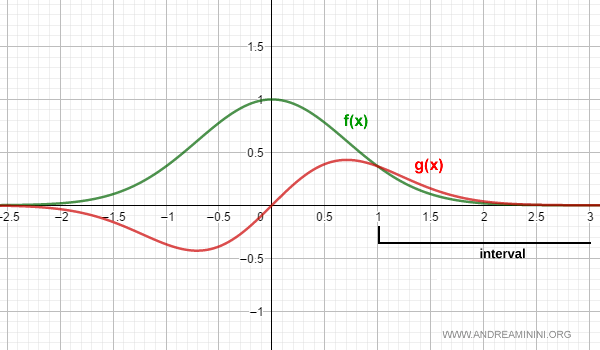
To simplify the analysis, let’s restrict the domain to the interval \([1, \infty)\), and compare \( f(x) \) with the function \( g(x) = e^{-x^2} \cdot x \):
$$ \int_1^{\infty} e^{-x^2} \cdot x \: dx $$
On this interval, it holds that:
$$ e^{-x^2} \le e^{-x^2} \cdot x $$
Therefore, by the comparison test:
$$ \int_1^{\infty} e^{-x^2} \: dx \le \int_1^{\infty} e^{-x^2} \cdot x \: dx $$
The second integral is more approachable, since its antiderivative is elementary:
$$ \int_1^{\infty} e^{-x^2} \cdot x \: dx = \lim_{ b \rightarrow \infty } \int_1^b e^{-x^2} \cdot x \: dx $$
$$ = \lim_{ b \rightarrow \infty } \left[ - \frac{1}{2} e^{-x^2} \right]_1^b $$
$$ = \lim_{ b \rightarrow \infty } - \frac{1}{2} e^{-b^2} + \frac{1}{2} e^{-1} $$
$$ = \lim_{ b \rightarrow \infty } - \frac{1}{2} e^{-b^2} + \frac{1}{2e} $$
$$ = 0 + \frac{1}{2e} $$
$$ = \frac{1}{2e} $$
Thus, the improper integral of \( g(x) \) converges to \( \frac{1}{2e} \):
$$ \int_1^{\infty} e^{-x^2} \cdot x \: dx = \frac{1}{2e} $$
And since:
$$ \int_1^{\infty} e^{-x^2} \: dx \le \int_1^{\infty} e^{-x^2} \cdot x \: dx $$
$$ \int_1^{\infty} e^{-x^2} \: dx \le \frac{1}{2e} $$
we can conclude that the improper integral of \( f(x) \) also converges.
And so on.


