Integration by Substitution
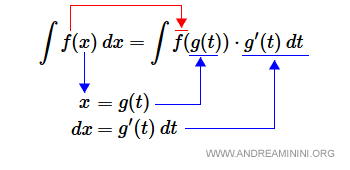
Let f(x) be a continuous function, and g(x) a differentiable function with continuous derivative. Then: $$ \int f(x) \: dx = \int f(g(t)) \cdot g'(t) \: dt $$ where \( x = g(t) \).
What is it for?
Integration by substitution is a standard method for evaluating indefinite integrals.
Two ways to apply substitution
This formula can be applied in either direction, depending on the structure of the integrand.
- First approach: Replace the variable \( x \) with the function \( g(t) \), and substitute \( dx \) with \( g'(t)\,dt \). The function f() stays the same, but the variable changes.
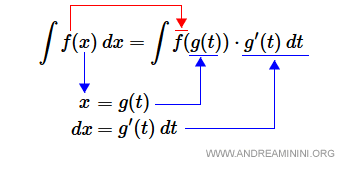
- Second approach: If the integrand is a composite function of the form \( f(g(x)) \cdot g'(x) \), you can simplify by substituting both \( g(x) \) and \( g'(x) \) with a new variable \( t \) and \( dt \).
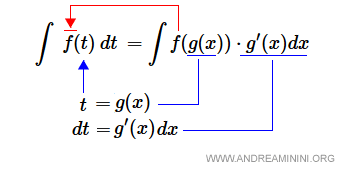
Which method should you use? That depends on the integrand. In some cases, the first approach works better; in others, the second is more efficient. There’s no universal rule - the key is practice and familiarity with different types of functions.
Worked Examples
Example 1
Evaluate the integral:
$$ \int \frac{ \sin \sqrt{x} }{\sqrt{x}} \: dx $$
We'll apply the first substitution method.
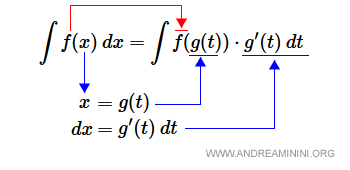
The expression \( \sqrt{x} \) is the part that makes this integral challenging.
To simplify, we set \( t = \sqrt{x} \), then express x and dx in terms of t:
$$ t = \sqrt{x} $$
$$ x = t^2 $$
$$ dx = \frac{d}{dt}(t^2) \, dt = 2t \, dt $$
Substituting into the integral:
$$ \int \frac{ \sin \sqrt{x} }{\sqrt{x}} \: dx = \int \frac{ \sin t }{t} \cdot 2t \: dt $$
$$ = \int \sin t \cdot 2 \: dt $$
$$ = 2 \cdot \int \sin t \: dt $$
$$ = -2 \cos t + c $$
Back-substituting \( t = \sqrt{x} \):
$$ = -2 \cos(\sqrt{x}) + c $$
Example 2
Now consider:
$$ \int \cos x \cdot \sin ( \sin x ) \: dx $$
The integrand is the product of \( \cos x \) and a composite function \( \sin(\sin x) \).
Since \( \cos x \) is the derivative of the inner function \( \sin x \), this is a clear case for the second substitution method.
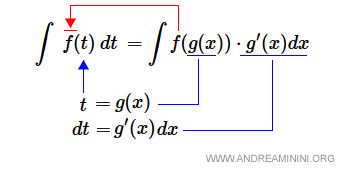
Let’s substitute:
$$ t = \sin x $$
Then:
$$ dt = \cos x \: dx $$
Substituting into the integral:
$$ \int \cos x \cdot \sin ( \sin x ) \: dx = \int \sin(t) \: dt $$
Which is a basic integral:
$$ = -\cos t + c $$
Returning to x:
$$ = -\cos(\sin x) + c $$
Example 3
Let’s evaluate:
$$ \int \frac{1}{\sqrt{x} - 3} \: dx $$
We’ll use the first substitution method again.
Let \( x = t^2 \), so:
$$ dx = 2t \: dt $$
Substitute into the integral:
$$ \int \frac{1}{\sqrt{x} - 3} \: dx = \int \frac{1}{t - 3} \cdot 2t \: dt $$
$$ = 2 \cdot \int \frac{t}{t - 3} \: dt $$
Now rewrite the numerator:
$$ = 2 \cdot \int \frac{(t - 3) + 3}{t - 3} \: dt $$
Split the integral using linearity:
$$ = 2 \cdot \left[ \int 1 \: dt + 3 \cdot \int \frac{1}{t - 3} \: dt \right] $$
Integrate term by term:
$$ = 2 \cdot \left[ t + 3 \log |t - 3| \right] + c $$
Now substitute back \( t = \sqrt{x} \):
$$ = 2 \sqrt{x} + 6 \log | \sqrt{x} - 3 | + c $$
So the solution is:
$$ \int \frac{1}{\sqrt{x} - 3} \: dx = 2 \sqrt{x} + 6 \log | \sqrt{x} - 3 | + c $$
Proof and Explanation
Integration by substitution is grounded in the chain rule for derivatives.
$$ \frac{d}{dt}F(g(t)) = F'(g(t)) \cdot g'(t) $$
Integrating both sides:
$$ \int \frac{d}{dt}F(g(t)) \: dt = \int F'(g(t)) \cdot g'(t) \: dt $$
Since integration and differentiation cancel each other:
$$ F(g(t)) = \int F'(g(t)) \cdot g'(t) \: dt $$
And if \( F'(g(t)) = f(g(t)) \), then:
$$ F(g(t)) = \int f(g(t)) \cdot g'(t) \: dt $$
So, by definition:
$$ \int f(g(t)) \: dt = \int f(g(t)) \cdot g'(t) \: dt $$
Now, using \( x = g(t) \), we rewrite the left-hand side as:
$$ \int f(x) \: dx = \int f(g(t)) \cdot g'(t) \: dt $$
And so on.