
Integrability Theorem for Continuous Functions
If a function \( f(x) \) is continuous over the interval [a, b], then it is Riemann integrable on [a, b].
Proof
According to the Cantor theorem, any function that is bounded on a closed interval [a, b] is uniformly continuous.
As a consequence, it is also continuous on that interval.
Given any \( \epsilon > 0 \), uniform continuity guarantees the existence of a \( \delta > 0 \) such that:
$$ |f(x) - f(x')| < \frac{\epsilon}{b - a} $$
for all \( x, x' \in [a, b] \) satisfying:
$$ |x - x'| < \delta $$
Now consider an arbitrary partition \( P \) of the interval [a, b]:
$$ P = ( x_0, x_1, x_2, \ldots, x_{n-1}, x_n ) $$
where \( x_0 = a \) and \( x_n = b \), so the partition becomes:
$$ P = ( a, x_1, x_2, \ldots, x_{n-1}, b ) $$
By assumption, the length of each subinterval is smaller than \( \delta \):
$$ |x_k - x_{k-1}| < \delta $$
On each subinterval \([x_{k-1}, x_k]\), define:
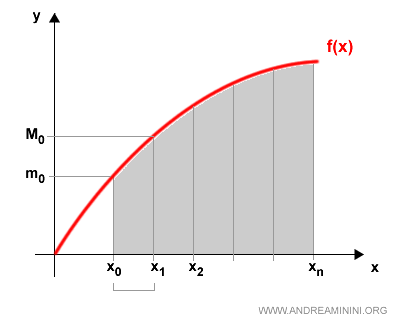
$$ m_k = \inf \{ f(x) \mid x \in [x_{k-1}, x_k] \} $$
$$ M_k = \sup \{ f(x) \mid x \in [x_{k-1}, x_k] \} $$
The inequality:
$$ |f(x) - f(x')| < \frac{\epsilon}{b - a} $$
then implies the following bound on the oscillation of \( f \) over each subinterval:
$$ M_k - m_k < \frac{\epsilon}{b - a} $$
Note: The absolute value is not needed here, since by definition the supremum \( M_k \) is greater than or equal to the infimum \( m_k \), so \( M_k - m_k \ge 0 \).
Multiplying both sides by the length of the interval \( x_k - x_{k-1} \), we get:
$$ (M_k - m_k) \cdot (x_k - x_{k-1}) < \frac{\epsilon}{b - a} \cdot (x_k - x_{k-1}) $$
Geometrically, the left-hand side represents the difference between the areas of two rectangles: one with height \( M_k \) and the other with height \( m_k \).
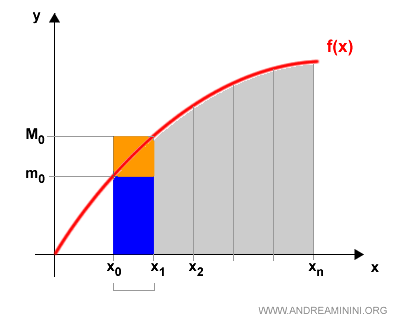
Summing over all subintervals in the partition \( P \), we obtain:
$$ \sum_{k=1}^n (M_k - m_k) \cdot (x_k - x_{k-1}) < \frac{\epsilon}{b - a} \cdot \sum_{k=1}^n (x_k - x_{k-1}) $$
The left-hand side is the difference between the upper and lower Riemann sums:
$$ S(P) - s(P) < \frac{\epsilon}{b - a} \cdot \sum_{k=1}^n (x_k - x_{k-1}) $$
Visually:
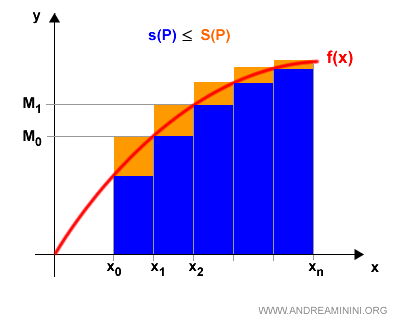
The sum \( \sum_{k=1}^n (x_k - x_{k-1}) \) equals the length of the entire interval:
$$ S(P) - s(P) < \frac{\epsilon}{b - a} \cdot (b - a) $$
Which simplifies to the classic Riemann integrability condition:
$$ S(P) - s(P) < \epsilon $$
This proves that any function continuous on [a, b] is Riemann integrable.
And so on.


