
Mean Value Theorem for Definite Integrals
If \( f(x) \) is continuous over the interval [a, b], then there exists a point \( x_0 \in [a, b] \) such that $$ \int_a^b f(x) \: dx = f(x_0) \cdot (b - a) $$ 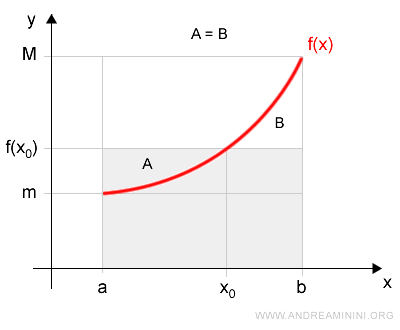
What does this mean?
The area of the rectangle given by \( f(x_0) \cdot (b - a) \) is equal to the area under the curve of \( f(x) \) over the interval [a, b], because the regions A and B have the same area.

This means that if we know the value \( x_0 \) where the function reaches its average height on [a, b], we can compute the same result as the definite integral using the expression \( f(x_0) \cdot (b - a) \).
![the definite integral of the function over [a, b], represented by the area under the curve](/data/andreaminininet/mean-value-theorem-for-definite-integrals-am-2025-3.gif)
Proof
The definite integral lies between the lower and upper Riemann sums, \( s(P) \) and \( S(P) \), for any partition \( P \) of the interval [a, b]:
$$ s(P) \le \int_a^b f(x) \: dx \le S(P) $$
Let’s consider a simple partition \( P \) made up of just two points: [a, b].
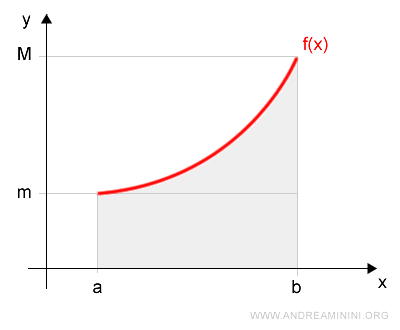
The lower sum, using \( m = \min f(x) \) on [a, b], is:
$$ s(P) = m \cdot (b - a) $$
The upper sum, using \( M = \max f(x) \) on [a, b], is:
$$ S(P) = M \cdot (b - a) $$
Substituting into the inequality gives:
$$ m \cdot (b - a) \le \int_a^b f(x) \: dx \le M \cdot (b - a) $$
Now divide each part of the inequality by \( (b - a) \):
$$ \frac{m \cdot (b - a)}{b - a} \le \frac{1}{b - a} \int_a^b f(x) \: dx \le \frac{M \cdot (b - a)}{b - a} $$
Which simplifies to:
$$ m \le \frac{1}{b - a} \int_a^b f(x) \: dx \le M $$
So there exists a number \( y_0 \) such that:
$$ y_0 = \frac{1}{b - a} \int_a^b f(x) \: dx $$
and:
$$ m \le y_0 \le M $$
By the Intermediate Value Theorem, there must exist a point \( x_0 \in [a, b] \) such that:
$$ y_0 = f(x_0) $$
This confirms the theorem:
$$ \frac{1}{b - a} \int_a^b f(x) \: dx = f(x_0) $$
and thus:
$$ \int_a^b f(x) \: dx = f(x_0) \cdot (b - a) $$
The rectangle formed by \( f(x_0) \cdot (b - a) \) has the same area as the region under the curve of \( f(x) \) over [a, b].
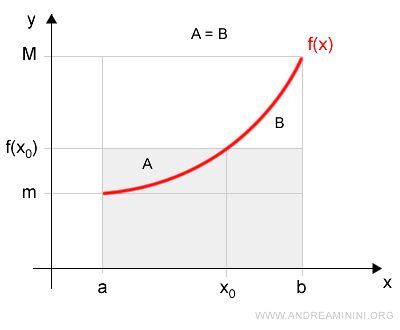
Therefore, the area given by \( f(x_0) \cdot (b - a) \) exactly matches the definite integral \( \int_a^b f(x) \: dx \).
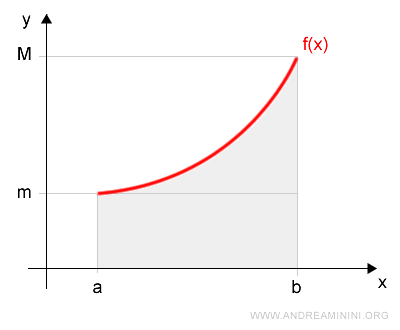
And so on.


