Union of Partitions in an Integral
Given two partitions P and Q of the interval [a, b], the partition R obtained by merging them, $$ R = P \cup Q $$ satisfies the following inequalities: $$ s(P) \le s(R) \le S(R) \le S(Q) $$ Here, \( s() \) denotes the lower Darboux sum and \( S() \) the upper Darboux sum.
The integral sum represents the area of a step-shaped region either inscribed in or circumscribed around the graph of the function, based on the chosen partition.
Proof
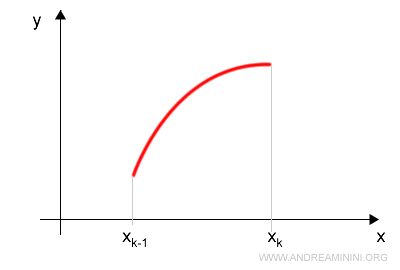
Partition P consists of two consecutive points: xk-1 and xk.
Partition Q contains three points - one additional point, x, compared to P.
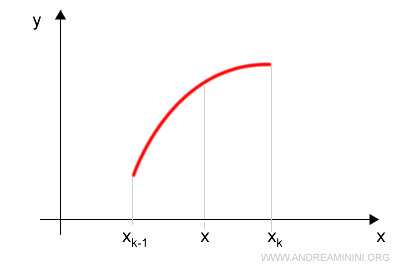
The union of the two partitions, denoted R, therefore consists of three points:
$$ R = P \cup Q = \{ x_{k-1}, x, x_k \} $$
This gives rise to two subintervals: [xk-1, x] and [x, xk].
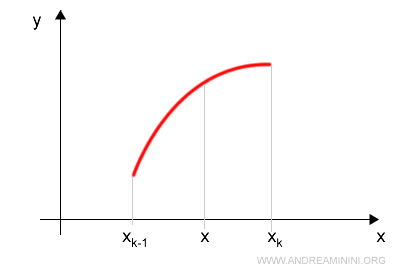
We now compute the lower and upper Darboux sums to establish the order of inequalities.
1] Lower Darboux Sums
We identify the infimum of the function on each subinterval of R:
$$ m_1 = \inf([x_{k-1}, x]) $$
$$ m_2 = \inf([x, x_k]) $$
Graphically, this looks like:
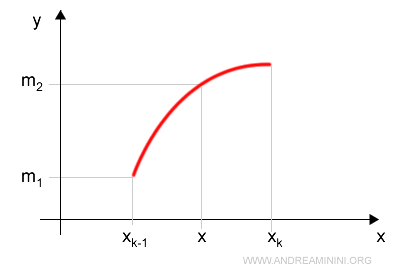
The lower sums for partitions P and R are given by:
$$ s(P) = m_k \cdot (x_k - x_{k-1}) $$
$$ s(R) = m_1 \cdot (x - x_{k-1}) + m_2 \cdot (x_k - x) $$
Here’s how this is represented graphically:
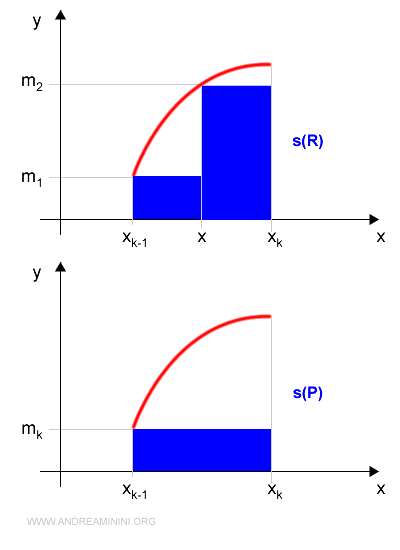
The difference between the two sums is:
$$ s(R) - s(P) = [m_1 \cdot (x - x_{k-1}) + m_2 \cdot (x_k - x)] - m_k \cdot (x_k - x_{k-1}) $$
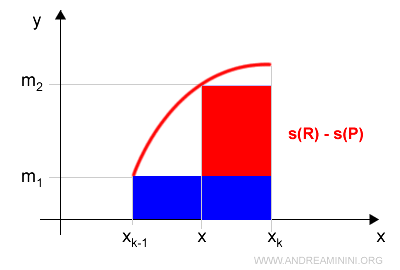
Note: From a geometric standpoint, it's already evident that \( s(R) - s(P) > 0 \). Hence, $$ s(R) \ge s(P) $$
Since
$$ m_1 \ge m_k \quad \text{and} \quad m_2 \ge m_k $$
because the interval [xk-1, xk] contains both subintervals [xk-1, x] and [x, xk],
we can substitute \( m_k \) in place of \( m_1 \) and \( m_2 \) to obtain:
$$ s(R) - s(P) \ge [m_k \cdot (x - x_{k-1}) + m_k \cdot (x_k - x)] - m_k \cdot (x_k - x_{k-1}) $$
$$ s(R) - s(P) \ge m_k \cdot (x - x_{k-1} + x_k - x - x_k + x_{k-1}) $$
$$ s(R) - s(P) \ge m_k \cdot 0 = 0 $$
Thus, $$ s(R) \ge s(P) $$
2] Upper Darboux Sums
Now, let’s calculate the supremum on each subinterval of R:
$$ M_1 = \sup([x_{k-1}, x]) $$
$$ M_2 = \sup([x, x_k]) $$
Graphically:
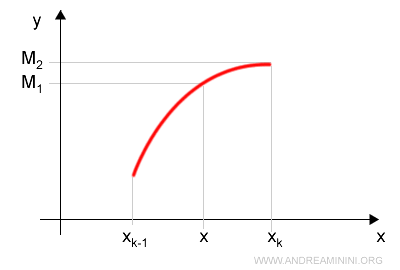
The upper sums for partitions Q and R are:
$$ S(Q) = M_k \cdot (x_k - x_{k-1}) $$
$$ S(R) = M_1 \cdot (x - x_{k-1}) + M_2 \cdot (x_k - x) $$
And here’s the corresponding visual:

The difference between the upper sums is:
$$ S(Q) - S(R) = M_k \cdot (x_k - x_{k-1}) - [M_1 \cdot (x - x_{k-1}) + M_2 \cdot (x_k - x)] $$
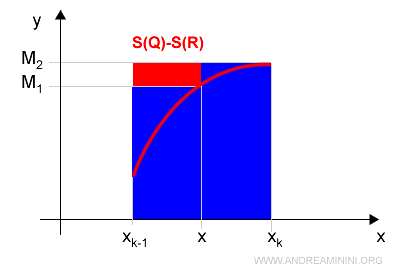
Note: Visually, it's clear that \( S(Q) - S(R) > 0 \), and so we conclude: $$ S(Q) \ge S(R) $$
Since
$$ M_1 \le M_k \quad \text{and} \quad M_2 \le M_k $$
we can again substitute \( M_k \) for both \( M_1 \) and \( M_2 \):
$$ S(Q) - S(R) \ge M_k \cdot (x_k - x_{k-1}) - [M_k \cdot (x - x_{k-1}) + M_k \cdot (x_k - x)] $$
$$ S(Q) - S(R) \ge M_k \cdot (x_k - x_{k-1} - x + x_{k-1} - x_k + x) $$
$$ S(Q) - S(R) \ge M_k \cdot 0 = 0 $$
Thus, $$ S(Q) \ge S(R) $$
3] Final Conclusion
From the analysis of both lower and upper Darboux sums, we’ve established:
$$ s(R) \ge s(P) \quad \text{and} \quad S(Q) \ge S(R) $$
And since upper sums are always at least as large as lower sums, we can consolidate all the inequalities:
$$ S(Q) \ge S(R) \ge s(R) \ge s(P) $$
Or, equivalently:
$$ s(P) \le s(R) \le S(R) \le S(Q) $$
This confirms the initial proposition.
And so on.