Integral of a Composite Function Times the Derivative of Its Inner Function
The indefinite integral of a composite function f(g(x)) multiplied by the derivative of its inner function g(x) equals the antiderivative of f(g(x)). $$ \int f(g(x)) \cdot g'(x) \: dx = F(g(x)) + k $$
This is essentially the reverse process of the chain rule in differentiation.
This rule provides a powerful tool for evaluating a broad class of integrals involving composite functions.
A Practical Example
Consider the following indefinite integral:
$$ \int 2x \cdot \sin x^2 \: dx $$
We can recognize sin x2 as a composite function f(g(x)), where:
$$ f(g(x)) = \sin x^2 $$
$$ g(x) = x^2 $$
Clearly, 2x is the derivative of the inner function g(x), which confirms the structure matches our integration rule.
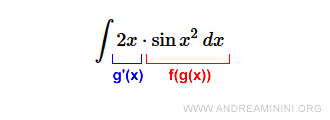
Now we apply the rule for integrating a composite function times the derivative of its inner argument:
$$ \int f(g(x)) \cdot g'(x) \: dx = F(g(x)) + k $$
$$ \int \sin x^2 \cdot 2x \: dx = F(g(x)) + k $$
Note. The antiderivative of the composite function f(g(x)) = sin x2 is \( F(g(x)) = -\cos x^2 \). To verify this result, we differentiate F(g(x)) using the chain rule: $$ D[F(g(x))] = F'(g(x)) \cdot g'(x) $$ $$ D[F(g(x))] = D[- \cos x^2] \cdot D[x^2] $$ $$ D[F(g(x))] = \sin x^2 \cdot 2x $$ which matches the original integrand.
Therefore, we conclude:
$$ \int \sin x^2 \cdot 2x \: dx = - \cos x^2 + k $$
And the integral is fully evaluated.
Explanation and Justification
According to the chain rule for derivatives:
$$ D[f(g(x))] = f'(g(x)) \cdot g'(x) $$
In integration, we know that:
$$ \int h'(x) \: dx = h(x) + k $$
If we treat \( h'(x) \) as \( f'(g(x)) \cdot g'(x) \), then we can integrate directly:
$$ \int f'(g(x)) \cdot g'(x) \: dx = f(g(x)) + k $$
And that completes the reasoning.