
Additive Property of Definite Integrals
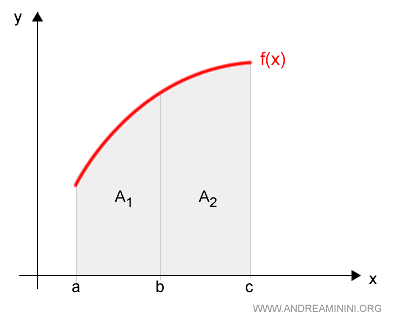
If a function \( f(x) \) is Riemann integrable over the interval [a, c], and this interval is divided into two adjacent subintervals [a, b] and [b, c], then the definite integral of \( f(x) \) over [a, c] is equal to the sum of the integrals over the two parts: $$ \int_a^c f(x) \:dx = \int_a^b f(x) \:dx + \int_b^c f(x) \:dx $$
Geometrically, this means that the areas \( A_1 \) and \( A_2 \) under the curve \( f(x) \) are additive.
Proof
If the point \( b \) lies strictly between \( a \) and \( c \), we can define two partitions:
$$ P_1 = [a, b] \qquad P_2 = [b, c] $$
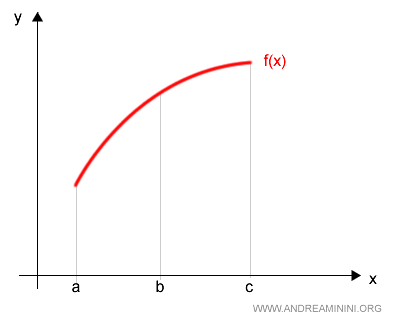
The union of these partitions yields the full partition \( P \):
$$ P = P_1 \cup P_2 = [a, b] \cup [b, c] $$
Accordingly, the lower Darboux sum over the entire interval satisfies:
$$ s(P) = s(P_1) + s(P_2) $$
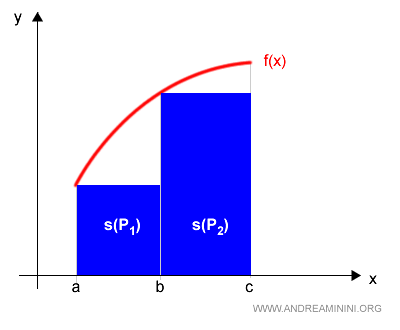
And similarly, the upper Darboux sum is:
$$ S(P) = S(P_1) + S(P_2) $$
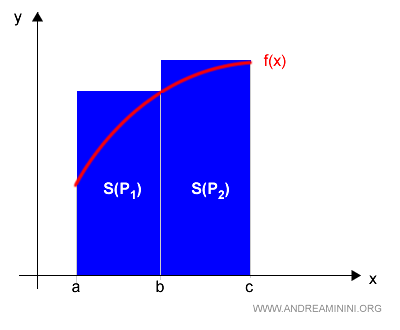
Therefore, by the definition of the Riemann integral, we conclude:
$$ \int_a^c f(x) \:dx = \int_a^b f(x) \:dx + \int_b^c f(x) \:dx $$
Note: When \( a = b \), the integral over [a, b] vanishes, so the formula simplifies to $$ \int_a^c f(x) \:dx = \int_a^b f(x) \:dx + \int_b^c f(x) \:dx = 0 + \int_b^c f(x) \:dx $$ Likewise, when \( a = c \), the integral over [a, c] evaluates to zero: $$ \int_a^c f(x) \:dx = \int_a^b f(x) \:dx - \int_b^a f(x) \:dx = 0 $$
And so on.


