Comparing Complex Numbers
Two complex numbers are equal $$ z_1 = z_2 $$ if and only if they have the same real part and the same imaginary part. In other words, both of the following conditions must hold: $$ Re(z_1) = Re(z_2) $$ $$ Im(z_1) = Im(z_2) $$
Equality for complex numbers is defined in the usual way: two complex numbers are equal when their corresponding real and imaginary parts are equal.
However, unlike real numbers, complex numbers do not have a natural order relation that is compatible with the field operations.
This means that complex numbers cannot, in general, be compared using the usual less-than and greater-than relations. While it makes sense to write \(3 < 5\) for real numbers, there is no corresponding natural ordering for complex numbers.
Example
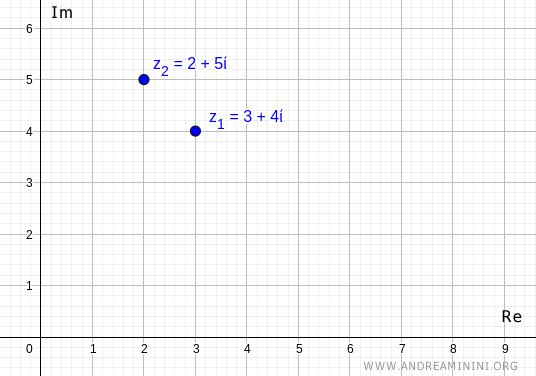
Consider the following two complex numbers:
$$ z_1 = (3,4) $$
$$ z_2 = (2,5) $$
These two complex numbers are not equal:
$$ z_1 \ne z_2 $$
The reason is that both their real parts and their imaginary parts are different:
$$ Re(z_1) = 3 \ne Re(z_2) = 2 $$
$$ Im(z_1) = 4 \ne Im(z_2) = 5 $$
Since complex numbers do not have a natural ordering compatible with the field operations, we cannot say that \(z_1\) is greater than or less than \(z_2\).
Example 2
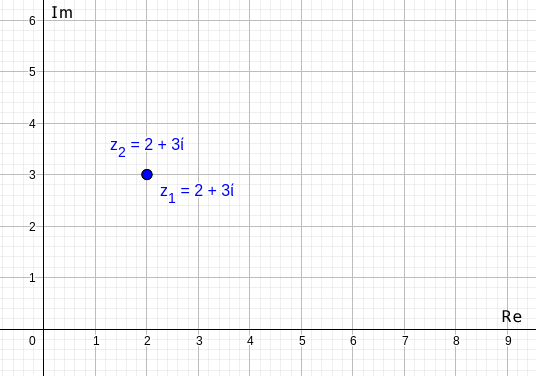
Now consider these two complex numbers:
$$ z_1 = (2,3) $$
$$ z_2 = (2,3) $$
In this case, the two complex numbers are equal because they have the same real part and the same imaginary part:
$$ Re(z_1) = Re(z_2) = 2 $$
$$ Im(z_1) = Im(z_2) = 3 $$
They therefore represent the same point, with coordinates (2,3), on the complex plane.
The same criterion applies to any pair of complex numbers: to determine whether they are equal, simply compare their real parts and their imaginary parts.