Inverse Cosine Function (Arccos)
What Is the Inverse Cosine Function?
The inverse cosine function, also known as the arccosine function, reverses the action of the cosine function. Given a cosine value, it returns the angle that produces that value. The function is usually written as arccos.
In textbooks and calculators, you will often see the inverse cosine written as cos-1. Here, the exponent -1 does not mean "raised to the power of -1". Instead, it indicates the inverse function.
How Does the Inverse Cosine Function Work?
The cosine function takes an angle and returns a number between -1 and 1.
The inverse cosine does the opposite. It starts with a value between -1 and 1 and returns the angle whose cosine is equal to that value.
Example
Suppose the cosine of an angle is 0.5.
$$ \cos \alpha = 0.5 $$
Which angle α produces this cosine value?
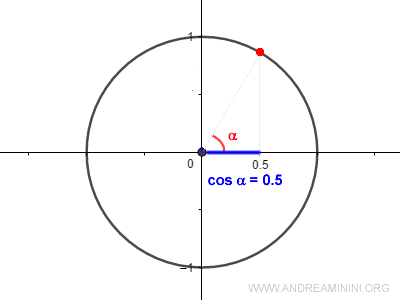
To find the answer, we apply the inverse cosine function:
$$ \alpha = \operatorname{arccos}(0.5) = \frac{\pi}{3} \text{ rad} $$
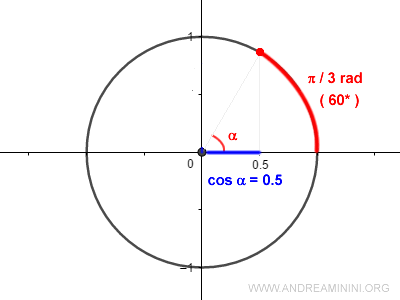
In other words, the angle whose cosine is 0.5 is π/3 radians, or 60°.
From a geometric point of view, the arccosine identifies the point on the unit circle whose horizontal coordinate matches the given cosine value.
The corresponding arc has the same measure in radians as the angle itself.
Why Does Cosine Need a Restricted Domain?
The cosine function takes values in the interval [-1, 1].
However, cosine is also a periodic function. This means that the same cosine value is produced by infinitely many different angles.
For example, the same value may occur at x1 and x2.
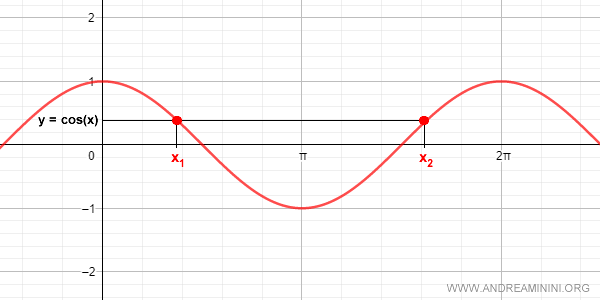
Because several angles can have the same cosine, the cosine function is not one-to-one over its entire domain.
An inverse function can only exist when each output corresponds to exactly one input.
$$ f:x \rightarrow y $$
To make cosine invertible, we must restrict its domain.
How Is the Inverse Cosine Defined?
The standard choice is to restrict cosine to the interval [0, π].
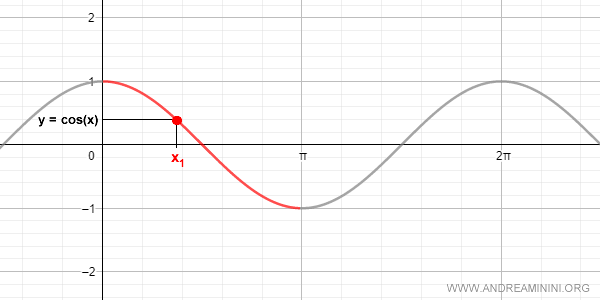
On this interval, cosine decreases continuously from 1 to -1. As a result, every value in [-1, 1] corresponds to exactly one angle.
This one-to-one relationship allows us to define the inverse cosine function.
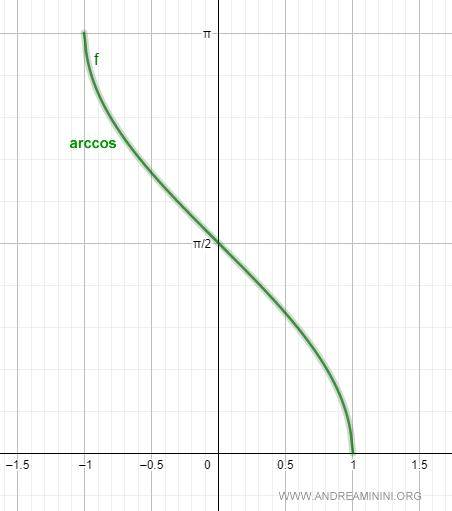
The inverse cosine, or arccosine, is therefore defined as
$$ \operatorname{arccos}(x) : [-1,1] \rightarrow [0,\pi] $$
The function is often abbreviated as arccos or acos.
For every value x between -1 and 1, arccos(x) returns the unique angle in the interval [0, π] whose cosine is equal to x.
Note: The interval [0, π] is called the principal interval of the inverse cosine function. Other intervals can also be used, provided that cosine remains one-to-one on them. These choices produce alternative inverse branches rather than the standard arccosine function.
How to Graph the Inverse Cosine Function
The graph of the inverse cosine function can be obtained directly from the graph of cosine restricted to the interval [0, π].
Like any inverse function, its graph is the reflection of the original graph across the line y = x.
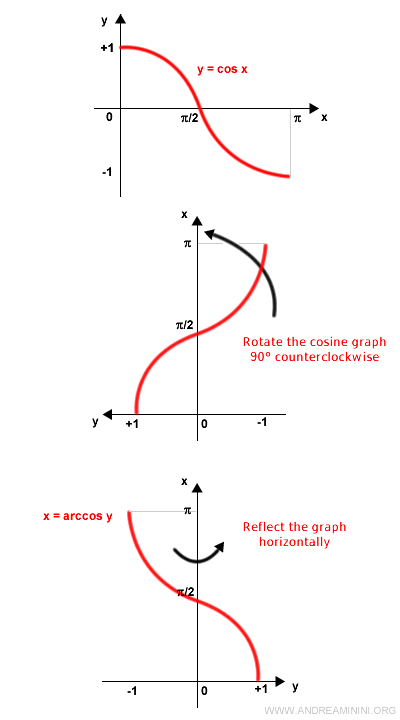
You can think of this process as swapping the roles of the horizontal and vertical axes.
The same idea applies to any interval where cosine is one-to-one.
For example, by restricting cosine to the interval [-π, 0], you can construct a different inverse branch with its own graph.