Tangent Lines to Curves
Suppose a secant line $ s $ intersects a curve at two distinct points $ P $ and $ Q $. As the point $ Q $ moves closer and closer to $ P $ along the curve, the secant line approaches a limiting position. This limiting line is called the tangent line $ t $ to the curve at point $ P $.
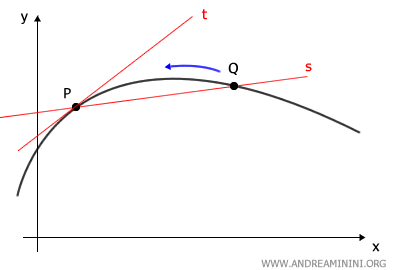
A tangent line is the line that locally follows the same direction as the curve at a given point.
In other words, if you zoom in near the point of tangency, the curve and the tangent line look almost identical over a very small region.
A tangent line does not always touch the curve at only one point. For many curves, the tangent line may intersect the curve again at other points.
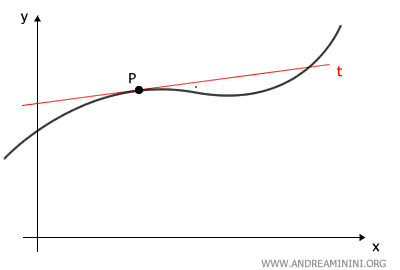
However, some curves have special geometric properties. For example, in circles and ellipses, the tangent line has exactly one point of contact with the curve.
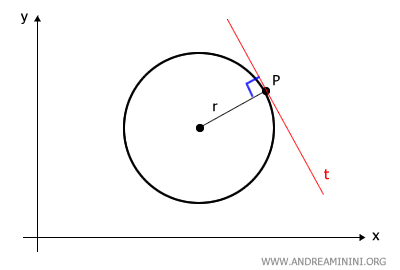
Example. In a circle, the tangent line at a point is perpendicular to the radius $ r $ drawn to the point of tangency $ P $. The line touches the circle at exactly one point.
Finding the Equation of a Tangent Line with Derivatives
If the curve is the graph of a function \( y=f(x) \), the tangent line at a point can be found using derivatives.
The derivative \( f'(x_0) \) represents the slope of the tangent line at the point whose x-coordinate is \( x_0 \).
Once the slope is known, the tangent line can be written using the point-slope form:
\( y-f(x_0)=f'(x_0)(x-x_0) \)
or equivalently
\( y=f'(x_0)(x-x_0)+f(x_0) \)
Example
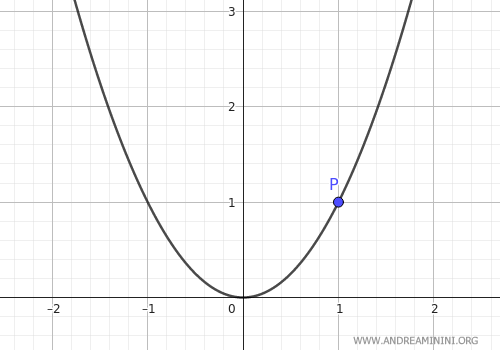
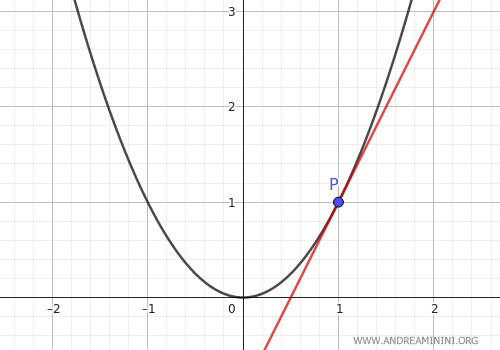
Consider the parabola
\( f(x)=x^2 \)
We want to find the tangent line at the point where \( x_0=1 \).
First, compute the corresponding point on the curve:
\( f(1)=1^2=1 \)
So the point of tangency is \( P(1,1) \)
Now write the general equation of a line passing through that point:
\[ (y-y_0)=m \cdot (x-x_0) \]
Substituting the coordinates of \( P \):
\[ (y-1)=m \cdot (x-1) \]
Next, compute the derivative of the function:
\( f'(x)=2x \)
Evaluate the derivative at \( x_0=1 \):
\( f'(1)=2 \)
Therefore, the slope of the tangent line is
\( m=2 \)
Substitute this value into the equation of the line:
\( y-1=2(x-1) \)
Simplify the equation:
\( y-1=2x-2 \)
\( y=2x-1 \)
Therefore, the tangent line to the parabola \( y=x^2 \) at the point \( P(1,1) \) is
\( y=2x-1 \)
The tangent line describes the local behavior of the function near the point of tangency.
And so on.