
Stationary Points
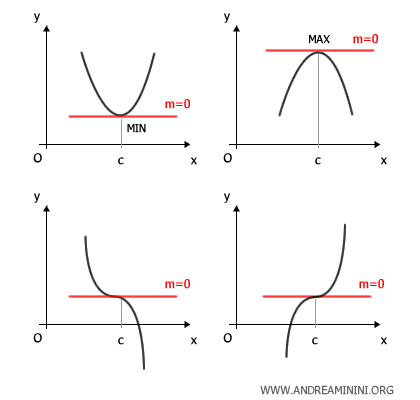
A stationary point is a point \( x=c \) on the graph of a function \( y=f(x) \) where the first derivative is zero, meaning \( f'(c)=0 \).
At a stationary point, the graph temporarily “levels off” and the tangent line becomes horizontal.
This is directly related to the meaning of the derivative. The derivative measures the slope of the tangent line to a graph:
- If the derivative is positive \( f'(x)>0 \), the function is increasing.
- If the derivative is negative \( f'(x)<0 \), the function is decreasing.
- If the derivative is zero \( f'(x)=0 \), the tangent line is horizontal.
Therefore, every stationary point corresponds to a point where the graph has zero slope.
Why are stationary points important? Stationary points are one of the main tools used to study the shape of a function. They help identify local maxima, local minima, and points of inflection with a horizontal tangent. In calculus, they are essential for understanding how a function behaves and how its graph changes direction.
How do you find stationary points?
To find the stationary points of a function, you usually follow four steps:
- Compute the first derivative.
- Set the derivative equal to zero.
- Solve the equation.
- Study how the function behaves around the solutions.
A complete example
Example 1
Consider the function
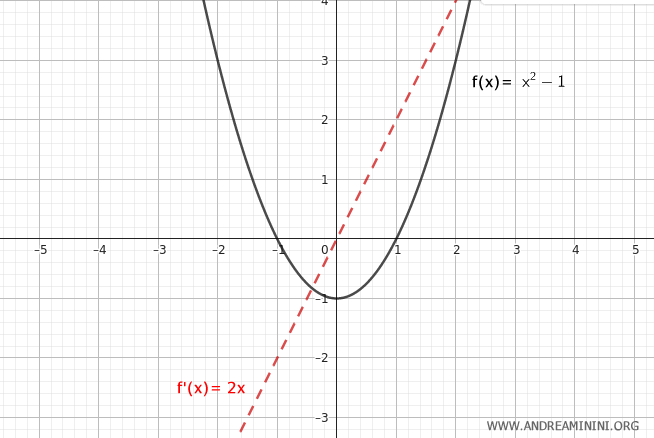
\[ f(x)= x^2-1 \]
Its derivative is
\[ f'(x)=2x \]
Now set the derivative equal to zero:
\[ 2x=0 \]
Solving the equation gives:
\[ x=0 \]
Next, study the sign of the derivative.
Before \( x=0 \), the derivative is negative \( f'(x)<0 \), so the function decreases.
After \( x=0 \), the derivative is positive \( f'(x)>0 \), so the function increases.
Since the function changes from decreasing to increasing, the point \( x=0 \) is a local minimum.
Example 2
Consider the function
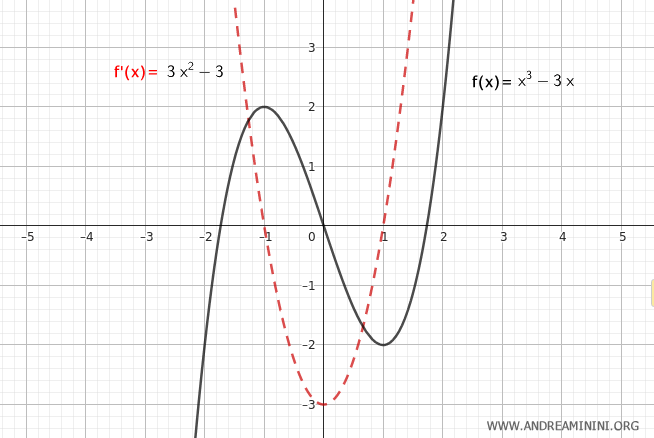
\[ f(x)=x^3-3x \]
Compute the derivative:
\[ f'(x)=3x^2-3 \]
Set the derivative equal to zero:
\[ 3x^2-3=0 \]
Divide both sides by 3:
\[ x^2-1=0 \]
Then solve the equation:
\[ x=\pm1 \]
So, the function has two stationary points:
\[ x=-1 \qquad x=1 \]
Now analyze the derivative in the different intervals:
- For \( x<-1 \), the derivative is positive \( f'(x)>0 \), so the function increases.
- For \( -1<x<1 \), the derivative is negative \( f'(x)<0 \), so the function decreases.
- For \( x>1 \), the derivative becomes positive again \( f'(x)>0 \), so the function increases.
Near \( x=-1 \), the function changes from increasing to decreasing. Therefore, \( x=-1 \) is a local maximum.
Near \( x=1 \), the function changes from decreasing to increasing. Therefore, \( x=1 \) is a local minimum.
Important. A stationary point is not always a maximum or a minimum. Sometimes the derivative becomes zero without changing sign. In that case, the function continues to increase or decrease on both sides of the point. This produces a point of inflection with a horizontal tangent.
Example 3
Consider the function
\[ f(x)=x^3 \]
The derivative is
\[ f'(x)=3x^2 \]
Set the derivative equal to zero:
\[ 3x^2 = 0 \]
which gives:
\[ x = 0 \]
However, in this case the derivative is positive both before and after the stationary point:
\[ f'(x)>0 \]
So the function keeps increasing on both sides of \( x=0 \).
This means the point is not a maximum or a minimum. Instead, it is a point of inflection with a horizontal tangent.
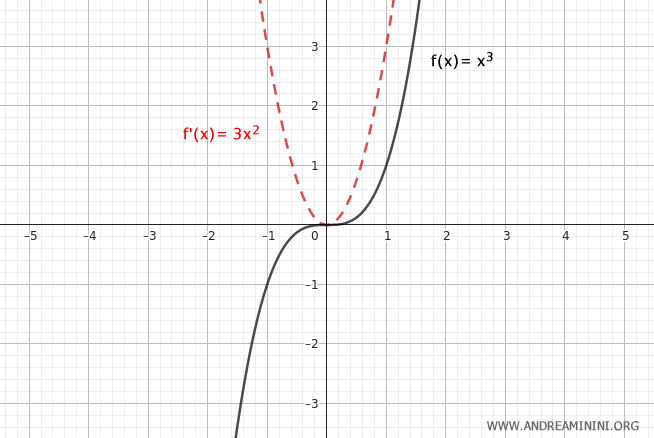
In general, a point of inflection with a horizontal tangent occurs when the derivative is zero but does not change sign around the point.
So, even though the tangent line is horizontal, the function continues increasing or decreasing after the stationary point.
And so on.


