Arc of a Circle
An arc of a circle, often shortened to simply arc, is a portion of a circle's circumference between two points, A and B.
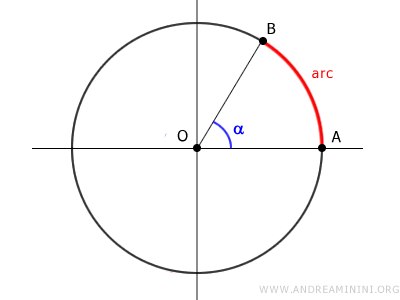
The points A and B are known as the endpoints of the arc.
Whenever you pick two distinct points on a circle, the circumference is split into two arcs. An arc therefore represents the curved distance between those points, measured along the circumference.
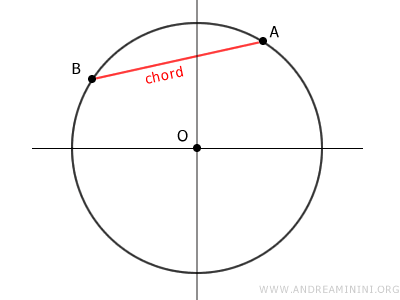
An arc should not be confused with a chord. While an arc follows the curve of the circle, a chord is the straight line segment connecting the same two endpoints.
Note: Two points on a circle determine two possible arcs. To specify exactly which arc is being considered, a third point, C, is often included in the notation. When only the endpoints A and B are given, the intended arc is usually determined by the chosen orientation, commonly counterclockwise from A to B.
How to Calculate Arc Length
The arc length is the distance measured along the circumference between the endpoints of the arc. If the central angle \(\alpha\) is expressed in radians, the arc length \(L\) is given by: $$ L = r \cdot \alpha $$ where \(r\) is the radius of the circle.
This formula shows that the arc length depends on two factors:
- the radius of the circle;
- the size of the central angle.
If the central angle is given in degrees, convert it to radians first:
$$ \alpha_{rad} = \frac{\pi \cdot \alpha_{degrees}}{180} $$
Substituting this expression into the arc-length formula gives:
$$ L = r \cdot \frac{\pi \cdot \alpha_{degrees}}{180} $$
A complete arc corresponds to the entire circumference of the circle. Since a full revolution measures \(2\pi\) radians, the arc length is equal to the circumference:
$$ L = 2 \pi r $$
Why does the formula work?
The formula comes from a simple proportional relationship. The larger the central angle, the larger the portion of the circumference covered by the arc. $$ 2\pi : \alpha = 2\pi r : L $$ A full angle of \(2\pi\) radians corresponds to the entire circumference \(2\pi r\). Solving this proportion leads directly to: $$ L = r \cdot \alpha $$ This is why arc length is directly proportional to the central angle when the angle is measured in radians.
Example
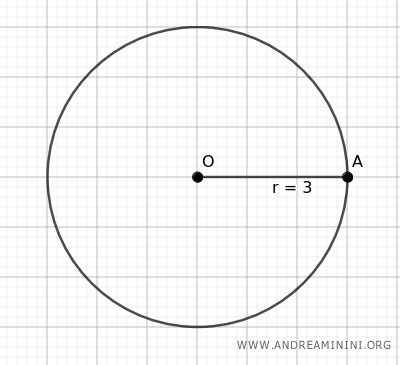
Consider a circle with radius \(r = 3\).
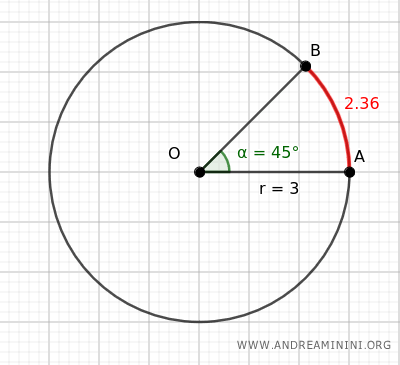
Suppose a central angle of 45° intercepts the arc between points A and B.
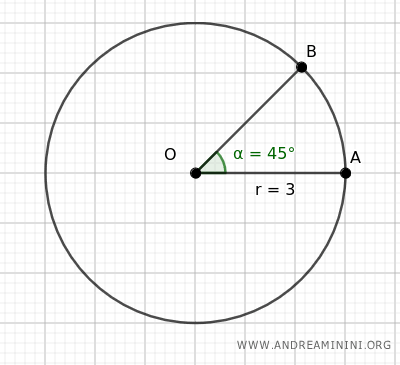
First, convert the angle to radians:
$$ \alpha = \frac{\pi \cdot 45^\circ}{180} = \frac{\pi}{4} $$
Now apply the arc-length formula:
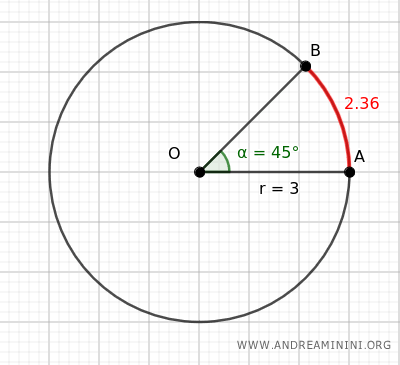
$$ L = r \cdot \alpha = 3 \cdot \frac{\pi}{4} \approx 2.36 $$
The length of the arc is therefore approximately 2.36 units.
Properties of Circular Arcs
Arcs are closely related to several other concepts in circle geometry.
For example, equal arcs subtend equal central angles and correspond to equal chords. In the same circle, or in congruent circles, equal arcs also determine equal inscribed angles.
- Direct Proportionality
Arc length is directly proportional to both the radius and the central angle. If either quantity doubles while the other remains unchanged, the arc length doubles as well.Example: For a circle with radius \(r = 3\) and a central angle of 45° (\(\pi/4\) radians): $$ L = \frac{\pi}{4} \cdot 3 \approx 2.356 $$
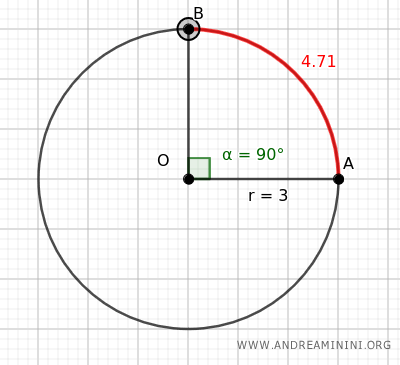
If the central angle is increased to 90° (\(\pi/2\) radians), the arc length doubles: $$ L = \frac{\pi}{2} \cdot 3 \approx 4.71 $$
- Chord
The straight line segment joining the endpoints of an arc is called a chord. Every arc has an associated chord.
- Circular Sector
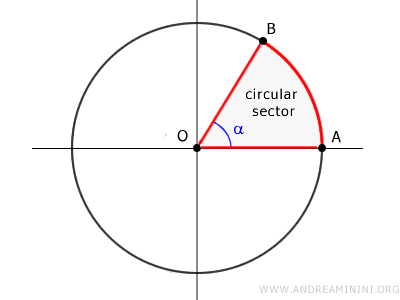
The region enclosed by an arc and the two radii connecting its endpoints to the center of the circle is called a circular sector.
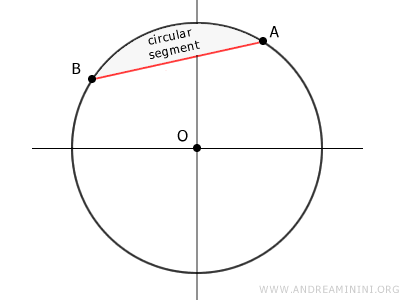
- Circular Segment
The region enclosed by an arc and its corresponding chord is called a circular segment.
Understanding arcs is essential for studying circle geometry because they connect many important concepts, including central angles, chords, sectors, segments, and inscribed angles.