
Derivative of the Identity Function
The derivative of the identity function \( f(x)=x \) is constant and equal to \( 1 \) at every point in its domain. \[ D \ x = 1 \]
This is one of the simplest and most important results in differential calculus.
The identity function \( f(x)=x \) increases uniformly. Every time the variable \( x \) increases by a certain amount, the value of the function increases by exactly the same amount. Because of this constant rate of change, its derivative is always equal to \( 1 \).
Computing the derivative
To calculate the derivative, I use the definition of the difference quotient:
\[ f'(x)=\lim_{h \to 0} \frac{f(x+h)-f(x)}{h} \]
Since \( f(x)=x \), it follows that
\[ f(x+h)=x+h \]
Substituting these expressions into the definition of the derivative gives:
\[ f'(x)=\lim_{h \to 0} \frac{(x+h)-x}{h} \]
\[ f'(x)=\lim_{h \to 0} \frac{x+h-x}{h} \]
Simplifying the numerator:
\[ f'(x)=\lim_{h \to 0} \frac{h}{h} \]
Since \( \frac{h}{h}=1 \) for every \( h \neq 0 \), we obtain:
\[ f'(x)=\lim_{h \to 0} 1 \]
The limit of a constant is the constant itself:
\[ f'(x)=1 \]
Therefore, the derivative of the identity function is always equal to \( 1 \).
Geometric interpretation
The graph of the function \( y=x \) is a straight line passing through the origin.
More precisely, it is the bisector of the first and third quadrants because it forms an angle of \( 45^\circ \) with the \( x \)-axis.
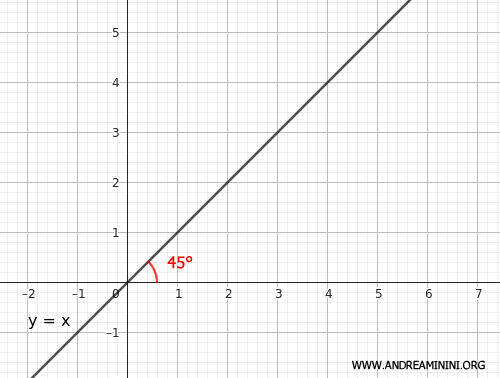
The slope of the line is
\[ m=\tan 45^\circ =1 \]
Since the graph is already a straight line, the tangent line at any point coincides with the graph itself.
For this reason, the derivative is always equal to \( 1 \).
A practical example
Consider the function
\[ f(x)=x \]
The graph has a constant slope everywhere. This means that no matter which two distinct points you choose, the slope between them is always the same.
For example, take the points \( (1,1) \) and \( (3,3) \).
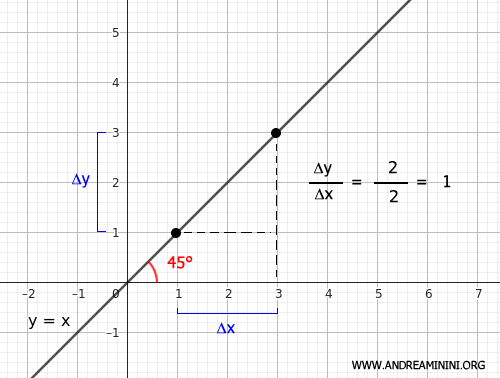
Now compute the slope:
\[ m=\frac{3-1}{3-1}=\frac{2}{2}=1 \]
Next, take the points \( (4,4) \) and \( (5,5) \), and calculate the slope again:
\[ m=\frac{5-4}{5-4}=\frac{1}{1}=1 \]
The result is always the same.
This confirms that the function grows at a constant rate and that its derivative is identically equal to \( 1 \).
The same reasoning applies to any pair of points on the graph.


