
Points of Non-Differentiability
A function is not differentiable at a point if its derivative does not exist or tends to infinity.
A function is differentiable at a point only when the derivative exists and remains finite.
Whenever the limit of the difference quotient fails to exist or diverges to infinity, the function is not differentiable at that point.
From a geometric perspective, points of non-differentiability appear as particular “irregularities” in the graph, such as vertical tangent inflection points, cusps, and corner points.
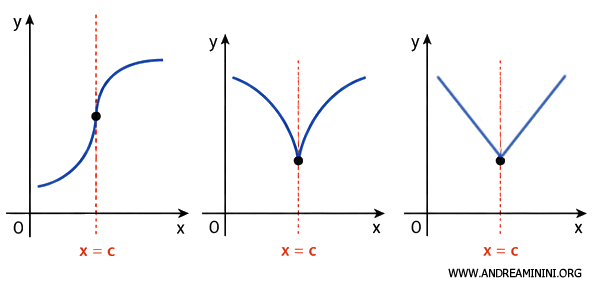
Geometric interpretation. The derivative represents the slope of the tangent line to the graph of the function. When the slope approaches a finite value, the function is differentiable. On the other hand, if the slope tends to \(+\infty \) or \(-\infty \), the tangent line becomes vertical, parallel to the y-axis, and its slope can no longer be defined. At that point the function is not differentiable. The derivative may also fail to exist when the function behaves differently from the left and from the right.
Vertical Tangent Inflection Points
A vertical tangent inflection point is a point where the function is continuous and the tangent line is vertical. In this case the left-hand and right-hand derivatives coincide, but both tend to \( +\infty \) \[ f'_-(c)=f'_+(c)=+\infty \] or both tend to \( -\infty \) \[ f'_-(c)=f'_+(c)=-\infty \]
In both situations the tangent line is vertical and parallel to the \( y \)-axis, so its equation is:
\[ x=c \]
Near this point the function changes concavity, which is why it is classified as an inflection point.
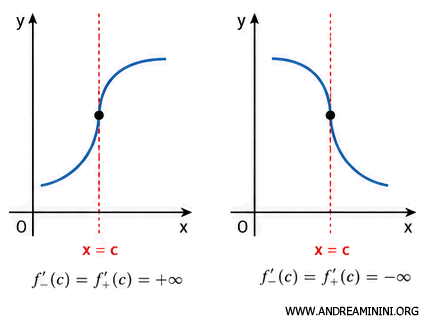
Geometrically, the tangent line exists. However, the derivative does not exist as a finite real number.
A practical example
Consider the function
\[ y=\sqrt[3]{x} \]
It can also be rewritten in power form:
\[ y=x^{\frac{1}{3}} \]
To compute the derivative, apply the power rule:
\[ \frac{d}{dx}(x^n)=n x^{n-1} \]
In this case the exponent is \( n=\frac{1}{3} \), so the derivative becomes:
\[ y'=\frac{1}{3}x^{\frac{1}{3}-1}=\frac{1}{3}x^{-\frac{2}{3}} \]
The derivative can also be written in equivalent form:
\[ y'=\frac{1}{3x^{2/3}} \]
At the point \( x=0 \), the function is continuous, but the derivative tends to infinity from both sides.
\[ x \to 0^+ \Rightarrow y' = + \infty \]
\[ x \to 0^- \Rightarrow y' = + \infty \]
This means that \( x=0 \) is a vertical tangent inflection point of the function.
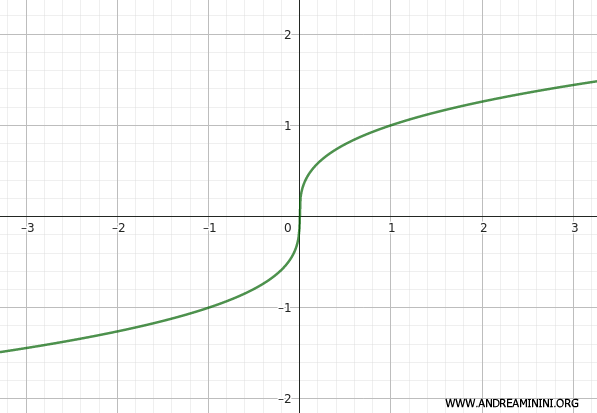
Since the derivative remains positive, the function is increasing at \( x=0 \).
Cusps
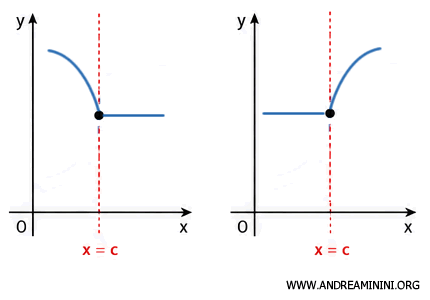
A cusp is a point where the function is continuous and the tangent line is vertical, while the left-hand and right-hand derivatives are both infinite but different. \[ f'_-(c)\neq f'_+(c) \]
More precisely, a cusp occurs when the left-hand derivative tends to
\[ f'_-(c)= -\infty \]
while the right-hand derivative tends to
\[ f'_+(c)= +\infty \]
or vice versa.
At this point the graph forms a sharp tip.
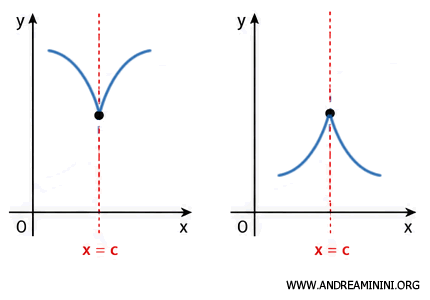
The vertical tangent exists geometrically, but the function changes direction abruptly. For this reason the one-sided derivatives do not coincide.
Note. In most cases both derivatives are infinite and have opposite signs. However, it is also possible for only one one-sided derivative to be infinite while the other remains finite. For example:
\[ f'_-(c)= +\infty \]
\[ f'_+(c)=0 \]
Even in this situation the point is not differentiable and the tangent line is not unique.
A practical example
Consider the function
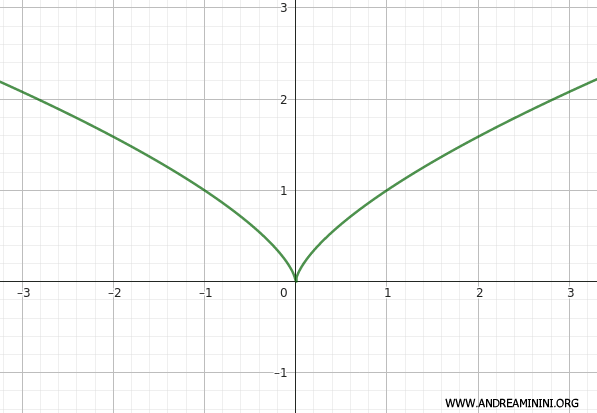
\[ y=\sqrt[3]{x^2} \]
To analyze it, it is useful to rewrite it in power form using the property of radicals:
\[ \sqrt[n]{a^m}=a^{\frac{m}{n}} \]
Therefore:
\[ y=x^{\frac{2}{3}} \]
This form is more convenient for computing the derivative.
Apply the power rule:
\[ \frac{d}{dx}(x^n)=n x^{n-1} \]
\[ y'=\frac{2}{3}x^{\frac{2}{3}-1}=\frac{2}{3}x^{-\frac{1}{3}} \]
Therefore, the derivative of the function is:
\[ f'(x)=\frac{2}{3\sqrt[3]{x}} \]
As \( x \to 0^+ \), the right-hand derivative tends to infinity:
\[ f'_+(x)\to +\infty \]
As \( x \to 0^- \), the left-hand derivative tends to negative infinity:
\[ f'_-(x)\to -\infty \]
Therefore, the one-sided derivatives are both infinite in absolute value but have opposite signs.
This means that the function is continuous at \( x=0 \), but the point is a cusp.
Corner Points
A corner point is a point where the function is continuous, the one-sided derivatives exist, are finite, but different. \[ f'_-(c)\neq f'_+(c) \]
In this case the tangent line changes slope abruptly, and the graph develops a corner.
As a result, the tangent line is not unique and the function is not differentiable at that point.
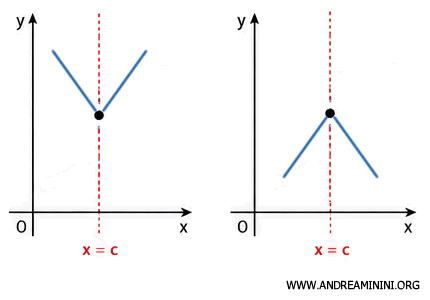
Note. In general both derivatives are finite but different. However, one one-sided derivative may be finite while the other is infinite. For example:
\[ f'_-(c)=0 \]
\[ f'_+(c)=+\infty \]
Even in this case the point is not differentiable and the tangent line is not unique.
A practical example
Consider the absolute value function:
\[ y=|x| \]
To compute the derivative, it is convenient to rewrite the absolute value as a piecewise-defined function:
\[ y= \begin{cases} x & \text{if } x \ge 0 \\ -x & \text{if } x <0 \end{cases} \]
Now differentiate the two branches separately.
For \( x>0 \), the function is \( y=x \), therefore:
\[ y'=1 \]
For \( x<0 \), the function is \( y=-x \), therefore:
\[ y'=-1 \]
Now check whether the function is differentiable at the origin.
The left-hand derivative at \( x=0 \) is:
\[ f'_-(0)=-1 \]
The right-hand derivative is:
\[ f'_+(0)=1 \]
Therefore, the left-hand and right-hand derivatives both exist and are finite, but they are different.
\[ f'_-(0)\neq f'_+(0) \]
This means that the function is not differentiable at the origin, and the point \( (0,0) \) is a corner point.
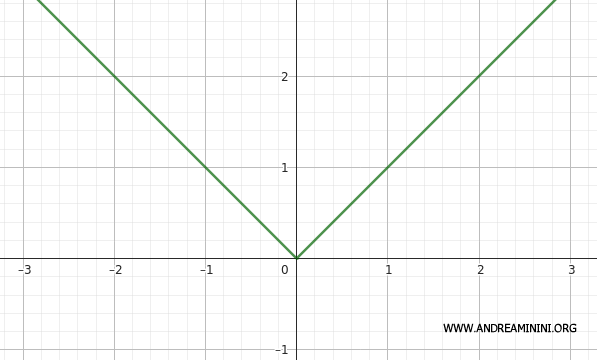
Even in this case the function is continuous at the point but not differentiable.
Remarks
Some additional observations about points where a function is not differentiable:
- Non-differentiability does not necessarily imply discontinuity.
Many functions are continuous but not differentiable at specific points. For example, at a corner point the function remains continuous even though the derivative does not exist. From a geometric standpoint, differentiability requires the graph to be smooth, without corners, sharp points, or vertical tangents.
And so on.


