Acute Triangle
An acute triangle is a triangle in which all three interior angles are less than 90°. In other words, every angle in the triangle is acute.
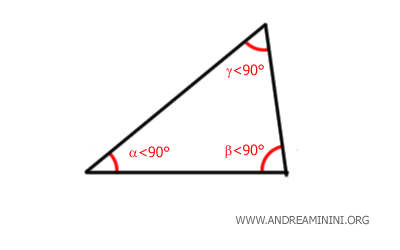
Like all triangles, an acute triangle has interior angles that add up to 180°. What makes it unique is that none of its angles reaches or exceeds 90°.
Acute triangles are among the most common types of triangles studied in geometry. Depending on the lengths of their sides, they can take several different forms.
An acute triangle may be scalene, with all sides of different lengths, isosceles, with two equal sides, or equilateral, with all three sides equal.
Properties of an Acute Triangle
Acute triangles have several interesting geometric properties that distinguish them from right and obtuse triangles.
- Circumcenter
The circumcenter, which is the point where the perpendicular bisectors of the sides meet, is always located inside an acute triangle. - Orthocenter
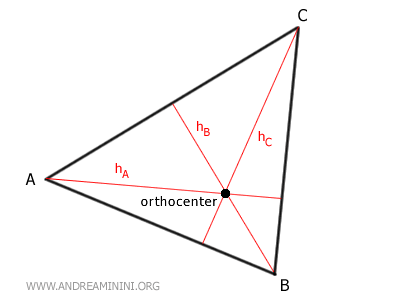
The orthocenter, formed by the intersection of the three altitudes, also lies inside the triangle.
- Centroid
The centroid, the point where the three medians intersect, is always found within the triangle. - Equilateral Triangle
An equilateral triangle is a special case of an acute triangle. Since all three of its angles measure 60°, every equilateral triangle is acute.
One useful way to recognize an acute triangle is to check its largest angle. If the largest angle is still less than 90°, then the triangle is acute.
Another notable feature is that the main geometric centers, including the circumcenter, orthocenter, and centroid, all lie inside the triangle. This is a characteristic unique to acute triangles and makes them particularly important in many geometric constructions.