
Relationship Between the Side and Height of an Equilateral Triangle
You can find the length of a side of an equilateral triangle if you know its height, using this formula: $$ l = \frac{2h}{ \sqrt{3} } $$
Sometimes, the same relationship is written in this equivalent form:
$$ l = \frac{2 \cdot \sqrt{3} }{3} h $$
Both versions yield exactly the same result.
The inverse formula lets you calculate the height (h) of an equilateral triangle when you know the side length (l): $$ h = \frac{ \sqrt{3} }{2} l $$
A Practical Example
Let’s look at an example involving an equilateral triangle whose side length is 3 and whose height is h = 2.5981.
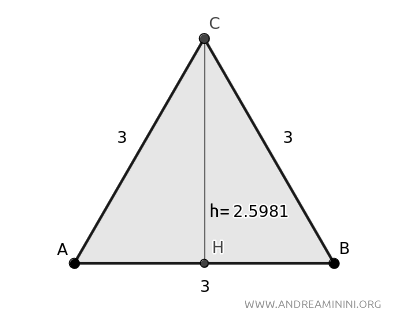
We’ll use the formula to check that the relationship between the side and height holds true.
$$ l = \frac{2h}{ \sqrt{3} } $$
Substituting h = 2.5981, we perform the calculation to find the side length:
$$ l = \frac{2 \cdot 2.5981}{ \sqrt{3} } $$
$$ l = \frac{5.1962}{ \sqrt{3} } $$
$$ l = 3 $$
This confirms that the side length of the equilateral triangle is 3 units.
The Proof
Let’s consider an equilateral triangle.
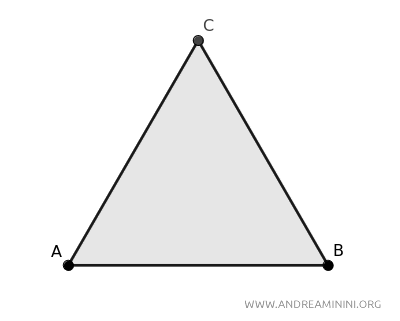
By definition, all three sides have the same length l:
$$ l = \overline{AB} = \overline{BC} = \overline{AC} $$
Now, let’s draw the height (h) from the top vertex to the base AB.
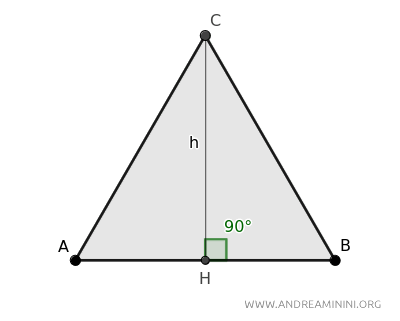
In an equilateral triangle, the height meets the base AB at a right angle, cutting it exactly in half at point H, the midpoint of AB.
This height splits the equilateral triangle into two congruent right triangles.
At this point, we can apply the Pythagorean Theorem to calculate the length of leg HC in right triangle AHC:
$$ \overline{HC} = \sqrt{\overline{AC}^2 - \overline{AH}^2} $$
We’ll consider segment HC as the height h, and segment AC as the side l of triangle ABC:
$$ h = \sqrt{l^2 - \overline{AH}^2} $$
Since segment AH is half the length of side AB (which equals l), we can express AH as l/2:
$$ h = \sqrt{l^2 - \left( \frac{l}{2} \right)^2} $$
Let’s simplify the expression step by step:
$$ h = \sqrt{l^2 - \frac{l^2}{4} } $$
$$ h = \sqrt{\frac{4l^2 - l^2}{4} } $$
$$ h = \sqrt{\frac{3l^2}{4} } $$
$$ h = \frac{l}{2} \sqrt{3} $$
We’ve now derived the formula that lets us calculate the height when we know the side length of an equilateral triangle.
To solve for the side length l instead, we multiply both sides of the equation by 2/√3:
$$ h \cdot \frac{2}{\sqrt{3}} = \frac{l}{2} \sqrt{3} \cdot \frac{2}{\sqrt{3}} $$
$$ \frac{2}{\sqrt{3}} h = l $$
This gives us the inverse formula for finding the side length when the height is known:
$$ l = \frac{2}{\sqrt{3}} h $$
Note: Sometimes, this last formula is written in another form, with the radical in the numerator. To achieve this, we multiply and divide the right-hand side of the equation by √3: $$ l = \frac{2}{\sqrt{3}} \cdot \frac{\sqrt{3}}{\sqrt{3}} \cdot h $$ $$ l = \frac{2 \cdot \sqrt{3} }{\sqrt{3} \cdot \sqrt{3}} h $$ $$ l = \frac{2 \cdot \sqrt{3} }{3} h $$
And so on.


