Limit of the Sequence kn as n→∞
The limit of the sequence kn as n→∞ depends on the value of k $$ \lim_{n \rightarrow ∞} k^n = \begin{cases} +∞ \:\:\: \text{if k>1} \\ 1 \:\:\: \text{if k=1} \\ 0 \:\:\: \text{if -1<k<1} \\ \text{does not exist} \:\:\: \text{if k \le -1} \end{cases} $$
Case k>1
$$ \lim_{n \rightarrow ∞} k^n $$
If k>1, we apply Bernoulli's inequality.
$$ k^n \ge 1+n(k-1) $$
Since k>1, the right-hand side diverges to +∞ as n tends to infinity.
$$ \lim_{n \rightarrow ∞} k^n \ge \lim_{n \rightarrow ∞} 1+n(k-1) $$
$$ \lim_{n \rightarrow ∞} k^n = +∞ $$
Hence, the sequence kn diverges to +∞ as n→∞.
Note. For example, if k=1.1
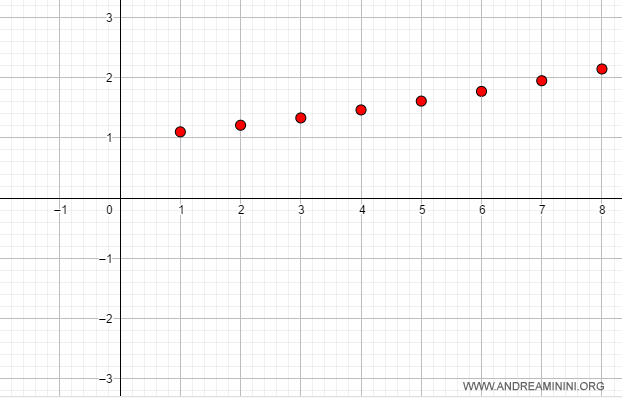
This behavior is consistent with the corresponding exponential function f(x)=kx.
Case k=1
$$ \lim_{n \rightarrow ∞} k^n $$
$$ \lim_{n \rightarrow ∞} 1^n $$
For every n, we have 1n=1.
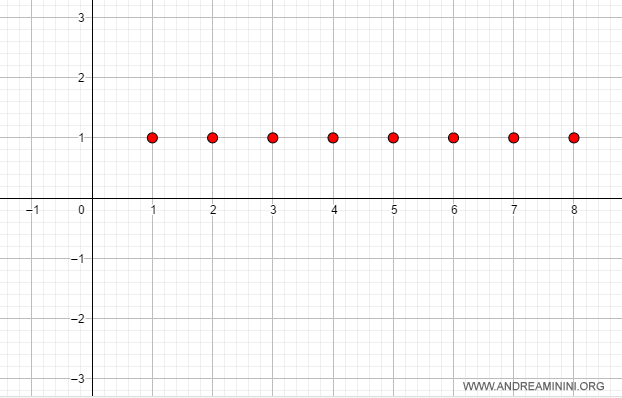
Therefore, the sequence is constant and converges to 1.
$$ \lim_{n \rightarrow ∞} 1^n = 1 $$
Example. The sequence converges to 1 as n tends to infinity.
Case -1<k<1 with k≠0
$$ \lim_{n \rightarrow ∞} k^n $$
We rewrite the expression in an equivalent form
$$ \lim_{n \rightarrow ∞} \left( \frac{1}{ \frac{1}{k} } \right)^n $$
$$ \lim_{n \rightarrow ∞} \frac{1}{\left( \frac{1}{k} \right)^n} $$
The inequality
$$ -1 < k < 1 $$
is equivalent to
$$ |k| < 1 $$
Dividing both sides by |k|, with k≠0, yields
$$ \frac{|k|}{|k|} < \frac{1}{|k|} $$
$$ 1 < \frac{1}{|k|} $$
that is,
$$ \frac{1}{|k|} > 1 $$
Hence, the base in the denominator exceeds 1, and therefore
$$ \left( \frac{1}{|k|} \right)^n \rightarrow +∞ \quad \text{as } n \rightarrow ∞ $$
It follows that
$$ \lim_{n \rightarrow ∞} \frac{1}{\left( \frac{1}{k} \right)^n} = 0 $$
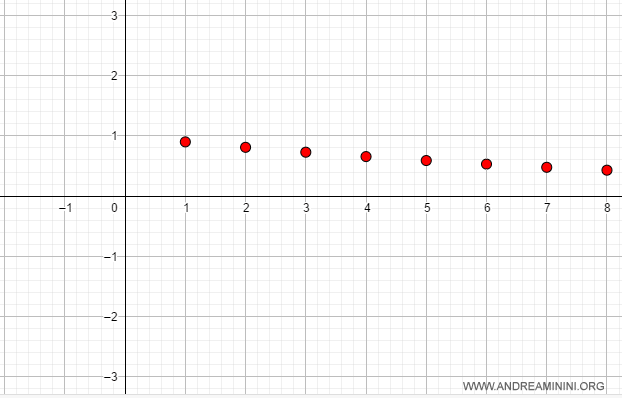
Thus, the sequence converges to 0 as n→∞.
Example. If k=0.9, the sequence converges to 0.
Case k=0
$$ \lim_{n \rightarrow ∞} k^n $$
$$ \lim_{n \rightarrow ∞} 0^n $$
For every n≥1, we have 0n=0.
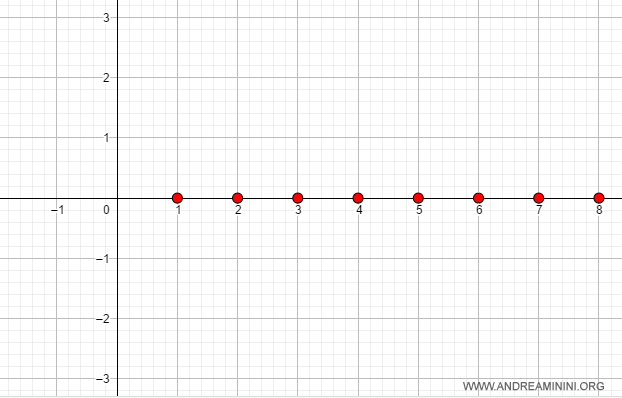
Therefore, the sequence is constant and converges to 0.
$$ \lim_{n \rightarrow ∞} 0^n = 0 $$
In this case, the sequence is infinitesimal.
Example. If k=0, the sequence converges to 0.
Case k<-1
$$ \lim_{n \rightarrow ∞} k^n $$
If k<-1, the sequence diverges.
Its terms alternate in sign, while their absolute values diverge to +∞.
More precisely,
$$ \lim_{n \rightarrow ∞} k^n = \begin{cases} +∞ \:\: \text{if n is even} \\ -∞ \:\: \text{if n is odd} \end{cases} $$
Therefore, the limit does not exist as n tends to infinity.
$$ \lim_{n \rightarrow ∞} k^n = \text{does not exist} $$
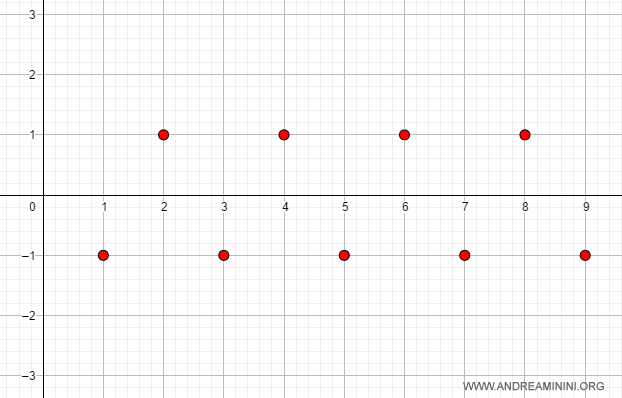
Example. If k=-1, the sequence oscillates between 1 and -1, so the limit does not exist as n→∞.
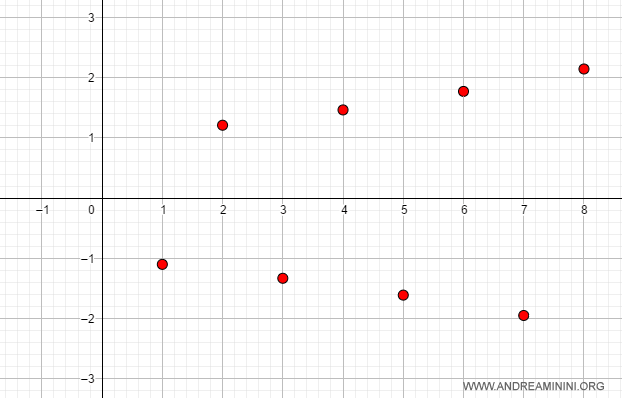
If k=-1.1, the sequence diverges to +∞ when n is even and to -∞ when n is odd.
And so on.