
Relationship Between the Side Length and the Radius of the Inscribed Circle in an Equilateral Triangle
The relationship between the side length of an equilateral triangle and the radius of its inscribed circle is given by the following formula: $$ l = 2r \sqrt{3} $$

A Practical Example
Let’s consider an equilateral triangle with sides measuring 3 units and an inscribed circle with a radius of r = 0.866.
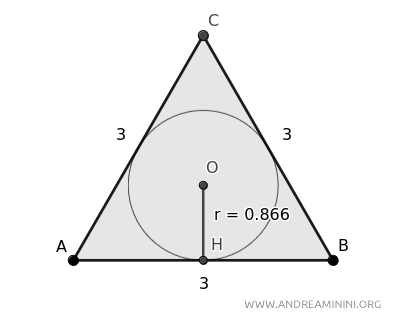
The formula relating the radius of the inscribed circle to the side length of the equilateral triangle is:
$$ l = 2r \sqrt{3} $$
Substituting the value r = 0.866, we have:
$$ l = 2 \times 0.866 \times \sqrt{3} $$
$$ l = 1.7321 \times \sqrt{3} $$
$$ l = 3 $$
This confirms that the side length of the equilateral triangle is indeed 3 units.
The Proof
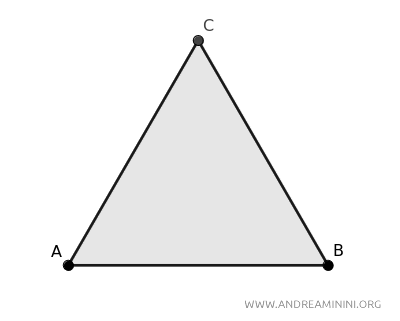
Consider an equilateral triangle ABC.
Draw the altitude h = CH from vertex C perpendicular to the base AB.
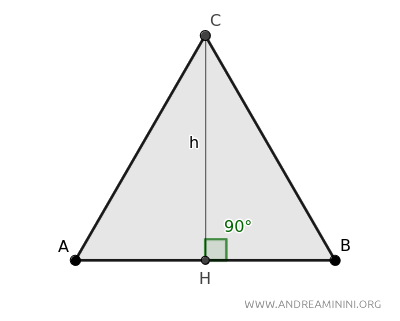
In an equilateral triangle, the altitude intersects the base AB at its midpoint H, dividing it into two equal segments, AH = BH.
Moreover, this altitude also serves as the median and the angle bisector from vertex C.
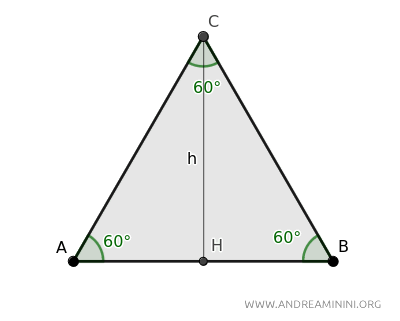
Next, we draw the other two medians from vertices A and B.
All three medians intersect at the centroid O of the triangle.
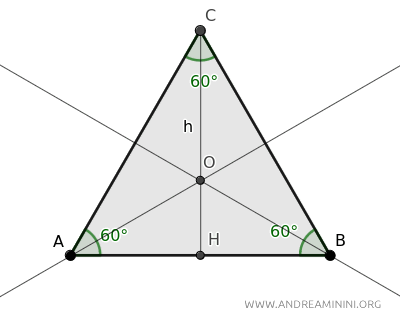
We now construct the inscribed circle (incircle) of the equilateral triangle, which is tangent to all three sides.
The segment OH represents the radius of the incircle.
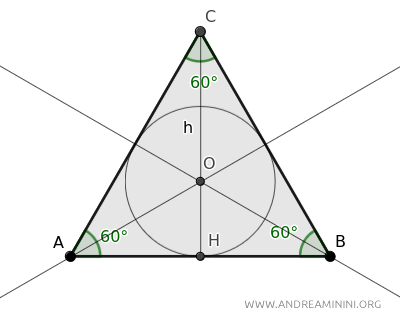
It is known that in any triangle, the centroid divides each median in a 2:1 ratio, meaning it splits the median into segments measuring one-third and two-thirds of its length. Therefore, the radius r = OH is equal to one-third of the altitude CH.
$$ \overline{OH} = \frac{1}{3} \times \overline{CH} $$
Thus, the altitude CH is three times the length of OH:
$$ \overline{CH} = 3 \times \overline{OH} $$
Here, OH = r is the radius of the inscribed circle, and CH = h is the altitude of the equilateral triangle.
$$ h = 3 \times r $$
We also know the relationship between the side length and the altitude of an equilateral triangle:
$$ h = \frac{l}{2} \sqrt{3} $$
Substituting h = 3r yields:
$$ 3r = \frac{l}{2} \sqrt{3} $$
From this equation, we can solve for r in terms of the side length l:
$$ r = \frac{l}{2 \times 3} \sqrt{3} $$
$$ r = \frac{l}{6} \sqrt{3} $$
We can simplify this expression by multiplying and dividing the right-hand side by √3:
$$ r = \frac{l}{6} \sqrt{3} \times \frac{\sqrt{3}}{\sqrt{3}} $$
$$ r = \frac{l}{6 \sqrt{3}} \times \left(\sqrt{3} \times \sqrt{3}\right) $$
$$ r = \frac{l}{6 \sqrt{3}} \times 3 $$
$$ r = \frac{l}{2 \sqrt{3}} $$
Finally, solving for the side length l in terms of the radius r of the inscribed circle, we obtain:
$$ l = 2r \sqrt{3} $$
This completes the proof of the relationship between the radius of the inscribed circle and the side length of an equilateral triangle.
And so on.


