
Limit of sin x over x
This fundamental trigonometric limit states that, as x approaches zero, the ratio between $ \sin x $ and $ x $ approaches the value 1. $$ \lim_{x \to 0} \frac{ \sin x }{x} = 1 $$
Proof
At first glance this limit has the indeterminate form $ \frac{0}{0} $, because as $ x \to 0 $ both the numerator $ \sin x \to 0 $ and the denominator $ x \to 0 $ approach zero.
$$ \lim_{x \to 0} \frac{ \sin x }{x} = \frac{0}{0} $$
Our goal, however, is to prove that the limit actually equals 1.
$$ \lim_{x \to 0} \frac{ \sin x }{x} = 1 $$
To establish this result, we must consider both the right hand and the left hand limits as $ x \to 0 $, namely the approaches $ x \to 0^+ $ and $ x \to 0^- $.
$$ \lim_{x \to 0^+} \frac{ \sin x }{x} = \lim_{x \to 0^-} \frac{ \sin x }{x} = 1 $$
In this case the function $ \frac{\sin x}{x} $ is an even function because
$$ \frac{\sin x}{x} = \frac{\sin(-x)}{-x} = \frac{- \sin x}{-x} $$
Therefore the graph is symmetric with respect to the y axis in a neighborhood of $ x = 0 $.
$$ \lim_{x \to 0^+} \frac{\sin x}{x} = \lim_{x \to 0^-} \frac{\sin x}{x} $$
This means that it is sufficient to prove only one of the two cases in order to establish the limit. For example, consider the case $ x \to 0^+ $.
$$ \lim_{x \to 0^+} \frac{\sin x}{x} $$
Here $ x $ denotes the angle measured in radians.
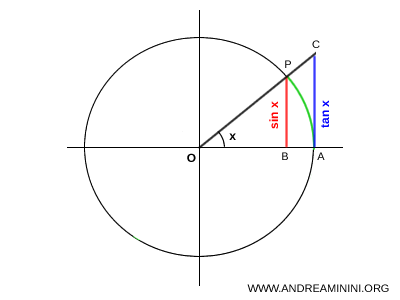
From the geometric diagram we observe that the angle in radians $ x $ corresponds to the arc of the circle $ \widehat{ AP } $, whose length lies between the segments $ \overline{ BP } = \sin x $ and $ \overline{ AC } = \tan x $.
$$ \overline{BP} < \widehat{ AP } < \overline{AC} $$
that is
$$ \sin x < x < \tan x $$
Now divide each term of the inequality by $ \sin(x) $.
$$ \frac{ \sin x }{ \sin x } < \frac{ x }{ \sin x } < \frac{ \tan x }{ \sin x } $$
$$ 1 < \frac{ x }{ \sin x } < \frac{ \tan x }{ \sin x } $$
Next, take the reciprocals of the inequality.
$$ \frac{ \sin x }{ \tan x } < \frac{ \sin x }{ x } < 1 $$
From the second fundamental trigonometric identity we know that $ \tan x = \frac{ \sin x }{ \cos x } $. Therefore we substitute $ \frac{\sin x }{ \tan x} = \cos x $.
$$ \cos x < \frac{ \sin x }{ x } < 1 $$
We now apply the squeeze theorem, computing the limit as $ x \to 0^+ $ for each term of the inequality.
$$ \lim_{x \to 0^+} \cos x < \lim_{x \to 0^+} \frac{ \sin x }{ x } < \lim_{x \to 0^+} 1 $$
The limits at both extremes are equal to 1.
$$ \underbrace{ \lim_{x \to 0^+} \cos x }_{1} < \lim_{x \to 0^+} \frac{ \sin x }{ x } < \underbrace{ \lim_{x \to 0^+} 1 }_{1} $$
$$ 1 < \lim_{x \to 0^+} \frac{ \sin x }{ x } < 1 $$
Consequently, the limit in the middle must also be equal to 1.
$$ \lim_{x \to 0^+} \frac{ \sin x }{ x } = 1 $$
as required.
And so on.


