


Mathematics, Physics and Science
Topology
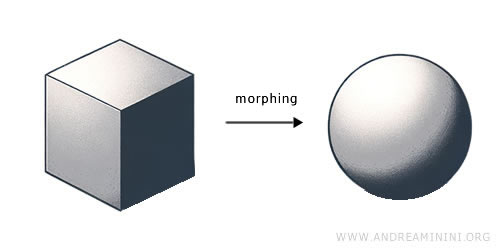 Topology is a branch of mathematics focused on the properties of space that are preserved under continuous deformations such as stretching and bending, but not tearing or gluing. It deals with concepts like continuity, compactness, and connectedness, and is often described using the notion of open sets. A topological space is a set equipped with a topology, a collection of open sets that satisfies certain axioms, allowing for the definition of continuous functions. Topology was developed in the early 20th century, with significant contributions from mathematicians such as Henri Poincaré and Felix Hausdorff. This field provides a foundational framework for many areas of mathematics and science, including analysis, geometry, and quantum physics.
Set Theory
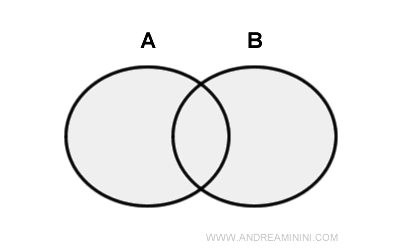
Set theory is a fundamental branch of mathematics focused on the study of sets, which are collections of well-defined and distinct objects. The objects that comprise a set are known as elements or members. A set is viewed as a single entity that encompasses its elements. Sets are typically denoted by uppercase letters (A, B, C, ...), while their elements are listed within curly braces. For instance, the set A containing the numbers 1, 2, and 3 is written as: A={1,2,3}.
Matrix
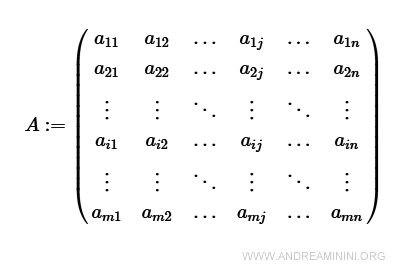 A matrix is an organized set of numbers arranged in rows and columns, represented as a rectangular array where each number is referred to as an element of the matrix. Typically, a matrix is denoted by an uppercase letter, such as \( A \), and its elements are indicated by a lowercase letter with two indices, such as \( a_{ij} \), where \( i \) represents the row and \( j \) the column. Matrices were introduced in the 17th century by the English mathematician James Joseph Sylvester. However, it was Arthur Cayley in the 19th century who advanced the modern theory of matrices.
Vectors
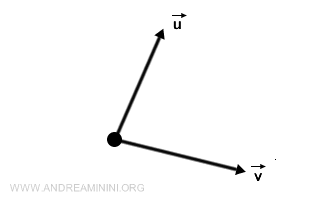 A vector is a mathematical quantity that possesses both magnitude and direction, represented by an arrow in geometric space. In notation, a vector is often indicated by a lowercase bold letter, such as $ \vec{v} $, or with an arrow above the letter, like \(\vec{v}\). Vectors can be described through their components, which represent the projections along the axes of a coordinate system. For example, a two-dimensional vector $ \vec{v} $ can be represented as \((v_x, v_y)\), where \(v_x\) and \(v_y\) are the components along the x and y axes, respectively. The theory of vectors has ancient roots, but it was the French mathematician Augustin-Louis Cauchy in the 19th century who formally developed the concept and its use in physical sciences and engineering.
Vector Space
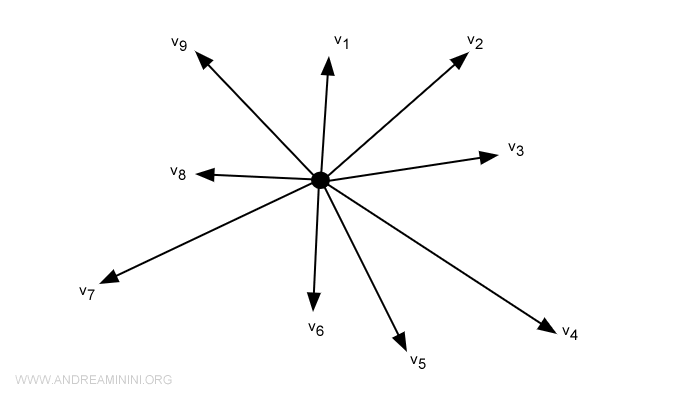 A vector space is a mathematical structure formed by a collection of vectors, which may be added together and multiplied by scalars. These operations satisfy certain axioms, such as associativity, commutativity, and distributivity. A vector space is typically denoted by a capital letter, like \(V\), and its elements, the vectors, are represented by lowercase letters. The concept of vector spaces is fundamental in linear algebra and provides a framework for analyzing linear equations, transformations, and mappings. The modern theory of vector spaces was formalized in the 19th century by mathematicians such as Hermann Grassmann and Giuseppe Peano. This theory underpins much of modern mathematics and physics, offering a robust structure for various applications.
Abstract Algebra
Abstract algebra is a branch of mathematics that studies algebraic structures such as groups, rings, fields, and modules. These structures are defined by sets equipped with operations that follow specific axioms, like closure, associativity, and the existence of identity elements. Abstract algebra provides a unifying framework for understanding and generalizing various algebraic systems. This field is denoted by capital letters such as \(A\) or \(B\) and involves elements represented by lowercase letters. The development of abstract algebra began in the 19th century with the work of mathematicians like Évariste Galois and Arthur Cayley, who introduced group theory to solve polynomial equations. Abstract algebra is essential in many areas of mathematics and science, offering powerful tools for solving complex problems and exploring the underlying structures of different mathematical systems.
Geometry
Geometry is a branch of mathematics devoted to the study of the properties and relationships of shapes and figures in space. It investigates points, lines, planes, angles, surfaces, and solids, considering their form, dimensions, and relative position. Depending on the methods and tools applied, several distinct fields can be identified: Euclidean geometry, founded on Euclid’s axioms; analytic geometry, which employs the coordinate system; differential geometry, which uses infinitesimal calculus to explore curves and surfaces; and non-Euclidean geometries, whose development profoundly reshaped both modern mathematics and physics. The origins of geometry can be traced back to the ancient Babylonian, Egyptian, and Greek civilizations. It was, however, Euclid who, in the 3rd century BCE, gave the subject its systematic structure in his influential work "The Elements". Today, geometry remains not only a cornerstone of pure mathematics but also an essential tool across a wide range of applied disciplines, from engineering to physics.


