
Conservation of Quark Flavor
In particle physics, the flavor of a quark (up, down, strange, etc.) is always preserved in strong and electromagnetic interactions, but it can change under the weak interaction. Since weak processes are much less frequent and occur more slowly than strong ones, physicists often speak of an approximate conservation of flavor.
This near-conservation of flavor was what led Murray Gell-Mann and other physicists to introduce the concept of “strangeness” along with the strange quark.
With this new quantum number, it became clear why strange particles are always created in pairs during strong interactions (which conserve strangeness), yet decay one by one through weak interactions (which do not conserve it).
Explanation
Every hadron (both baryons and mesons) is built from a specific combination of quarks.
Each quark is characterized by a quantum number known as its flavor:
- up (u)
- down (d)
- strange (s)
- charm (c)
- bottom (b)
- top (t)
Whether these quantum numbers are conserved at a given interaction vertex depends on the type of fundamental force involved.
Two main cases stand out:
A] Strong or Electromagnetic Interaction
In both strong and electromagnetic processes, quark flavor is conserved. In other words, quarks keep their identity.
For example, in strong collisions strangeness is conserved: strange particles are always produced in pairs.
$$ \pi^- (\bar{u}d) + p (uud) \;\;\rightarrow\;\; K^0 (d\bar{s}) + \Lambda (uds) $$
On the left, there are no strange quarks, so the total strangeness is zero (\(S = 0\)).
On the right, a strange quark and an anti-strange quark appear together, balancing each other out:
\[
\underset{S=0}{\pi^- (\bar{u}d)} +
\underset{S=0}{p (uud)}
\;\;\longrightarrow\;\;
\underset{S=+1}{K^0 (d \color{red}{ \bar{s} })} +
\underset{S=-1}{\Lambda (ud \color{red}{ s })}
\]
The net strangeness is therefore zero both before (left) and after (right), since the strange quark and anti-quark appear as a pair \((+1, -1)\).
This makes the process fully compatible with strong interactions, which always conserve flavor.
B] Weak Interaction
Weak interactions do not conserve flavor. In this case, a quark can transform into a different type by emitting or absorbing a \( W^\pm \) boson.
For instance, in weak decays strangeness changes from \( -1 \) (initial state) to \( 0 \) (final state):
\[
\underset{S=-1}{\Lambda^0 (uds)}
\;\;\longrightarrow\;\;
\underset{S=0}{p (uud)} \;+\;
\underset{S=0}{\pi^- (\bar{u}d)}
\]
Here, the \( \Lambda^0 \) baryon decays via the weak force into a proton (\( p \)) and a \( W^- \) boson, which then converts into a pion (\( \pi^- \)). In this process, strangeness is not conserved.
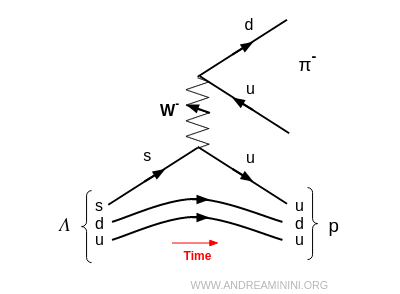
Strangeness violation is a defining feature of weak interactions.
This insight was one of the key pieces of evidence demonstrating that the weak force is fundamentally different from both the strong and the electromagnetic interactions.
And so on.


