
Quantum Vacuum
The quantum vacuum is the lowest-energy state of a physical system described by quantum fields. It is not an “empty” space, but a dynamical state in which fluctuations and measurable physical properties are always present.
In the quantum vacuum, fields are never exactly zero.
Even when the expectation value of a field is zero, quantum fluctuations still occur around that value. These are known as vacuum fluctuations.
From these fluctuations emerge virtual particles and short-lived electromagnetic excitations.
These entities cannot be observed as stable particles. They exist only for extremely brief intervals and are consistent with the energy-time uncertainty relation.
To visualize this, imagine the surface of a lake that looks perfectly calm from a distance. When you get closer, you notice constant, subtle ripples. The vacuum behaves in a similar way: it is never truly "at rest".

Why is the quantum vacuum not truly empty?
The quantum vacuum is not a simple absence of matter. It is a system made of fundamental quantum fields, continuous fluctuations, and an irreducible residual energy.
Each field (electromagnetic, fermionic, and others) has its own zero-point energy and intrinsic fluctuations. This makes the vacuum a complex and constantly evolving physical system.
As a result, the vacuum is active, structured, and physically significant. It is never completely "empty".
This leads to a key shift from classical physics: the vacuum is not the absence of reality, but its most basic physical state.
Note. This perspective raises important open questions, such as the origin of vacuum energy, its relationship with gravity, and its role in cosmology, especially in connection with the cosmological constant. These are central topics in modern theoretical physics.
Within the quantum vacuum, field fluctuations continuously give rise to particle-antiparticle pairs.
These pairs are highly unstable and annihilate almost immediately after forming.
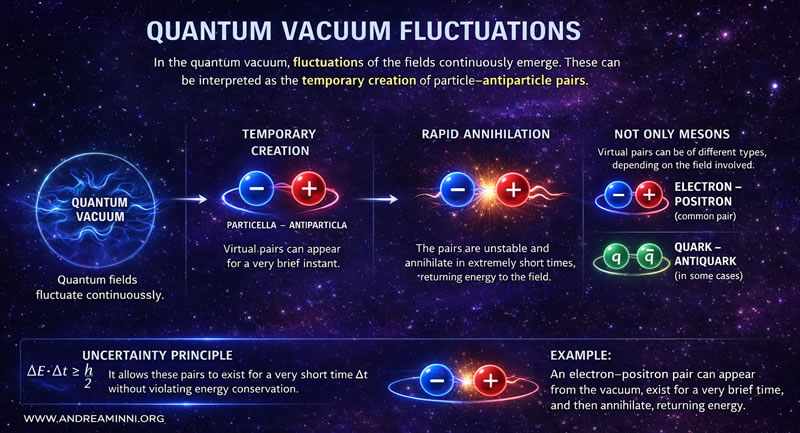
They are not necessarily mesons (quark-antiquark pairs). Depending on the field involved, they can also be simpler systems, such as electron-positron pairs.
For instance, an electron-positron pair can briefly appear, exist for a very short time, and then annihilate, returning its energy to the field. This behavior is consistent with the uncertainty principle.
Zero-point energy
Every quantum field has a nonzero minimum energy, called zero-point energy.
This means that the vacuum retains energy even when no particles are present, and that this energy can produce observable effects.
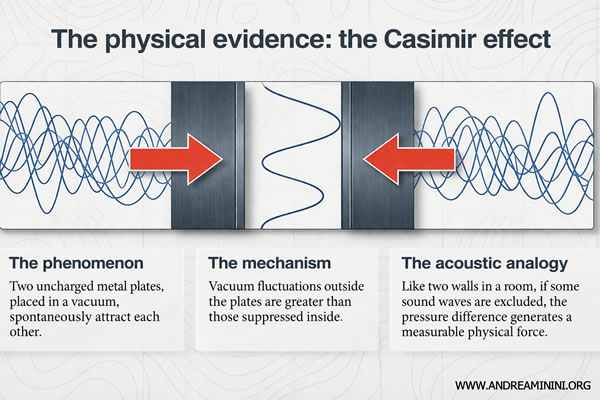
A classic example is the Casimir effect: two metallic plates placed very close together in a vacuum experience an attractive force. This happens because the spectrum of vacuum fluctuations between the plates differs from that outside. Between the plates, only certain electromagnetic modes are allowed, corresponding to specific wavelengths. Outside, a wider range of modes can exist. As a result, the vacuum energy between the plates is lower than outside. This difference creates a pressure that pushes the plates toward each other.
Vacuum expectation value
In some theories, the vacuum state is not symmetric.
In the Standard Model, certain fields acquire a nonzero vacuum expectation value even in the lowest-energy state.
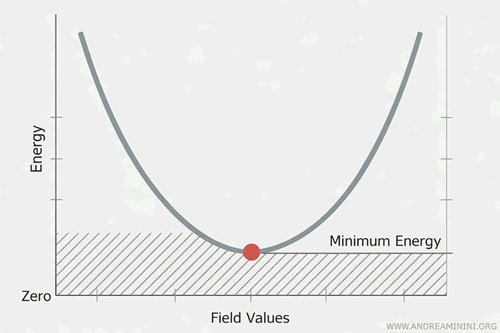
The most important example is the Higgs field, which has a constant nonzero value in the vacuum. Through its interaction with particles, it plays a key role in the origin of their masses.
This phenomenon is known as spontaneous symmetry breaking.
A useful way to picture this is to imagine the Higgs field as a room filled with an invisible medium. A particle moving through it can be slowed down to different degrees, effectively acquiring mass depending on how strongly it interacts with the field.
Nonlinear properties of the vacuum
Under extreme conditions, such as very strong electric fields, the vacuum can become polarized and exhibit nonlinear effects.
In these regimes, virtual particle pairs can modify the physical properties of space itself.
For example, quantum electrodynamics (QED) predicts that in the presence of extremely strong electric fields, the vacuum behaves in a slightly nonlinear way, similar to a material medium with birefringent properties.
This leads to phenomena such as vacuum birefringence and the deflection of light in strong fields.
In this sense, the vacuum can behave like a transparent medium that slightly alters how light propagates.
And so on.


