
Heisenberg's Uncertainty Principle
Heisenberg's uncertainty principle states that certain pairs of physical observables, known as conjugate variables, cannot simultaneously be assigned arbitrarily small uncertainties. The best-known example is a particle's position and momentum.
The uncertainty principle transformed the classical view of measurement and became one of the cornerstones of quantum mechanics.
For example, a particle's position and momentum cannot both be specified with arbitrary precision at the same time. The more precisely one observable is defined, the less precisely the other can be known.
This is not simply a limitation of measuring instruments. It is a fundamental feature of quantum systems. Even with ideal instruments, the uncertainty relation still applies.
Note. In quantum mechanics, certain observables cannot simultaneously possess arbitrarily well-defined values in the same quantum state. Uncertainty is therefore neither a technological limitation nor a weakness in the theory. It is a basic feature of the quantum description of nature. Understanding this principle means coming to grips with one of the deepest ideas in quantum mechanics and in our modern picture of the microscopic world.
The Position-Momentum Uncertainty Relation
The best-known uncertainty relation concerns position and momentum.
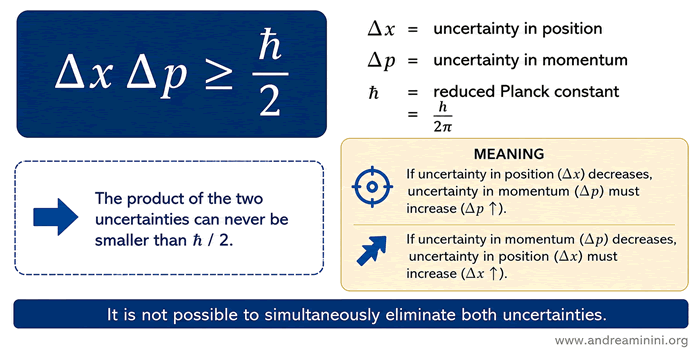
$$ \Delta x \, \Delta p \ge \frac{\hbar}{2} $$
where:
- \(\Delta x\) is the uncertainty in position;
- \(\Delta p\) is the uncertainty in momentum;
- \(\hbar=\dfrac{h}{2\pi}\) is the reduced Planck constant.
The equation tells us that the product of these two uncertainties can never be smaller than \(\hbar/2\).
What Does the Relation Actually Mean?
As the uncertainty in a particle's position decreases, the uncertainty in its momentum must increase.
Conversely, if the particle's momentum is known with very high precision, its position becomes increasingly uncertain.
In other words, the two uncertainties cannot both be reduced to zero at the same time.
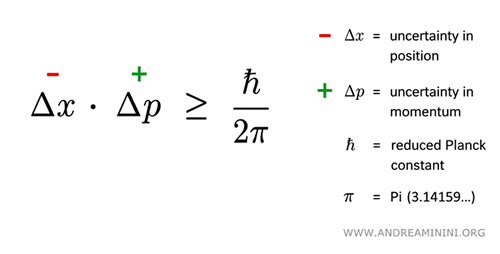
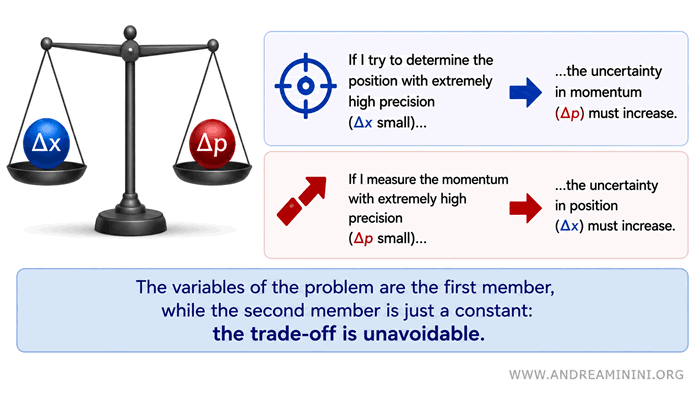
For example, if I try to determine the particle's position more precisely, the uncertainty \(\Delta x\) becomes smaller.
Since the right-hand side of the equation is a fixed constant, the uncertainty in momentum \(\Delta p\) must increase accordingly. The same reasoning works in reverse.
An Intuitive Example
Imagine that we want to observe an electron.
To detect it optically, we need to illuminate it with a photon. When the photon interacts with the electron, it transfers momentum to it and changes its subsequent motion.
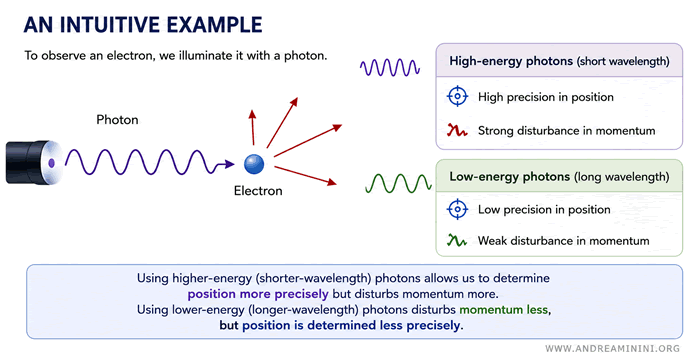
If I use high-energy photons with very short wavelengths, I can determine the electron's position more accurately. However, the interaction produces a larger change in its momentum.
If I use lower-energy photons with longer wavelengths, the electron's momentum is disturbed less, but its position cannot be resolved as precisely.
Heisenberg's Gamma-Ray Microscope
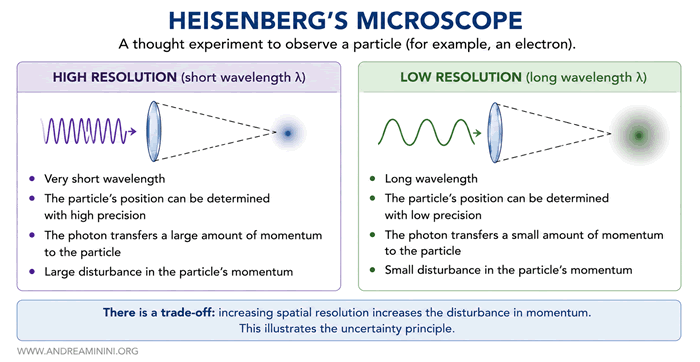
Heisenberg illustrated this idea with a thought experiment known as the gamma-ray microscope.
There are two limiting cases.
- High resolution. The wavelength is very short. The particle's position can be determined with high precision, but the photon transfers a relatively large amount of momentum to the particle and significantly disturbs its motion.
- Low resolution. The wavelength is longer. The particle's momentum is disturbed less, but its position is measured less precisely because of the microscope's optical resolution limit.
This thought experiment makes the trade-off between spatial resolution and momentum disturbance easier to visualize. However, the modern uncertainty relation does not arise solely from measurement disturbance. More fundamentally, it follows from the mathematical structure of quantum mechanics itself.
The Wave-Mechanical Origin of the Uncertainty Principle
The uncertainty principle does not arise only from the act of measurement. It also follows from the wave nature of matter introduced by de Broglie's hypothesis and developed within wave mechanics.
Every quantum particle is described by a wave function. The position-space and momentum-space forms of that wave function are mathematically related through a Fourier transform.
A wave function that is tightly localized in position space must be built from a superposition of many different wavelengths and therefore many different momentum components. As a result, the uncertainty in momentum increases.
The Mathematical Formulation
The first rigorous derivation of the position-momentum uncertainty relation was given by Earle Hesse Kennard in 1927.
$$ \sigma_x \sigma_p \ge \frac{\hbar}{2} $$
In this form, the uncertainties are represented by the standard deviations of the probability distributions for position and momentum in a given quantum state.
Noncommuting Operators
In quantum mechanics, every physical observable is represented by an operator.
The position and momentum operators do not commute.
$$ [\hat{x},\hat{p}] = i\hbar $$
This noncommutativity means that no quantum state can have both a perfectly definite position and a perfectly definite momentum. More generally, the Robertson uncertainty relation links the uncertainties of two observables to the expectation value of their commutator.
Other Uncertainty Relations
The uncertainty principle is not limited to position and momentum. Similar relations apply to many other pairs of noncommuting observables.
Energy and Time
$$ \Delta E \, \Delta t \gtrsim \frac{\hbar}{2} $$
The energy-time uncertainty relation requires more care than the position-momentum relation because time is usually treated as a parameter rather than as a quantum operator conjugate to the Hamiltonian. Depending on the context, \(\Delta t\) may represent a characteristic evolution time, the duration of a measurement, or the lifetime of an unstable state.
This relation helps explain several physical phenomena.
- the finite lifetimes of excited or unstable states;
- the natural linewidths of spectral transitions;
- the characteristic timescales associated with off-shell processes involving virtual particles in quantum field theory, although virtual particles should not be described as particles that literally borrow energy and briefly violate energy conservation.
Angular Momentum
$$ \sigma_{J_i}\sigma_{J_j} \ge \frac{\hbar}{2} \left| \langle J_k\rangle \right| $$
Different components of angular momentum cannot simultaneously have arbitrarily small uncertainties. For cyclic permutations of \(i\), \(j\), and \(k\), their operators satisfy the commutation relation \([\hat J_i,\hat J_j]=i\hbar\hat J_k\).
Particle Number and Phase
In quantum optics and in the theory of superconductivity, number-phase uncertainty relations are often written schematically as
$$ \Delta N \, \Delta \phi \ge 1 $$
This relation expresses a trade-off between uncertainty in particle number and uncertainty in phase. In superconductors, the relevant number variable is generally associated with Cooper pairs, while \(\phi\) represents the phase of the superconducting order parameter. The exact numerical factor and mathematical formulation depend on the definitions being used because quantum phase does not have a universally applicable self-adjoint operator analogous to the position operator.
The Einstein-Bohr Debate
The uncertainty principle helped spark one of the most important debates in the history of physics.
Albert Einstein believed that quantum mechanics did not provide a complete description of physical reality. Although he recognized its extraordinary success in predicting experimental results, he rejected the idea that irreducible probability and indeterminacy represented the final description of nature. He explored the possibility that a deeper theory might explain quantum phenomena through additional variables or a more complete description of physical states.
His famous statement, "God does not play dice," neatly captures his resistance to treating fundamental randomness as an irreducible feature of nature.
Niels Bohr defended the conceptual framework usually associated with the Copenhagen interpretation. He argued that quantum phenomena could not be described independently of the experimental arrangements used to observe them and that the uncertainty relations reflected a fundamental feature of the quantum description rather than a defect in the theory.
Bohr responded to Einstein's objections by defending the consistency and completeness of quantum mechanics within its proper domain of application. Their debate continued for many years and played a major role in clarifying the conceptual foundations of quantum theory.
The EPR Argument
In 1935, Albert Einstein, Boris Podolsky, and Nathan Rosen proposed a thought experiment that became known as the EPR argument, or EPR paradox.
Their aim was to show that, if locality and their criterion of physical reality were accepted, the quantum-mechanical wave function could not provide a complete description of physical reality. They argued that a more complete theory might include additional variables capable of specifying properties that standard quantum mechanics did not assign definite values before measurement.
The EPR argument inspired extensive research into quantum entanglement, locality, and the completeness of quantum mechanics. Decades later, Bell's theorem showed that no theory satisfying Bell's assumptions of locality can reproduce all the statistical predictions of quantum mechanics. Subsequent experiments have repeatedly violated Bell inequalities and agreed with quantum-mechanical predictions, ruling out broad classes of local hidden-variable theories. Bell's theorem does not, however, exclude every possible hidden-variable theory, since explicitly nonlocal theories remain viable.
Popper's Criticism
The philosopher Karl Popper criticized the Copenhagen interpretation and supported a statistical, or ensemble, interpretation of the uncertainty relations. He argued that these relations should primarily be understood as constraints on statistical distributions for ensembles of similarly prepared particles rather than as statements about a subjective lack of knowledge concerning an individual particle. His position contributed to the philosophical debate over the interpretation of quantum mechanics, although it did not change the theory's experimentally testable predictions.
Modern Developments
Modern research has extended and refined the original uncertainty relations.
Entropic Uncertainty Relations
Entropic uncertainty relations use information-theoretic quantities, such as Shannon entropy, instead of standard deviations to measure uncertainty. This approach is more general in several respects and remains useful for probability distributions whose variance may provide an incomplete or misleading picture of uncertainty.
Ozawa's Error-Disturbance Relation
Masanao Ozawa distinguished the intrinsic statistical uncertainty of a quantum state from measurement error and from the disturbance introduced by a measuring apparatus.
$$ \varepsilon_A\eta_B + \varepsilon_A\sigma_B + \sigma_A\eta_B \ge \frac12 \left| \langle[\hat A,\hat B]\rangle \right| $$
In this expression, \(\varepsilon_A\) denotes the measurement error associated with observable \(A\), \(\eta_B\) denotes the disturbance induced in observable \(B\), and \(\sigma_A\) and \(\sigma_B\) are the intrinsic standard deviations of the two observables in the initial quantum state.
This relation generalizes the traditional error-disturbance formulation associated with Heisenberg by clearly distinguishing measurement error, measurement-induced disturbance, and the intrinsic quantum uncertainties of the state.


