
Quantum Superposition in Quantum Mechanics
Quantum superposition is a fundamental principle of quantum mechanics stating that, before a measurement is made, the quantum state of a physical system can be represented as a linear combination of multiple possible quantum states, each associated with a complex probability amplitude.
Quantum superposition is one of the cornerstones of quantum mechanics. It is also one of its most surprising concepts because it challenges the way we normally think about physical reality.
It provides the mathematical framework used to describe microscopic systems such as electrons, photons, and other elementary particles.
Unlike classical physics, where an object is assumed to have well-defined physical properties at every moment, quantum mechanics offers a fundamentally different picture of nature.
According to the superposition principle, before a measurement is performed, a quantum system is described by a combination of several possible quantum states rather than by a single definite state.
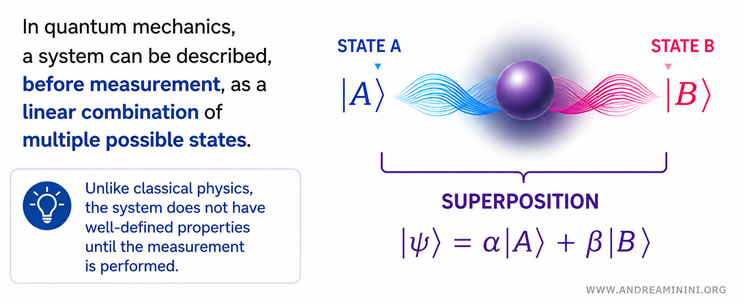
Note. This does not mean that the system rapidly jumps from one state to another, nor that it simultaneously possesses every corresponding property in the classical sense. Instead, its quantum state is represented by a mathematical combination of all the states compatible with the physical situation under consideration.
Quantum Superposition and Electron Spin
One of the simplest examples of quantum superposition involves the spin of an electron. Spin is an intrinsic quantum property of elementary particles. When an electron's spin is measured along a given axis, only two outcomes are possible.
These spin states are conventionally written as:
- spin ↑ (spin up)
- spin ↓ (spin down)
In classical physics, we would assume that the electron already has one of these two spin orientations before the measurement takes place.
Quantum mechanics tells a different story. Before measurement, the electron's state is represented as a superposition of both spin states:
\[ |\psi\rangle = \alpha |\uparrow\rangle + \beta |\downarrow\rangle \]
Here, \( |\uparrow\rangle \) and \( |\downarrow\rangle \) denote the two possible spin states along the chosen measurement axis.
The coefficients \( \alpha \) and \( \beta \) are known as probability amplitudes. They are generally complex numbers. According to the Born rule, the probability of measuring each spin state is given by the squared magnitude of its corresponding amplitude, namely \( |\alpha|^2 \) and \( |\beta|^2 \).
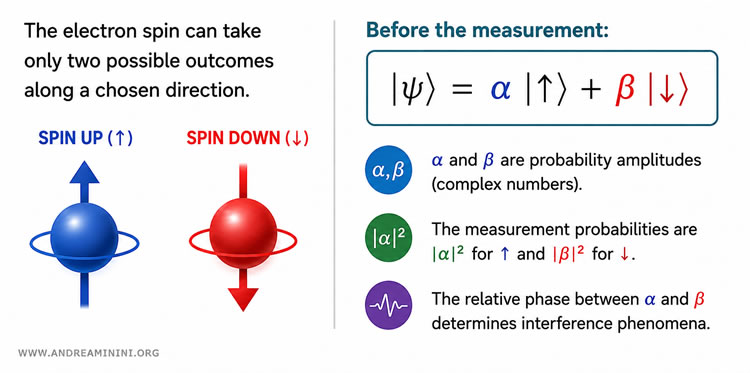
It is important not to interpret this expression as meaning that the electron literally has two different spin orientations at the same time, as if it existed in two classical configurations simultaneously.
Instead, the electron is described by a single quantum state that is a linear combination of the two basis states. This is a uniquely quantum concept with no direct equivalent in classical mechanics.
Note. The amplitudes \( \alpha \) and \( \beta \) contain much more information than measurement probabilities alone. Their relative phase also has physical meaning because it determines how the different components of the superposition combine through interference. This is what gives rise to quantum interference, one of the defining phenomena of quantum mechanics.
Why Is Quantum Superposition Possible?
Quantum superposition is not an arbitrary assumption. It follows directly from the mathematical structure of quantum mechanics.
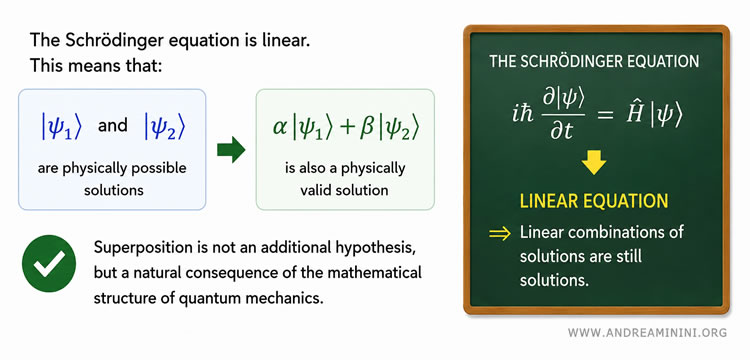
The Schrödinger equation, which governs the time evolution of a quantum state, is a linear differential equation.
Because of this linearity, if two state vectors are valid solutions of the Schrödinger equation, then any linear combination of those solutions is also a valid quantum state. This mathematical property is what makes quantum superposition possible.
In other words, superposition is not an extra rule added to the theory. It is a natural consequence of the mathematical formalism on which quantum mechanics is built.
An Intuitive Analogy
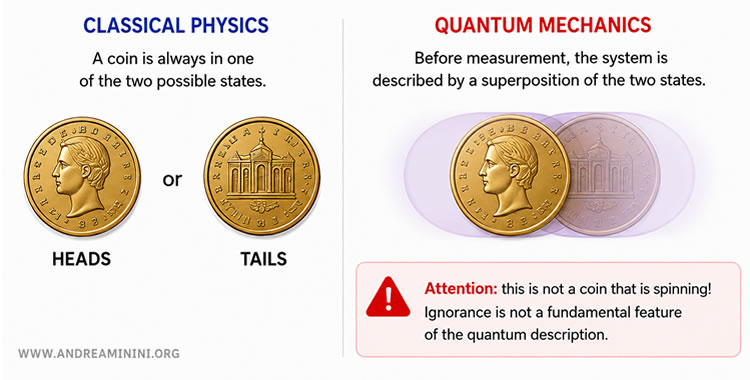
A helpful way to develop an intuitive understanding of quantum superposition is through the coin analogy.
In classical physics, a coin is always in one of two well-defined states: heads or tails.
Quantum mechanics suggests something fundamentally different. Before a measurement is made, the system is not described simply as being in the "heads" state or the "tails" state. Instead, it is represented by a superposition of both possibilities.
This analogy has its limits, however. A quantum superposition should not be imagined as a coin spinning through the air. At every instant during its flight, the coin has a definite physical orientation. The fact that we cannot predict which side will face upward when it lands is simply due to incomplete knowledge of its initial conditions and subsequent motion.
Quantum superposition is fundamentally different. It is not a consequence of missing information or observational uncertainty. Rather, it is an intrinsic feature of the quantum-mechanical description of nature itself.
The Role of Measurement
The picture changes once a measurement is performed.
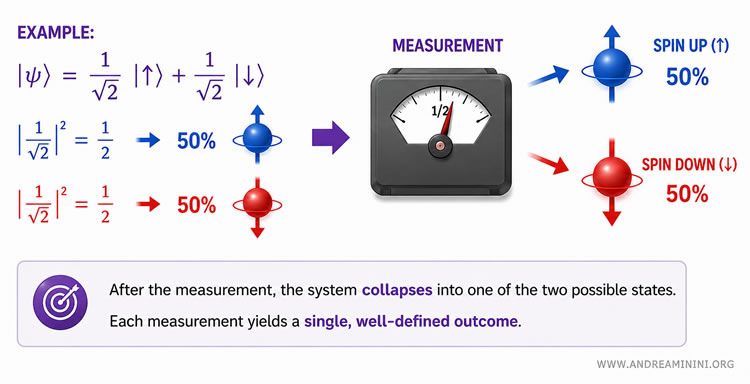
Suppose the electron is described by the following superposition state:
\[ |\psi\rangle=\frac{1}{\sqrt{2}}|\uparrow\rangle+\frac{1}{\sqrt{2}}|\downarrow\rangle \]
Here, the two probability amplitudes have equal magnitudes. According to the Born rule, measuring the electron's spin can produce two possible outcomes, each occurring with the same probability:
- spin ↑ (spin up) with a probability of 50%.
- spin ↓ (spin down) with a probability of 50%.
Once the measurement is complete, the electron is found in one, and only one, of the two possible spin states. The original superposition no longer describes the system. In other words, every individual measurement always produces a single, well-defined outcome.
This behavior is one of the defining features of quantum mechanics and one of the clearest ways in which it differs from classical physics.
The Double-Slit Experiment
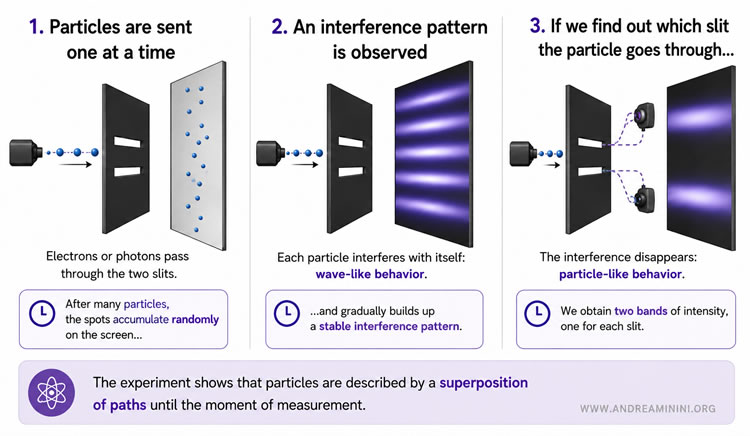
The best-known experimental demonstration of quantum superposition is the double-slit experiment.
When a particle, such as an electron or a photon, can pass through two slits without any measurement revealing which path it takes, the system is described by a superposition of the two possible paths.
Because the two components of the superposition remain coherent, they interfere with one another and produce the characteristic interference pattern on the detection screen.
If a measurement is made to determine which slit the particle passes through, the superposition is destroyed and the interference pattern disappears.
This remarkable experiment provides one of the strongest pieces of evidence for the quantum nature of matter.
Quantum Superposition Is Not the Same as Ignorance
One of the most fascinating aspects of quantum mechanics is that quantum superposition cannot be explained simply as a lack of information.
A useful comparison is a face-down playing card. If you cannot see the card, you do not know whether it is an ace or a king. Even so, the card already has a definite identity. The uncertainty exists only in the observer's knowledge.
A quantum system is fundamentally different.
According to the standard formulation of quantum mechanics, before a measurement is performed, the system does not possess a definite value for the observable being measured. The superposition is therefore a genuine property of the quantum state itself rather than an incomplete description caused by the observer's lack of information.
This idea remains one of the central conceptual questions in modern physics and has inspired decades of scientific and philosophical debate about the nature of reality and the meaning of quantum measurement.
Quantum Superposition vs. a Statistical Mixture
A quantum superposition should not be confused with a statistical mixture.
- In a statistical mixture, the system is already in one of the possible states. The uncertainty reflects only the observer's lack of knowledge about which state the system occupies.
- In a quantum superposition, the system is described by a single coherent quantum state that combines multiple possibilities simultaneously.
This distinction is not merely theoretical. It can be tested experimentally.
A quantum superposition can produce interference effects, whereas a statistical mixture cannot. Observing an interference pattern therefore provides strong evidence that the system is genuinely in a superposition rather than in a simple probabilistic mixture of pre-existing states.
Decoherence and the Fragility of Quantum Superposition
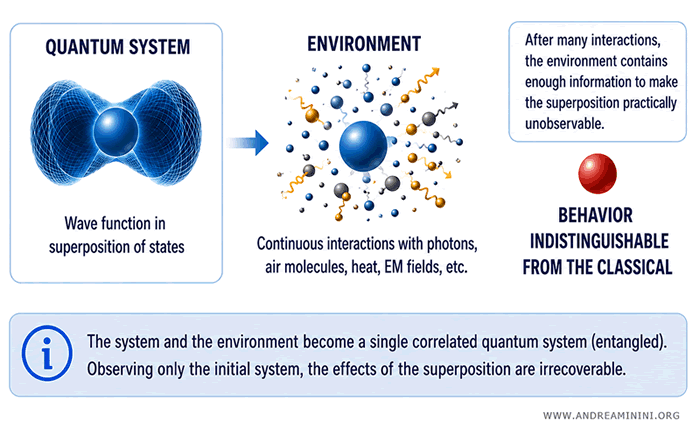
Quantum decoherence makes superposition states effectively unobservable at the macroscopic scale because of the system's continuous interactions with its surrounding environment.
Quantum superpositions are extraordinarily fragile.
An isolated quantum system can preserve a coherent superposition. In the real world, however, virtually every quantum system constantly interacts with its surroundings. Photons, air molecules, lattice vibrations, electromagnetic fields, and countless other environmental influences continually affect the system.
These interactions give rise to a process known as quantum decoherence.
Decoherence is the gradual loss of coherence between the different components of a quantum superposition. Put simply, the different components of the wave function gradually lose their ability to interfere coherently with one another.
Quantum interference is possible only because the components of a superposition maintain precise phase relationships. As long as this coherence is preserved, they can combine and produce effects that have no counterpart in classical physics.
Note. Decoherence does not necessarily destroy the wave function itself. Instead, it suppresses the observable interference between its different components, causing the system to behave, for all practical purposes, as though it were classical. For this reason, decoherence is widely regarded as the mechanism that explains the emergence of classical behavior from quantum systems. However, by itself it does not resolve the quantum measurement problem.
Decoherence also explains why we do not observe quantum superpositions in everyday life. Large objects interact continuously with their environment through an enormous number of microscopic processes, causing quantum coherence to disappear on extremely short timescales.
As a result, everyday objects always appear to exist in a single, well-defined macroscopic state.
And so on.


