
Quantum Interference
Quantum interference is one of the most distinctive phenomena in quantum mechanics. It occurs when a quantum system can evolve to the same final state through multiple possible paths.
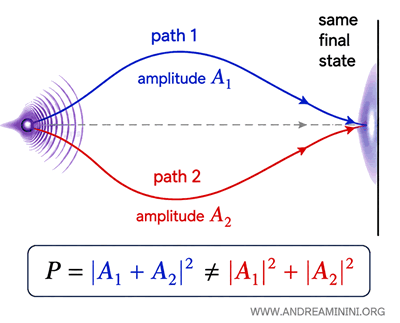
Unlike classical physics, where probabilities are added directly, quantum mechanics first combines the probability amplitudes associated with the different paths. These amplitudes are complex numbers that describe the quantum state of the system.
Because of this, the final probability distribution can be dramatically different from the one predicted by classical physics.
The Double Slit Experiment
The most famous demonstration of quantum interference is the double slit experiment.
A source emits photons or electrons toward a barrier containing two narrow slits. Behind the barrier is a detection screen that records the position where each particle arrives.
If both slits are open and no measurement is made to determine which path the particle takes, an interference pattern appears on the screen. The pattern consists of alternating bright and dark fringes.
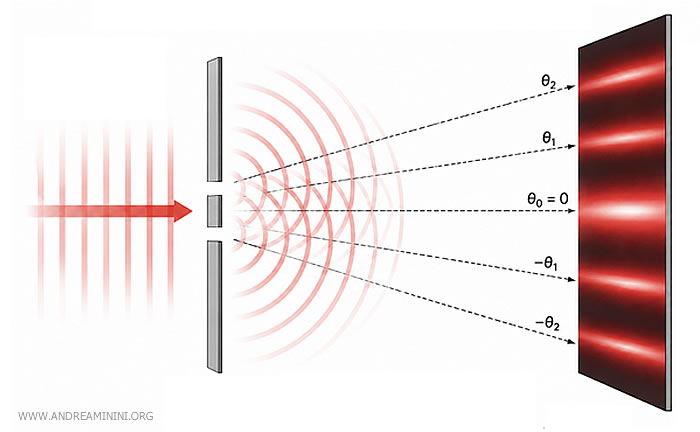
The most surprising aspect is that the same pattern appears even when particles pass through the apparatus one at a time.
Each particle produces a single detection event on the screen. As more particles are detected, these individual events gradually build up into the familiar interference pattern.
This behavior shows that the wave function evolves as a superposition of all the possible paths available to the system.
Note. In the standard formulation of quantum mechanics, it is more accurate to say that the wave function is in a superposition of states. It is therefore not appropriate to assign the particle a definite classical trajectory through both slits.
How Does Quantum Interference Arise?
Whenever a quantum system can evolve along more than one possible path, each path is associated with a probability amplitude.
If these amplitudes are denoted by \(A_1\) and \(A_2\), the probability of detecting the particle is
\[ P = |A_1 + A_2|^2 \]
Expanding the squared modulus gives
\[ P = |A_1|^2 + |A_2|^2 + 2\,\mathrm{Re}(A_1A_2^*) \]
Here, \(A_2^*\) denotes the complex conjugate of the probability amplitude \(A_2\).
The first two terms represent the contributions from the individual paths. The third term, known as the interference term, is responsible for the appearance of the interference fringes on the screen.
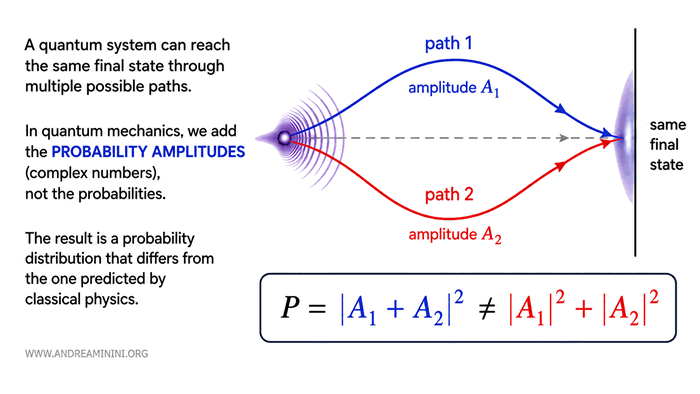
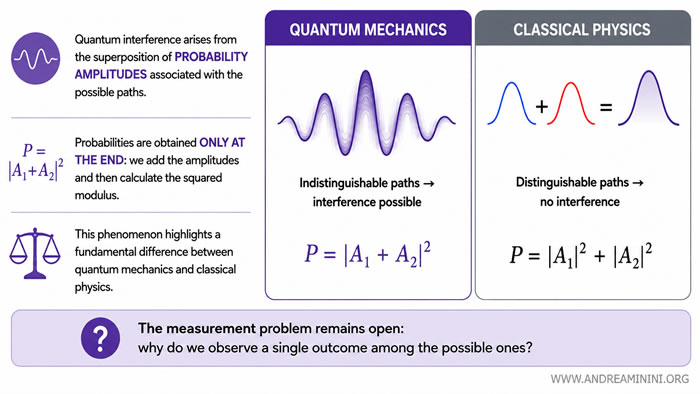
Note. If the probabilities were added directly, as in classical physics or whenever information is available about which slit the particle passed through, the interference term would disappear and no interference pattern would be observed. In that case, the probability would be \[ |A_1|^2 + |A_2|^2 \] In quantum mechanics, however, if the alternative paths are indistinguishable, the probability amplitudes are added first, and only then is the squared modulus calculated: \[ P = |A_1 + A_2|^2 \] Therefore, in general, \[ |A_1 + A_2|^2 \ne |A_1|^2 + |A_2|^2 \] The difference between these two expressions is the interference term.
In other words, quantum interference shows that it is not the particles themselves that interfere directly, but the probability amplitudes associated with the different possible quantum states of the system.
The observable probabilities emerge only after the amplitudes have been added together and the squared modulus of the resulting complex quantity has been calculated.
This is one of the fundamental differences between quantum mechanics and classical physics, revealing that microscopic systems obey principles that are profoundly different from those governing the everyday world.
Constructive and Destructive Interference
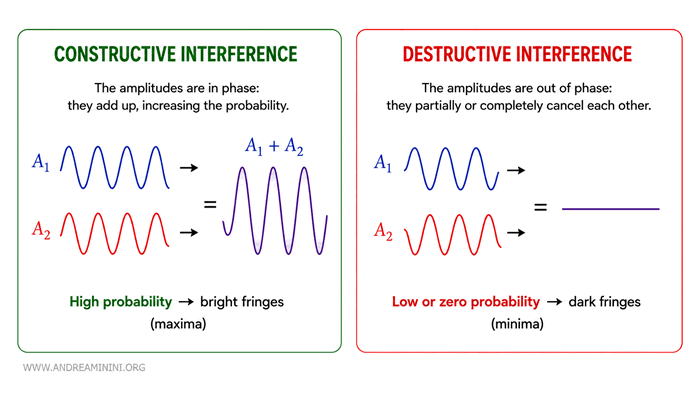
Quantum interference can produce two different effects.
- Constructive interference
Constructive interference occurs when the probability amplitudes reinforce one another, increasing the probability of detecting the particle at a particular location. These regions appear as bright interference fringes. - Destructive interference
Destructive interference occurs when the probability amplitudes partially or completely cancel each other. As a result, the probability of detecting the particle decreases or even becomes zero. These regions appear as dark interference fringes.
Why Does the Interference Pattern Disappear When the Path Is Measured?
If a detector is introduced to determine through which slit the quantum system passes, the interference pattern disappears.
This effect does not depend on the presence of a conscious human observer.
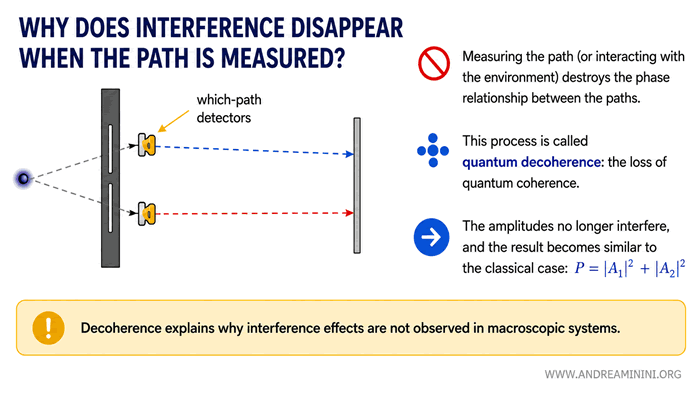
The disappearance of the interference pattern is caused by the physical interaction between the quantum system and the measuring apparatus, or more generally, with its surrounding environment.
This interaction destroys the phase relationship between the alternative paths. The process is known as quantum decoherence, meaning the loss of quantum coherence.
As a result, the probability amplitudes no longer interfere with one another, and the system behaves in a way that is effectively described by classical physics.
Note. Decoherence explains why interference effects are not observed in macroscopic systems. However, it does not solve the measurement problem, namely why only one outcome is observed among all the possibilities described by the wave function.
Applications
Quantum interference lies at the heart of many of the most important technologies emerging from modern quantum physics.
In quantum computing, for example, interference enables certain algorithms to increase the probability of obtaining the correct answer while suppressing incorrect ones.
It is also a key ingredient in quantum communication and quantum cryptography, where it works together with other uniquely quantum effects.
Other important applications include quantum interferometers, which make extremely precise measurements possible, and quantum sensors, capable of detecting extraordinarily small changes in physical quantities.
As quantum technologies continue to develop, new applications based on quantum interference are expected to emerge across science and engineering.


