Quantum Decoherence
Quantum decoherence is the process by which a quantum system loses its ability to display observable quantum interference because of its interaction with the surrounding environment.
Decoherence explains why the everyday world appears to follow the laws of classical physics, even though everything around us is fundamentally made of quantum particles.
How Does Quantum Decoherence Occur?
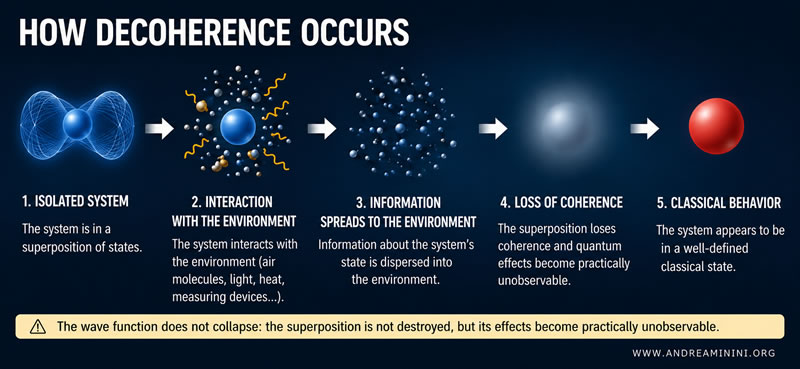
A quantum system, such as an electron or a photon, can exist in a superposition of states. Instead of occupying just one state, its quantum state is described as a combination of multiple possible states.
As long as the system remains sufficiently isolated from its environment, the coherence of this superposition is preserved, allowing quantum interference effects to occur.
The situation changes once the system begins interacting with its surroundings. Air molecules, electromagnetic radiation, thermal radiation, or even a measuring device continuously exchange information with the system.
As these interactions accumulate, the different components of the superposition gradually lose their phase coherence. The distinctive interference effects predicted by quantum mechanics become effectively impossible to observe, and the system behaves just like a classical object. In other words, it appears to occupy a single well-defined classical state.
Note. The expression "well-defined classical state" is used only to describe the system's observable behavior. Decoherence does not cause the wave function to collapse or eliminate the superposition. Instead, it suppresses the observable interference between the components of the superposition. The superposition is still part of the quantum description, but its effects can no longer be detected by observing the system alone.
What Happens During Decoherence?
When a quantum system exists in a superposition of states, all of its possible outcomes are encoded in a single quantum state, usually represented by a wave function.
If the system could remain perfectly isolated, the coherence of the superposition would be preserved indefinitely and its evolution would continue to follow the laws of quantum mechanics.
In reality, however, no physical system is completely isolated. Electrons, atoms, and molecules constantly interact with photons, air molecules, thermal radiation, and electromagnetic fields.
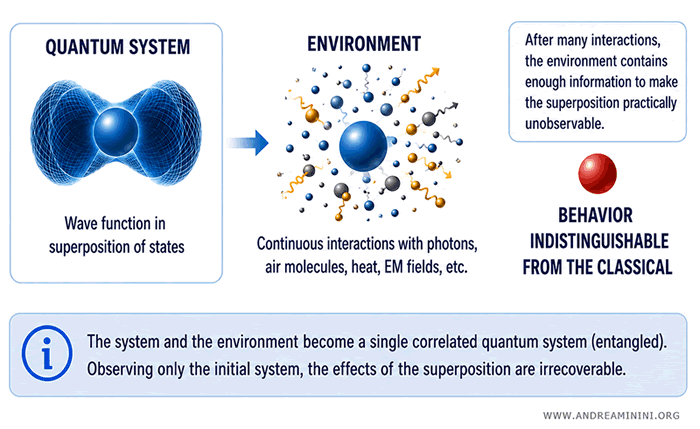
Every interaction transfers a small amount of information from the system to its environment. After countless interactions, the environment becomes strongly correlated with the system and effectively stores information about its quantum state. At that point, interference between the components of the superposition becomes practically impossible to observe, and the system behaves as though it were a classical object.
Note. The wave function is not destroyed. Instead, the system and its surroundings evolve into a single entangled quantum state. If it were possible to observe the entire combined system, including the environment, its evolution would still be fully described by quantum mechanics. However, when we observe only the original system and ignore the countless environmental degrees of freedom, the coherence between the components of the superposition becomes effectively inaccessible. The resulting reduced quantum state behaves like a classical statistical mixture. This is why decoherence does not eliminate the superposition itself. It simply makes its interference effects impossible to observe in practice.
The Disappearance of Interference
One of the defining features of a quantum superposition is that its different components can interfere with one another.
Quantum interference is responsible for many of the most remarkable predictions of quantum mechanics. One of the best-known examples is the interference pattern produced in the double-slit experiment.
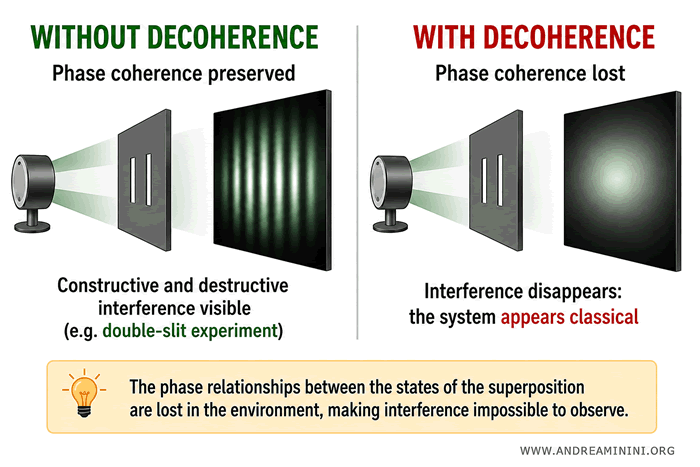
When decoherence occurs, these interference effects rapidly disappear from observation. As a result, the system behaves exactly as we would expect from classical physics.
The underlying reason is the loss of phase coherence between the different components of the superposition.
A simple analogy comes from water waves. As long as two waves maintain a fixed phase relationship, they reinforce or cancel each other, creating a stable interference pattern. Once their relative phase becomes random, that pattern disappears.
The same idea applies in quantum mechanics. As a system interacts with its environment, information about the relative phases of the superposition spreads across an enormous number of environmental degrees of freedom. Once this information is dispersed, interference can no longer be observed by measuring the system alone.
Decoherence and Wave Function Collapse
Decoherence is not the same as wave function collapse.
In interpretations of quantum mechanics that include collapse, wave function collapse is the process through which a measurement produces one definite outcome from all the possibilities described by the quantum state.
Decoherence, on the other hand, is the loss of observable quantum coherence caused by interactions with the environment. It explains why interference effects disappear so quickly in macroscopic systems without requiring the wave function itself to physically collapse.
For this reason, decoherence explains how classical behavior naturally emerges from quantum dynamics. However, it does not explain why one particular measurement outcome is realized instead of another. In other words, decoherence accounts for an essential part of the quantum-to-classical transition, but it does not solve the measurement problem by itself.
Example. Imagine dropping a stone into a perfectly still pond. Circular ripples spread across the surface, creating a clear and recognizable pattern. Now imagine that rain and wind continuously disturb the water. The original ripples do not disappear, but they become buried beneath countless new ripples, making the original pattern impossible to distinguish.
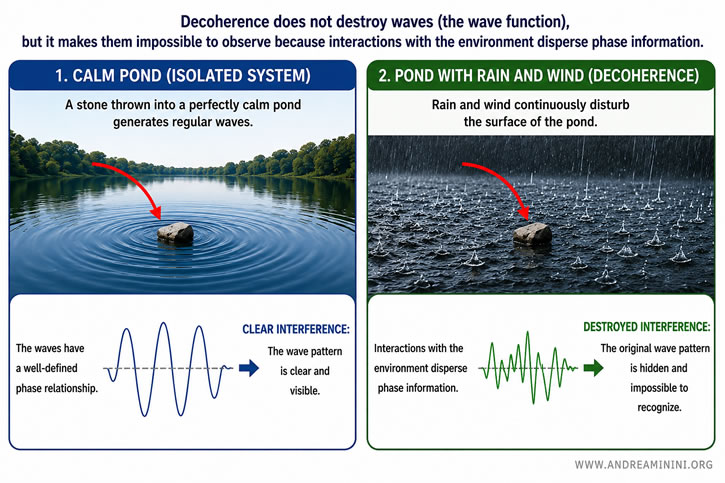
Quantum decoherence works in much the same way. It does not eliminate the system's wave function. Instead, continuous interactions with the environment distribute information about the relative phases between the components of the superposition throughout the surroundings, suppressing observable interference. Wave function collapse is a different concept. In interpretations that postulate collapse, it represents the selection of a single measurement outcome. Decoherence explains why quantum interference becomes effectively unobservable, but it does not determine which outcome is ultimately observed.
Why Does the Macroscopic World Look Classical?
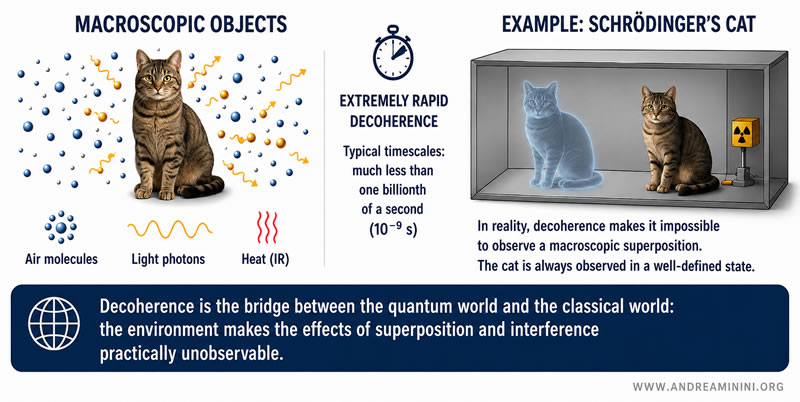
Decoherence occurs extraordinarily quickly in macroscopic objects.
A cat, a person, or even a grain of dust constantly interacts with enormous numbers of air molecules, photons, and infrared radiation emitted by its own temperature. These interactions occur so frequently that decoherence takes place on incredibly short timescales, often much shorter than a billionth of a second.
This is why we never observe everyday objects in quantum superpositions, such as Schrödinger's famous cat being both alive and dead at the same time. Interactions with the environment suppress observable interference almost immediately, long before such superpositions could ever be detected at the macroscopic level.
A Practical Example
The famous Schrödinger's cat thought experiment offers an intuitive way to understand quantum decoherence.
In principle, the cat could be described by a quantum state that is a superposition of the states "alive" and "dead." In reality, however, the cat constantly interacts with billions of particles, thermal radiation, electromagnetic fields, and the surrounding environment.
These continual interactions produce extremely rapid decoherence, making interference between macroscopically distinct states effectively impossible to observe. As a result, the cat behaves like a classical system and is always observed in one definite state.
In summary, decoherence provides the key physical mechanism linking the quantum and classical worlds. It does not modify the laws of quantum mechanics. Instead, it explains why quantum interference becomes effectively unobservable in macroscopic systems. Continuous interaction with the environment makes the coherence between the components of a superposition inaccessible to local observations, allowing the familiar behavior described by classical physics to emerge.