Higher-Order Derivative Test for Local Extrema and Inflection Points
The higher-order derivative test helps determine whether a stationary point is a local maximum, a local minimum, or a stationary inflection point.
Suppose a function \(y=f(x)\) has continuous derivatives through order \(n\) on an open interval. At an interior point \(x_0\), assume that all derivatives from the first through the \((n-1)\)th are zero:
\[ f'(x_0)=f''(x_0)=\cdots=f^{(n-1)}(x_0)=0 \]
If the \(n\)th derivative is nonzero, with \(n\geq 2\),
\[ f^{(n)}(x_0)\neq 0 \]
then the order and sign of this derivative determine the type of stationary point:
- If \(n\) is even, the function has a strict local maximum at \(x_0\) when \(f^{(n)}(x_0)<0\), or a strict local minimum when \(f^{(n)}(x_0)>0\).
- If \(n\) is odd, the graph has a stationary inflection point at \(x_0\). The function is decreasing through the point when \(f^{(n)}(x_0)<0\), and increasing through the point when \(f^{(n)}(x_0)>0\).
The main advantage of the higher-order derivative test is that it allows me to classify a stationary point even when the second derivative test fails.
To understand why, I'll start with a function \(f(x)\) and a stationary point \(x_0\), where the first derivative is zero.
\[ f'(x_0)=0 \]
At this point, the graph has a horizontal tangent line. However, a horizontal tangent does not necessarily indicate a maximum or minimum. The point could also be a stationary inflection point.
Normally, I would use the second derivative test to distinguish between these possibilities. If the second derivative is positive, the function has a local minimum. If it is negative, the function has a local maximum.
What happens when the second derivative is also zero?
In that case, the second derivative test is inconclusive. I can still investigate the point by calculating higher-order derivatives until I find the first one that is nonzero.
Once I find that derivative, I only need to check two things: whether its order is even or odd, and whether its value is positive or negative.
- Even-order derivative: If the first nonzero derivative is the fourth, sixth, or another even-order derivative, the function has a strict local extremum. A positive value indicates a local minimum, while a negative value indicates a local maximum.
- Odd-order derivative: If the first nonzero derivative is the third, fifth, seventh, or another odd-order derivative, the graph has a stationary inflection point. A positive value indicates that the function is increasing through the point, while a negative value indicates that it is decreasing through the point.
Note. The higher-order derivative test is inconclusive if every derivative evaluated at the stationary point is zero. In that case, I can use another method, such as examining the sign of the first derivative on either side of the point. This can help determine whether the function has a local maximum or minimum.
Worked Example: Finding a Local Minimum
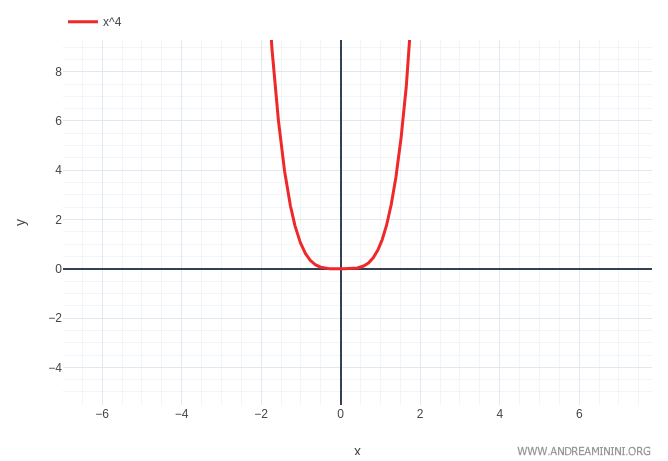
Consider the function
\[ f(x)=x^4 \]
I'll start by calculating the first derivative.
\[ f'(x)=4x^3 \]
The derivative is zero at \(x_0=0\), so the function has a stationary point there.
Next, I calculate the second derivative.
\[ f''(x)=12x^2 \]
The second derivative is also zero at \(x_0=0\). This means the second derivative test cannot determine the type of stationary point.
I'll continue with the third derivative.
\[ f'''(x)=24x \]
This derivative is also zero at \(x_0=0\), so I need to calculate the fourth derivative.
\[ f^{(4)}(x)=24 \]
Now I've found the first nonzero derivative. Its value at \(x_0=0\) is positive.
\[ f^{(4)}(0)=24>0 \]
Since the fourth derivative is of even order and is positive, I can conclude that the function has a strict local minimum at \(x_0=0\).
Example 2: Finding a Local Maximum
Now consider the function
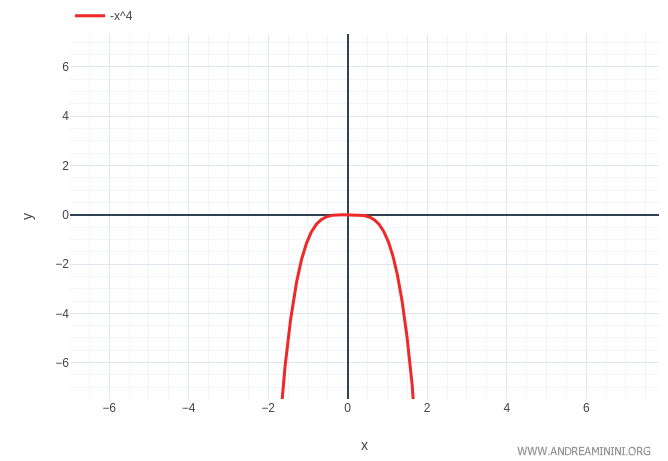
\[ f(x)=-x^4 \]
I'll calculate its successive derivatives.
\[ \begin{aligned} f'(x)&=-4x^3\\ f''(x)&=-12x^2\\ f'''(x)&=-24x\\ f^{(4)}(x)&=-24 \end{aligned} \]
At \(x_0=0\), the first three derivatives are zero. The fourth derivative, however, is negative.
\[ f^{(4)}(0)=-24<0 \]
The first nonzero derivative is therefore of even order and has a negative value.
According to the higher-order derivative test, the function has a strict local maximum at \(x_0=0\).
Example 3: Finding a Stationary Inflection Point
Finally, consider the function
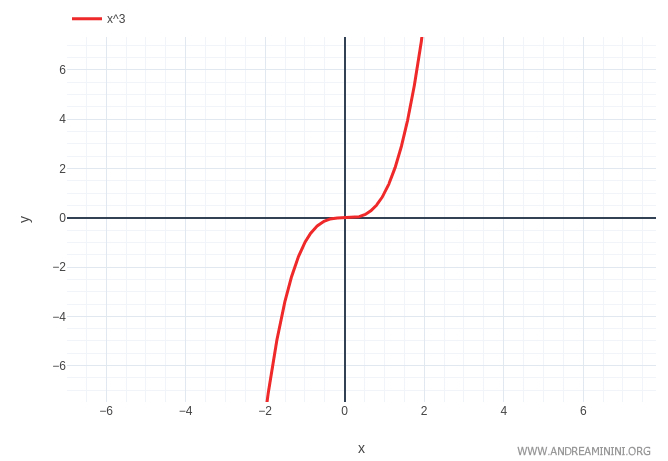
\[ f(x)=x^3 \]
I'll begin with the first derivative.
\[ f'(x)=3x^2 \]
The first derivative is zero at \(x_0=0\), so this is a stationary point.
Next, I calculate the second derivative.
\[ f''(x)=6x \]
The second derivative is also zero at \(x_0=0\). I'll therefore calculate the third derivative.
\[ f'''(x)=6 \]
This time, the derivative is positive and nonzero.
\[ f'''(0)=6>0 \]
The first nonzero derivative is of odd order, so the stationary point is not a local maximum or minimum. Instead, the graph has a stationary inflection point at \(x_0=0\).
Since the third derivative is positive, the function is increasing through the point.
Example 4: A Stationary Inflection Point on a Decreasing Curve
Consider the function
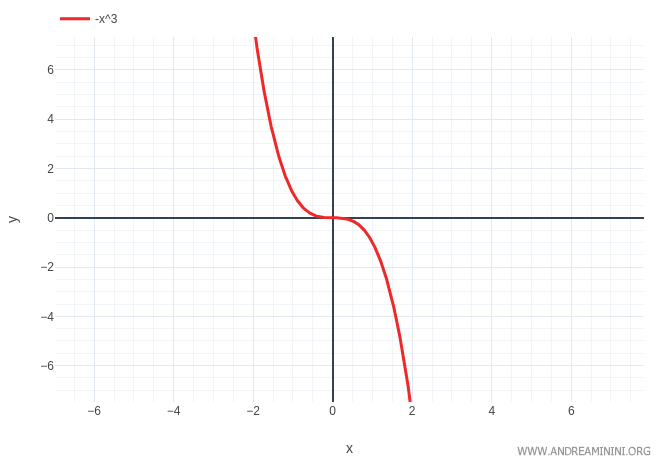
\[ f(x)=-x^3 \]
I'll start by calculating its successive derivatives.
\[ \begin{aligned} f'(x)&=-3x^2\\ f''(x)&=-6x\\ f'''(x)&=-6 \end{aligned} \]
At \(x_0=0\), both the first and second derivatives are zero, but the third derivative is negative.
\[ f'''(0)=-6<0 \]
The first nonzero derivative is therefore of odd order and has a negative value. According to the higher-order derivative test, the graph has a stationary inflection point at \(x_0=0\), where the function is decreasing.
Why Does the Higher-Order Derivative Test Work?
The higher-order derivative test can be explained using Taylor's theorem, which describes how a function behaves near a given point.
Suppose all derivatives from the first through the \((n-1)\)th are zero at a stationary point \(x_0\), while the \(n\)th derivative is nonzero. Taylor's theorem gives
\[ f(x)=f(x_0)+\frac{f^{(n)}(x_0)}{n!}(x-x_0)^n+o((x-x_0)^n) \]
The little-o term represents a remainder that becomes negligible compared with \((x-x_0)^n\) as \(x\) approaches \(x_0\).
This means that, sufficiently close to \(x_0\), the first nonzero term in the Taylor expansion determines how the function behaves.
- If \(n\) is even, the power \((x-x_0)^n\) is positive on both sides of \(x_0\), except at the point itself, where it is zero. If the \(n\)th derivative is positive, the function takes values greater than \(f(x_0)\) at all sufficiently close points other than \(x_0\). Therefore, \(x_0\) is a strict local minimum. If the derivative is negative, the function takes smaller values, so \(x_0\) is a strict local maximum.
- If \(n\) is odd, the power \((x-x_0)^n\) changes sign as \(x\) passes through \(x_0\). The function therefore crosses the horizontal level \(y=f(x_0)\). Since \(n\geq 3\), the second derivative also changes sign near \(x_0\), causing the graph to change concavity. The result is a stationary inflection point. The function is increasing or decreasing through the point depending on the sign of the \(n\)th derivative.
Proof of the Higher-Order Derivative Test
To understand why the test works, I'll examine the four cases in which the first nonzero derivative is either the second or the third derivative.
I'll begin with local maxima and minima, then move on to stationary inflection points.
1. Negative Second Derivative: Local Maximum
Consider a function \(f(x)\) satisfying the following conditions at \(x_0\):
\[ f'(x_0)=0 \qquad f''(x_0)<0 \]
Since the second derivative is continuous at \(x_0\), I can find a sufficiently small interval around this point where it remains negative.
\[ f''(x)<0 \]
What does a negative second derivative tell me?
The second derivative describes how the first derivative changes. When \(f''(x)<0\), the first derivative is strictly decreasing.
I also know that \(f'(x_0)=0\). Since the first derivative is decreasing, it must be positive to the left of \(x_0\) and negative to the right, within this interval.
\[ \begin{aligned} f'(x)>0 &\quad \text{if }x<x_0\\ f'(x)<0 &\quad \text{if }x>x_0 \end{aligned} \]
Now I can determine how the function behaves.
A positive first derivative means the function is increasing, while a negative first derivative means it is decreasing.
Therefore, the function increases up to \(x_0\) and decreases afterward. Its value at \(x_0\) is greater than the values at all sufficiently close points other than \(x_0\).
I can conclude that the function has a strict local maximum at \(x_0\).
2. Positive Second Derivative: Local Minimum
Now consider the opposite case:
\[ f'(x_0)=0 \qquad f''(x_0)>0 \]
Since the second derivative is continuous, I can find a sufficiently small interval around \(x_0\) where it remains positive.
\[ f''(x)>0 \]
A positive second derivative means the first derivative is strictly increasing.
Since \(f'(x_0)=0\), the first derivative must be negative to the left of \(x_0\) and positive to the right.
\[ \begin{aligned} f'(x)<0 &\quad \text{if }x<x_0\\ f'(x)>0 &\quad \text{if }x>x_0 \end{aligned} \]
What happens to the function?
It decreases before \(x_0\) and increases afterward. Therefore, \(f(x_0)\) is less than the function values at all sufficiently close points other than \(x_0\).
I can conclude that the function has a strict local minimum at \(x_0\).
3. Negative Third Derivative: Stationary Inflection Point on a Decreasing Curve
Now I'll consider a different situation. Suppose both the first and second derivatives are zero at \(x_0\), while the third derivative is negative.
\[ f'(x_0)=f''(x_0)=0 \]
\[ f'''(x_0)<0 \]
Since the third derivative is continuous at \(x_0\), I can find a sufficiently small interval around this point where it remains negative.
The third derivative describes how the second derivative changes. Since it is negative, the second derivative is strictly decreasing.
Because \(f''(x_0)=0\), the second derivative must be positive to the left of \(x_0\) and negative to the right.
\[ \begin{aligned} f''(x)>0 &\quad \text{if }x<x_0\\ f''(x)<0 &\quad \text{if }x>x_0 \end{aligned} \]
This change in sign tells me that the graph changes concavity at \(x_0\).
To the left of the point, the graph is concave up. To the right, it is concave down.
Therefore, the graph has an inflection point at \(x_0\).
But why is the tangent horizontal, and why is the function decreasing?
The tangent line is horizontal because \(f'(x_0)=0\).
To determine whether the function is increasing or decreasing through the inflection point, I'll examine the sign of the first derivative.
To the left of \(x_0\), the second derivative is positive, so the first derivative is strictly increasing. Since it reaches zero at \(x_0\), it must be negative before that point.
To the right of \(x_0\), the second derivative is negative, so the first derivative is strictly decreasing. Starting from zero at \(x_0\), it becomes negative again.
Therefore,
\[ f'(x)<0 \qquad \text{for }x\neq x_0 \]
throughout a sufficiently small neighborhood of \(x_0\).
The function is strictly decreasing on both sides of \(x_0\), but its concavity changes at that point.
I can conclude that the graph has a stationary inflection point at \(x_0\), where the function is decreasing.
4. Positive Third Derivative: Stationary Inflection Point on an Increasing Curve
Finally, I'll examine the case where the first two derivatives are zero and the third derivative is positive.
\[ f'(x_0)=f''(x_0)=0 \]
\[ f'''(x_0)>0 \]
Since the third derivative is continuous and positive at \(x_0\), it remains positive in a sufficiently small interval around the point.
This means the second derivative is strictly increasing.
Because \(f''(x_0)=0\), the second derivative must be negative to the left of \(x_0\) and positive to the right.
\[ \begin{aligned} f''(x)<0 &\quad \text{if }x<x_0\\ f''(x)>0 &\quad \text{if }x>x_0 \end{aligned} \]
The graph therefore changes concavity, going from concave down to concave up.
Since \(f'(x_0)=0\), the tangent line is also horizontal.
Is the function increasing or decreasing through the point?
To the left of \(x_0\), the first derivative is strictly decreasing toward zero. It must therefore be positive before reaching \(x_0\).
To the right of \(x_0\), the first derivative is strictly increasing from zero, so it takes positive values there as well.
Thus,
\[ f'(x)>0 \qquad \text{for }x\neq x_0 \]
throughout a sufficiently small neighborhood of \(x_0\).
The function is strictly increasing on both sides of \(x_0\), while its concavity changes at the point.
I can conclude that the graph has a stationary inflection point at \(x_0\), where the function is increasing.
These four cases show how the signs of the second and third derivatives determine the behavior of a function near a stationary point.
For higher-order derivatives, I can apply the same underlying principle using Taylor's theorem. The first nonzero term in the Taylor expansion determines whether the stationary point is a strict local maximum, a strict local minimum, or a stationary inflection point.
The method therefore extends to derivatives of higher order.