Inflection Points
An inflection point is a point on the graph of a function where the concavity changes.
Let $ y=f(x) $ be a function defined and continuous on an interval \(I\) and differentiable throughout the interval, except possibly at a single point \(x_0\). The point \((x_0,f(x_0))\) is an inflection point if the graph changes concavity as it passes through \(x_0\).
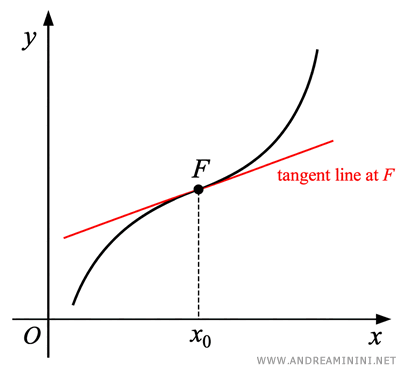
In practical terms, the curve bends differently on the two sides of an inflection point.
For example, the graph may be concave down before the inflection point and concave up after it. The opposite change can also occur.
The tangent line at an inflection point
If the function is differentiable at an inflection point, the graph has a tangent line at that point.
The tangent line may be horizontal or oblique. An inflection point may also have a vertical tangent, in which case the ordinary derivative at that point is not finite.
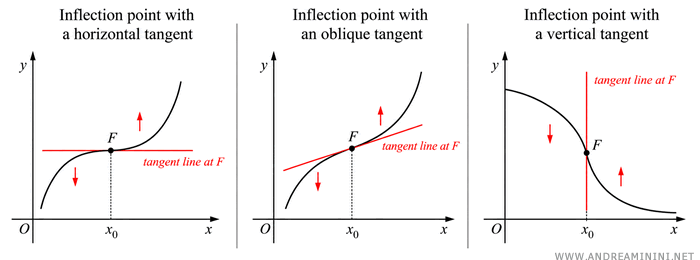
For a sufficiently smooth curve with a well-defined tangent at the inflection point, the curve typically crosses its tangent line at the point of inflection.
This geometric behavior is closely related to the change in concavity that occurs at the inflection point.
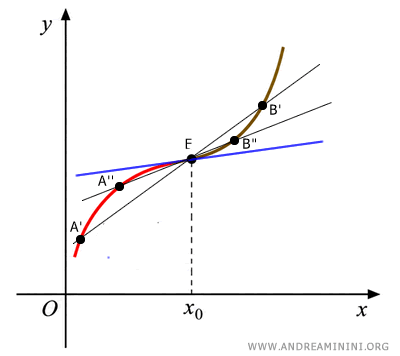
Why? Consider an inflection point \(F\) and a secant line that intersects the curve at \(A\), \(F\), and \(B\). As \(A\) and \(B\) move closer and closer to \(F\), the secant line approaches the tangent line. In the limiting configuration, the three intersections approach \(F\). For sufficiently smooth algebraic curves, this behavior can be described by saying that the tangent line has an odd order of contact with the curve at an ordinary inflection point.
How to classify an inflection point
There are two useful ways to describe an inflection point.
The first is based on the direction of the tangent line, when a tangent exists.
- If the tangent line is parallel to the \(x\)-axis, the inflection point has a horizontal tangent.
- If the tangent line is parallel to the \(y\)-axis, the inflection point has a vertical tangent.
- If the tangent line is parallel to neither axis, the inflection point has an oblique tangent.
The second is based on the direction of the change in concavity.
- The graph may change from concave down to concave up.
- The graph may change from concave up to concave down.
Note. These two descriptions are independent. For example, an inflection point may have a horizontal tangent while the graph changes from concave down to concave up. Likewise, it may have an oblique tangent while the graph changes from concave up to concave down.
The key idea is simple: what defines an inflection point is always a change in concavity. The direction of the tangent line, when one exists, provides additional information about the geometry of the graph.
Inflection points and tangent lines
When a tangent line exists at an inflection point, we can further describe the point according to the direction of that tangent.
The tangent line may be horizontal, vertical, or oblique.
Inflection point with a horizontal tangent
An inflection point has a horizontal tangent when its tangent line is parallel to the \(x\)-axis.
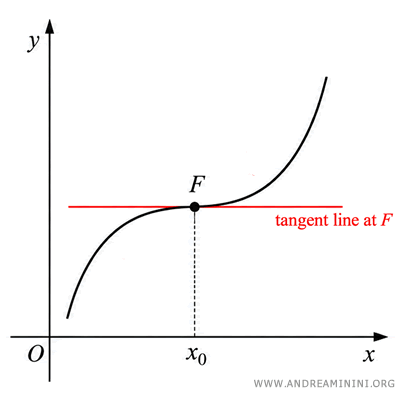
In this case, the slope of the tangent line is zero. Therefore, if the function is differentiable at \(x_0\), the derivative satisfies $ f'(x_0)=0 $.
Note. The condition $ f'(x_0)=0 $ by itself is not enough to show that \(x_0\) is an inflection point. The graph must also change concavity at \(x_0\). If the concavity does not change, the point may instead be a local maximum, a local minimum, or another type of stationary point.
Inflection point with a vertical tangent
An inflection point has a vertical tangent when its tangent line is parallel to the \(y\)-axis.
/data/andreamininiorg/flessi-am-2026-7.gif
In this case, the ordinary derivative at the point is not finite and may be undefined, while the graph still has a vertical tangent. A standard example is the graph of \(f(x)=\sqrt[3]{x}\) at \(x=0\).
Inflection point with an oblique tangent
An inflection point has an oblique tangent when its tangent line is parallel to neither the \(x\)-axis nor the \(y\)-axis.
In this case, the tangent line has a finite, nonzero slope.
If the function is differentiable at \(x_0\), the derivative at the inflection point is finite and nonzero: $ f'(x_0)\neq 0 $.
From concave down to concave up
One possible type of inflection occurs when the graph changes from concave down to concave up.
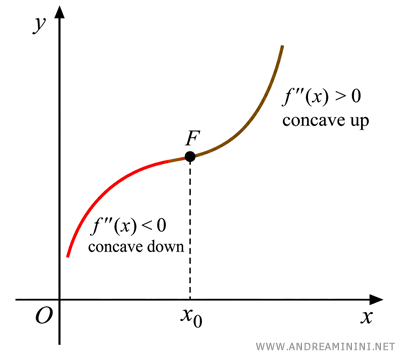
More specifically:
- to the left of the inflection point, the graph is concave down;
- to the right of the inflection point, the graph is concave up.
As we move through the inflection point from left to right, the way the graph bends changes.
Note. If the function is twice differentiable on intervals immediately to the left and right of the inflection point \(x_0\), the second derivative satisfies $ f''(x)<0 $ to the left of \(x_0\) (concave down) and $ f''(x)>0 $ to the right of \(x_0\) (concave up).
This type of inflection point may have a horizontal, vertical, or oblique tangent, depending on the behavior of the function at the point.
There is an important distinction to keep in mind: a change from concave down to concave up does not mean that the function itself is necessarily increasing.
Concavity describes how the slope of the graph changes, not whether the function is moving upward or downward.
These are two separate ideas. Increasing and decreasing behavior concerns the monotonicity of the function and is related to the sign of \(f'(x)\). Concavity, on the other hand, concerns how the slope changes and, when the second derivative exists, is related to the sign of \(f''(x)\).
Keeping this distinction in mind helps avoid confusing the monotonicity of a function with the concavity of its graph.
From concave up to concave down
The opposite type of change occurs when the graph goes from concave up to concave down.
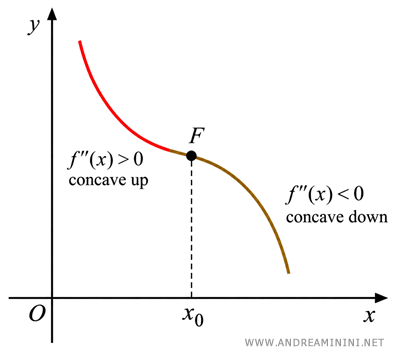
In this case:
- to the left of the inflection point, the graph is concave up;
- to the right of the inflection point, the graph is concave down.
Note. If the function is twice differentiable on intervals immediately to the left and right of the inflection point \(x_0\), the second derivative satisfies $ f''(x)>0 $ to the left of \(x_0\) (concave up) and $ f''(x)<0 $ to the right of \(x_0\) (concave down).
This type of inflection point may also have a horizontal, vertical, or oblique tangent, depending on the behavior of the function at the point.
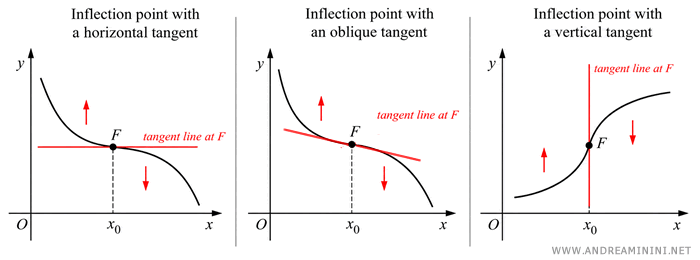
Here again, the defining feature is the change in concavity as the graph passes through the point, in this case from concave up to concave down.
This does not necessarily mean that the function itself is decreasing.
Whether a function is increasing or decreasing and whether its graph is concave up or concave down are separate properties. The first is determined by the behavior of the first derivative, while the second describes how the slope itself changes.