Concavity of a Function
Let \( y=f(x) \) be a function defined and differentiable on an interval \( I \). At every interior point \(x_0 \), the graph of the function has a tangent line, which we denote by \(y=t(x) \). By comparing the graph with its tangent line, we can determine whether the function is concave upward or concave downward.https://www.andreaminini.net/data/andreaminininet/higher-order-derivative-test-for-inflection-points-and-concavity-amnet-202610-3.gif
- Concave upward
A function is said to be concave upward at the point \(x_0 \) if there is an open neighborhood \(I_{x_0} \) of \(x_0 \) such that, for every point in the neighborhood other than \(x_0 \), the graph lies above the tangent line. \[ f(x)>t(x) \qquad \forall x \in I_{x_0}, \ x\neq x_0 \] In this situation, the tangent line lies below the graph of the function. A function that is concave upward on an interval is also called convex on that interval.

- Concave downward
A function is said to be concave downward at the point \(x_0 \) if there is an open neighborhood \(I_{x_0} \) of \(x_0 \) such that, for every point in the neighborhood other than \(x_0 \), the graph lies below the tangent line. \[ f(x)<t(x) \qquad \forall x \in I_{x_0}, \ x\neq x_0 \] In this situation, the tangent line lies above the graph of the function. A function that is concave downward on an interval is simply called concave on that interval.

In simple terms, concavity describes how the graph of a function bends. A graph that bends upward is concave upward, while a graph that bends downward is concave downward.
From a geometric point of view, the type of concavity can be determined by comparing the graph of the function with its tangent line.
A Practical Example
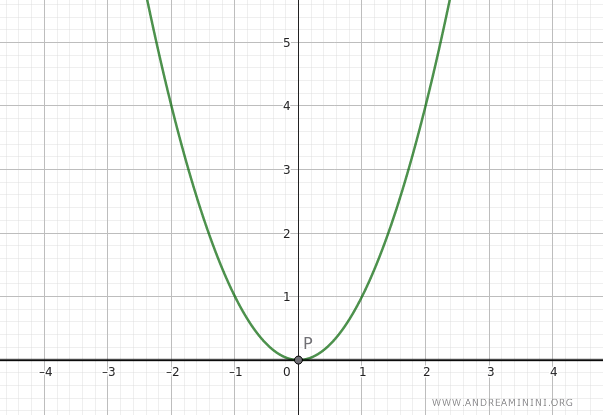
Consider the function
\[ f(x)=x^2 \]
At the point \( x_0=0 \), the tangent line coincides with the \( x \)-axis, so its equation is
\[ y=0 \]
In a neighborhood of the origin,
\[ x^2>0 \qquad (x\neq0) \]
Since the graph of the parabola always lies above its tangent line, the function is concave upward.
Example 2
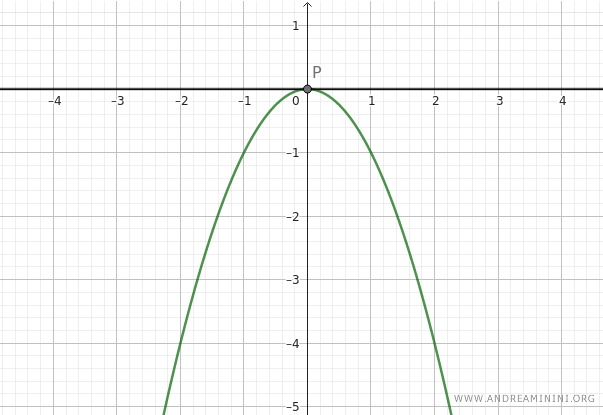
Now consider the function
\[ f(x)=-x^2 \]
At the point \( x_0=0 \), the tangent line is again
\[ y=0 \]
For every nonzero point in a neighborhood of the origin,
\[ -x^2<0 \]
This time, the graph lies below the tangent line, so the function is concave downward.
How to Determine Concavity
The geometric idea is straightforward. Simply compare the graph with its tangent line.
- If the graph lies above the tangent line, the function is concave upward.
- If the graph lies below the tangent line, the function is concave downward.
This geometric interpretation leads directly to the second derivative test, which allows us to determine concavity without comparing the graph and the tangent line point by point.
In practice, the geometric approach is rarely used because it would require analyzing the relative position of the graph and its tangent line at every point.
Instead, concavity is almost always determined analytically by studying the sign of the second derivative.
Concavity and the Second Derivative
The second derivative tells us how a function's slope changes. It also provides a straightforward way to determine whether a graph curves upward or downward.
If a function is twice differentiable on an interval \( I \), and its second derivative is continuous and nonzero at a point \( x \), we can determine the graph's local concavity by checking the sign of \( f''(x) \).
- If \( f''(x)>0 \), the graph is concave up (locally convex).
- If \( f''(x)<0 \), the graph is concave down.
Examining the sign of the second derivative is one of the easiest ways to study a function's concavity. It also helps us identify possible inflection points, where the graph changes from concave up to concave down, or vice versa.
Example 1: A Function That Is Concave Up
Let's start with a simple function:
\[ f(x)=x^2 \]
We can determine its concavity without drawing the graph. First, we find the first derivative:
\[ f'(x)=2x \]
Next, we differentiate again to obtain the second derivative:
\[ f''(x)=2 \]
Notice that the second derivative is constant and positive for every real number \(x\):
\[ f''(x)=2>0 \qquad \forall x \in \mathbb{R} \]
Since the second derivative is always positive, the graph is concave up throughout its entire domain.
Note. This result matches the familiar shape of the parabola \(y=x^2 \), which opens upward. The tangent line at any point lies below the parabola everywhere else, touching it only at the point of tangency.
Example 2: A Function That Is Concave Down
Now consider a similar function, but with a negative sign:
\[ f(x)=-x^2 \]
We begin by calculating its first derivative:
\[ f'(x)=-2x \]
Differentiating once more gives:
\[ f''(x)=-2 \]
This time, the second derivative is constant and negative for every real number \(x\):
\[ f''(x)=-2<0 \qquad \forall x \in \mathbb{R} \]
Because the second derivative is always negative, the graph is concave down throughout its entire domain.
Note. This result agrees with the shape of the parabola \( y=-x^2 \), which opens downward. The tangent line at any point lies above the parabola everywhere else, touching it only at the point of tangency.
These two examples illustrate the basic principle: the sign of the second derivative determines the direction of concavity.
For more complicated functions, we follow the same procedure. We calculate the second derivative, determine where it is positive or negative, and use those intervals to describe the graph's concavity.
If the concavity changes at a point where the function is continuous, that point is an inflection point.
Proof of the Second Derivative Criterion for Concavity
We have seen how the second derivative can be used to determine concavity. But why does this method work?
To understand the reasoning, we will compare the graph of a function with its tangent line.
Let \(y=f(x)\) be a function with a continuous second derivative on an open interval \(I\), and let \(x_0\) be an interior point of that interval.
Our goal is to prove two statements:
- If \(f''(x_0)>0\), the graph is concave up in a neighborhood of \(x_0\).
- If \(f''(x_0)<0\), the graph is concave down in a neighborhood of \(x_0\).
We begin with the point on the graph whose coordinates are:
\[ P=(x_0,f(x_0)) \]
The equation of the tangent line at \(P\) is:
\[ y-f(x_0)=f'(x_0)(x-x_0) \]
Solving for \(y\), we obtain:
\[ y = f(x_0) + f'(x_0)(x-x_0) \]
Let's define a function \( t(x)=y \) that gives the y-coordinate of the tangent line for each value of \(x\):
\[ t(x)=f(x_0)+f'(x_0)(x-x_0) \]
We can now compare the graph of \(f\) with its tangent line.
To do this, we introduce an auxiliary function \(g(x)\), defined as the vertical difference between the graph and the tangent line:
\[ g(x)=f(x)-t(x) \]
Substituting the expression \( t(x) =f(x_0)+f'(x_0)(x-x_0) \), we get:
\[ g(x)=f(x)-[f(x_0)+f'(x_0)(x-x_0)] \]
Expanding the expression gives:
\[ g(x)=f(x) - f(x_0) - f'(x_0)(x-x_0) \]
By our assumptions, \(g(x)\) is twice differentiable.
Its first derivative is:
\[ g'(x)=f'(x)-f'(x_0) \]
Differentiating again, we obtain:
\[ g''(x)=f''(x) - \frac{d}{dx}[f'(x_0)] \]
Since \(x_0\) is fixed, \(f'(x_0)\) is a constant with respect to \(x\). The derivative of a constant is zero:
\[ \frac{d}{dx}[f'(x_0)]=0 \]
Therefore:
\[ g''(x)=f''(x) - 0 \]
And so:
\[ g''(x)=f''(x) \]
This is an important result: the auxiliary function and the original function have the same second derivative.
Now consider what happens at \(x_0\).
The graph and its tangent line both pass through the point \(P\), so their vertical difference is zero:
\[ g(x_0)=0 \]
Also, because the line is tangent to the graph at \(P\), the two functions have the same first derivative at \(x_0\):
\[ f'(x_0)=t'(x_0) \]
As a result, the first derivative of their difference is zero:
\[ g'(x_0)=f'(x_0)-t'(x_0)=0 \]
We now have two useful conditions:
- \( g(x_0)=0 \): the graph and tangent line meet at \(x_0\).
- \( g'(x_0)=0 \): the auxiliary function has a stationary point at \(x_0\).
These conditions allow us to determine whether the graph lies above or below its tangent line near \(x_0\).
1] First Case: Positive Second Derivative
Suppose the second derivative is positive at \(x_0\):
\[ f''(x_0)>0 \]
Recall that:
\[ g'(x_0)=f'(x_0)-t'(x_0) \]
Differentiating once more gives:
\[ g''(x_0)=f''(x_0)-t''(x_0) \]
Since \( t(x) \) is an affine function representing a straight line, its first derivative \( t'(x) \) is constant. Its second derivative is therefore zero:
\[ t''(x_0)=0 \]
Substituting this result, we obtain:
\[ g''(x_0)=f''(x_0)-0 \]
Hence:
\[ g''(x_0)=f''(x_0) \]
We already know that \(g''(x)=f''(x)\). Since the second derivative is continuous, we also have:
\[ \lim_{x\to x_0}g''(x)=g''(x_0)=f''(x_0)>0 \]
Our assumption is that \( f''(x_0)>0 \). By continuity, \(g''(x)\) must remain positive in a sufficiently small neighborhood of \(x_0\).
Therefore, there exists a neighborhood \(I_{x_0}\) in which:
\[ g''(x)>0 \]
What does this tell us?
A positive second derivative means that the first derivative \(g'(x)\) is strictly increasing throughout this neighborhood.
Since \(g'(x_0)=0\), the increasing behavior of \(g'(x)\) implies:
\[ g'(x)<g'(x_0)=0 \quad \text{if }x<x_0 \]
\[ g'(x)>g'(x_0)=0 \quad \text{if }x>x_0 \]
In other words, \(g'(x)\) is negative to the left of \(x_0\) and positive to the right.
We can summarize these conditions as:
\[ g'(x)<0 \quad \text{if }x<x_0 \]
\[ g'(x)>0 \quad \text{if }x>x_0 \]
Therefore, \(g(x)\) decreases as \(x\) approaches \(x_0\) from the left and increases as \(x\) moves away from \(x_0\) to the right.
By the first derivative test, \(g\) has a strict local minimum at \(x_0\).
We also know that:
\[ g(x_0)=0 \]
Since this is a strict local minimum, the value of \(g(x)\) must be greater than zero at every nearby point other than \(x_0\):
\[ g(x)>g(x_0)=0 \]
Equivalently:
\[ g(x)>0 \]
Now recall the definition of the auxiliary function:
\[ g(x)=f(x)-t(x) \]
Substituting this expression into the inequality gives:
\[ f(x)-t(x)>0 \]
Therefore:
\[ f(x)>t(x) \]
This inequality tells us that the graph of \(f\) lies locally above its tangent line, except at the point of tangency, where the two meet.
We have therefore shown that when \(f''(x_0)>0\), the graph is concave up in a neighborhood of \(x_0\).
2] Second Case: Negative Second Derivative
Now let's consider the opposite situation. Suppose the second derivative is negative at \(x_0\):
\[ f''(x_0)<0 \]
From the previous calculations, we already know that:
\[ g''(x_0) = f''(x_0) \]
Since \( f''(x_0)<0 \), it follows that:
\[ g''(x_0) = f''(x_0) < 0 \]
Therefore:
\[ g''(x_0) < 0 \]
Because the second derivative is continuous, \(g''(x)\) remains negative in a sufficiently small neighborhood \(I_{x_0}\) of \(x_0\).
Throughout this neighborhood:
\[ g''(x)=f''(x)<0 \]
A negative second derivative means that the first derivative \(g'(x)\) is strictly decreasing.
Since \(g'(x_0)=0\), we obtain:
\[ g'(x)>g'(x_0)=0 \quad \text{if }x<x_0 \]
\[ g'(x)<g'(x_0)=0 \quad \text{if }x>x_0 \]
In other words, \(g'(x)\) is positive to the left of \(x_0\) and negative to the right.
We can express these conditions as:
\[ g'(x)>0 \quad \text{if }x<x_0 \]
\[ g'(x)<0 \quad \text{if }x>x_0 \]
Thus, \(g(x)\) increases as \(x\) approaches \(x_0\) from the left and decreases as \(x\) moves away from \(x_0\) to the right.
By the first derivative test, \(g\) has a strict local maximum at \(x_0\).
Since:
\[ g(x_0)=0 \]
the value of \(g(x)\) must be negative at every sufficiently nearby point other than \(x_0\):
\[ g(x)<g(x_0)=0 \]
Equivalently:
\[ g(x) < 0 \]
Recall that:
\[ g(x)=f(x)-t(x) \]
Substituting this expression gives:
\[ f(x)-t(x)<0 \]
Therefore:
\[ f(x)<t(x) \]
This inequality shows that the graph of \(f\) lies locally below its tangent line, except at the point of tangency.
We have therefore proved that when \(f''(x_0)<0\), the graph is concave down in a neighborhood of \(x_0\).
This completes the proof of the second derivative criterion for concavity in both cases.
The key idea is that the sign of the second derivative determines how the slope changes. A positive second derivative means the slope is increasing, producing a graph that is concave up. A negative second derivative means the slope is decreasing, producing a graph that is concave down.
By applying this criterion, we can determine a function's concavity without relying on its graph, making the second derivative an essential tool for analyzing the behavior of functions.
Determining Concavity Using Higher-Order Derivatives
I consider a function \(y=f(x)\) with continuous derivatives through order \(n\), where \(n\geq 3\), on an open interval containing \(x_0\). I assume that all derivatives of orders \(2\) through \(n-1\) are zero at \(x_0\): \[ f''(x_0)=f'''(x_0)=\ldots=f^{(n-1)}(x_0)=0 \] while \(f^{(n)}(x_0)\neq 0\). To determine the concavity near \(x_0\), I check whether \(n\) is even or odd and whether \(f^{(n)}(x_0)\) is positive or negative. The following conclusions apply in a sufficiently small neighborhood of \(x_0\).
If \(n\) is even, the function has the same concavity on both sides of \(x_0\):
- If \(f^{(n)}(x_0)>0\), the function is concave up.
- If \(f^{(n)}(x_0)<0\), the function is concave down.
If \(n\) is odd, the concavity changes as \(x\) passes through \(x_0\) from left to right:
- If \(f^{(n)}(x_0)>0\), the function changes from concave down to concave up.
- If \(f^{(n)}(x_0)<0\), the function changes from concave up to concave down.
Thus, \((x_0,f(x_0))\) is an inflection point when \(n\) is odd, but not when \(n\) is even.
This criterion lets me determine the concavity near a point where the second derivative is zero.
Example
I consider the function:
\[ f(x)=x^4+2x \]
To determine its concavity, I calculate the first two derivatives:
\[ f'(x)=4x^3+2,\qquad f''(x)=12x^2 \]
The second derivative is zero only at \(x_0=0\). To determine what happens near this point, I calculate the next two higher-order derivatives:
\[ f'''(x)=24x,\qquad f^{(4)}(x)=24 \]
At \(x_0=0\), the third derivative is also zero, but the fourth derivative is positive:
\[ f''(0)=f'''(0)=0,\qquad f^{(4)}(0)=24>0 \]
Among the derivatives of order two and higher, the fourth derivative is the first to have a nonzero value at \(x_0=0\). Its order is even, and its value is positive.
The function is therefore concave up on both sides of \(0\) near the point. Since the concavity does not change, \((0,0)\) is not an inflection point.
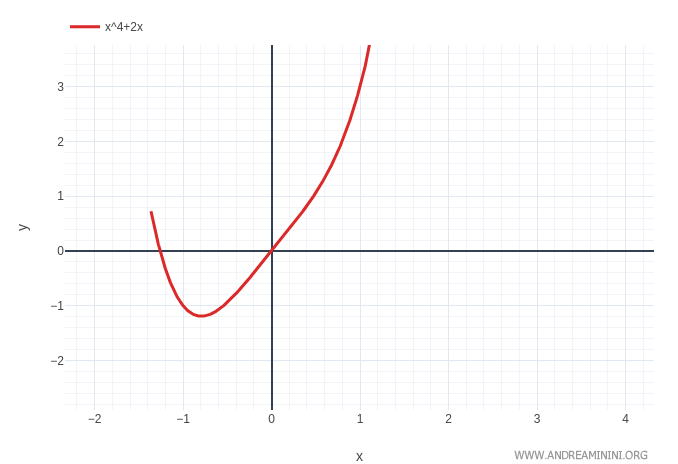
To extend the analysis to the entire domain, I note that:
\[ f''(x)=12x^2>0\qquad \text{for all }x\neq 0 \]
The function is therefore concave up on all of \(\mathbb{R}\), even though its second derivative is zero at \(x=0\).
The same approach can be applied to other functions that satisfy the conditions above.