Higher-Order Derivative Test for Inflection Points and Concavity
Let \(y=f(x)\) be a function with continuous derivatives through order \(n\) on an open interval containing \(x_0\). Suppose the first derivative is nonzero: \[ f'(x_0)\neq 0 \] All derivatives from the second through order \(n-1\) are zero at \(x_0\): \[ f''(x_0)=f'''(x_0)=\ldots=f^{(n-1)}(x_0)=0 \] However, the \(n\)th derivative is nonzero: \[ f^{(n)}(x_0)\neq 0 \qquad \text{for }n\geq 3 \] The result depends on whether \(n\) is odd or even.
If \(n\) is odd, the point \((x_0,f(x_0))\) is an inflection point with a nonhorizontal tangent line:
- If \(f^{(n)}(x_0)>0\), the graph changes from concave down to concave up as \(x\) increases through \(x_0\).
- If \(f^{(n)}(x_0)<0\), the graph changes from concave up to concave down as \(x\) increases through \(x_0\).
If \(n\) is even, the point \((x_0,f(x_0))\) is not an inflection point:
- If \(f^{(n)}(x_0)>0\), the graph is concave up on both sides of \(x_0\).
- If \(f^{(n)}(x_0)<0\), the graph is concave down on both sides of \(x_0\).
What happens when the second derivative of a function is zero? Does that mean the graph has an inflection point? Not necessarily. The higher-order derivative test helps me determine whether the concavity changes at that point or remains the same.
To apply this version of the test, I first check that the first derivative is nonzero: \( f'(x_0) \ne 0 \). This tells me that the tangent line to the graph at \((x_0,f(x_0))\) is not horizontal.
If the first derivative is zero, I can instead use the higher-order derivative test for local extrema and inflection points with horizontal tangents.
Note. The order of a derivative tells me how many times a function \( f(x) \) has been differentiated. The first derivative has order 1, the second derivative has order 2, and so on. When the second derivative is zero, I look for the first nonzero derivative of higher order. If its order is odd, the graph changes concavity. If its order is even, the concavity stays the same near the point. The sign of that derivative tells me whether the graph is concave up or concave down, or how its concavity changes.
Example 1: Finding an Inflection Point
Consider the function:
\[ f(x)=x+x^3 \]
I want to determine whether the graph has an inflection point at \(x_0=0\). I start by calculating its derivatives:
\[ f'(x)=1+3x^2,\qquad f''(x)=6x,\qquad f'''(x)=6 \]
Next, I evaluate the derivatives at \(x_0=0\):
\[ f'(0)=1\neq 0,\qquad f''(0)=0,\qquad f'''(0)=6>0 \]
The first derivative is nonzero, the second derivative is zero, and the third derivative is positive.
Since the first nonzero derivative beyond the second is the third derivative, which has odd order, I can conclude that \((0,0)\) is an inflection point with a nonhorizontal tangent line.
Furthermore, because \(f'''(0)>0\), the graph changes from concave down to concave up as \(x\) increases through \(0\).
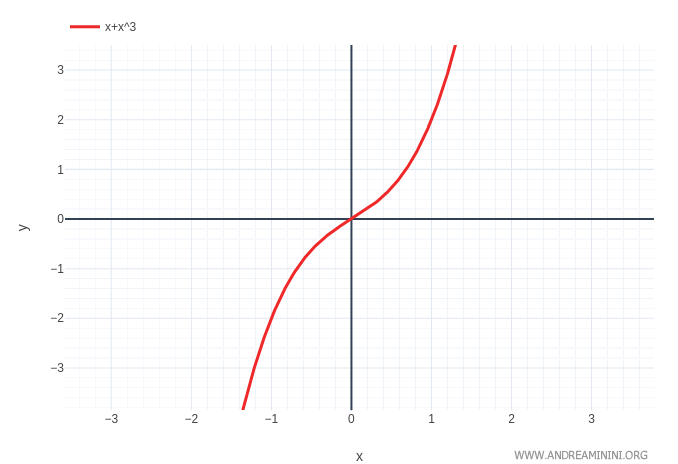
I can check the result directly using the second derivative. Since \(f''(x)=6x\) is negative for \(x<0\) and positive for \(x>0\), the graph changes concavity at the origin.
Example 2
Now consider a similar function:
\[ f(x)=x+x^4 \]
Does this function also have an inflection point at \(x_0=0\)? To find out, I calculate its derivatives:
\[ f'(x)=1+4x^3,\qquad f''(x)=12x^2,\qquad f'''(x)=24x,\qquad f^{(4)}(x)=24 \]
Evaluating them at \(x_0=0\), I get:
\[ f'(0)=1\neq 0,\qquad f''(0)=f'''(0)=0,\qquad f^{(4)}(0)=24>0 \]
This time, the first nonzero derivative beyond the second is the fourth derivative. Its order is even, and its value is positive.
Therefore, the graph is concave up on both sides of \(0\). There is no change in concavity, so \((0,0)\) is not an inflection point.
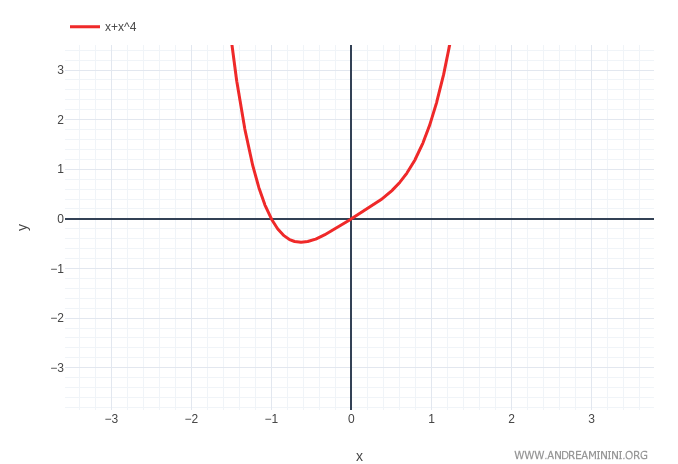
I can verify this by looking at the second derivative: \(f''(x)=12x^2\) is positive for every \(x\neq 0\). The graph remains concave up on both sides of the origin.
This example highlights an important point: a zero second derivative does not automatically mean that a function has an inflection point. What matters is whether the graph actually changes concavity.
What If the First Derivative Is Zero?
So far, I have assumed that \(f'(x_0)\neq 0\), which means the tangent line is not horizontal. But what happens if the first derivative is also zero?
The higher-order derivative test can still help me determine whether the graph changes concavity. If \(f'(x_0)=0\) and the remaining assumptions hold, there are two possibilities:
- If \(n\) is odd, the graph has an inflection point with a horizontal tangent at \((x_0,f(x_0))\).
- If \(n\) is even, there is no inflection point. Instead, the function has a strict local minimum at \(x_0\) if \(f^{(n)}(x_0)>0\), or a strict local maximum if \(f^{(n)}(x_0)<0\).
For example, consider \(f(x)=x^3\). At \(x_0=0\), I find that \(f'(0)=f''(0)=0\) and \(f'''(0)=6>0\). The first nonzero derivative is the third derivative, which has odd order. Therefore, \((0,0)\) is an inflection point with a horizontal tangent line, whose equation is \(y=0\).
Proof of the Higher-Order Derivative Test
To prove the higher-order derivative test, I use Taylor's theorem. Instead of expanding the original function \(f(x)\), I apply it to the second derivative \(f''(x)\). Why? Because the sign of the second derivative tells me whether the graph is concave up or concave down.
I start by defining a new function:
\[ g(x)=f''(x). \]
When I differentiate \(g\), I obtain the higher-order derivatives of \(f\):
\[ g'(x)=f'''(x),\qquad g''(x)=f^{(4)}(x),\qquad \ldots,\qquad g^{(n-2)}(x)=f^{(n)}(x). \]
Why does the exponent \(n-2\) appear? Since \(g\) is already the second derivative of \(f\), I need to differentiate it another \(n-2\) times to reach the \(n\)th derivative of \(f\).
Next, I apply Taylor's theorem to \(g\), expanding about \(x_0\) through order \(n-2\):
\[ g(x)=g(x_0)+g'(x_0)(x-x_0) +\frac{g''(x_0)}{2!}(x-x_0)^2 +\ldots+ \frac{g^{(n-2)}(x_0)}{(n-2)!}(x-x_0)^{n-2} +R(x) \]
Here, \(R(x)\) is the remainder term, the difference between the function and its Taylor polynomial. Using the Peano form of the remainder, I have:
\[ \lim_{x\to x_0}\frac{R(x)}{(x-x_0)^{n-2}}=0 \]
In little-o notation, I can write this as \(R(x)=o((x-x_0)^{n-2})\) as \(x\to x_0\). This means that the remainder approaches zero faster than \((x-x_0)^{n-2}\). Near \(x_0\), its contribution becomes negligible compared with that power.
Now I replace \(g\) with \(f''\) and substitute the corresponding derivatives:
\[ f''(x)=f''(x_0)+f'''(x_0)(x-x_0) +\frac{f^{(4)}(x_0)}{2!}(x-x_0)^2 +\ldots+ \frac{f^{(n)}(x_0)}{(n-2)!}(x-x_0)^{n-2} +R(x). \]
By the assumptions of the test, all derivatives from the second through the \((n-1)\)th are zero at \(x_0\):
\[ f''(x_0)=f'''(x_0)=\ldots=f^{(n-1)}(x_0)=0 \]
As a result, every term in the Taylor polynomial vanishes except the last one:
\[ f''(x)= \frac{f^{(n)}(x_0)}{(n-2)!}(x-x_0)^{n-2}+R(x) \]
Note. To see how this works, suppose the first nonzero derivative beyond the second is the fifth derivative. Then: \[ f''(x_0)=f'''(x_0)=f^{(4)}(x_0)=0, \qquad f^{(5)}(x_0)\neq 0 \] The Taylor expansion becomes: \[ f''(x)= \underbrace{f''(x_0)}_{0} +\underbrace{f'''(x_0)}_{0}(x-x_0) +\frac{\underbrace{f^{(4)}(x_0)}_{0}}{2!}(x-x_0)^2 +\frac{f^{(5)}(x_0)}{3!}(x-x_0)^3+R(x) \] Since the first three terms are zero, only the fourth term and the remainder remain: \[ f''(x)=\frac{f^{(5)}(x_0)}{6}(x-x_0)^3+R(x) \]
For \(x\neq x_0\), I factor out \((x-x_0)^{n-2}\):
\[ f''(x)=(x-x_0)^{n-2} \left[ \frac{f^{(n)}(x_0)}{(n-2)!} +\frac{R(x)}{(x-x_0)^{n-2}} \right]. \]
This is the key step. Inside the brackets, I have a nonzero constant plus a term that approaches zero. As \(x\) gets sufficiently close to \(x_0\), the term approaching zero becomes too small to change the sign of the constant.
Therefore, near \(x_0\), the sign of \(f''(x)\) is determined by:
\[ \frac{f^{(n)}(x_0)}{(n-2)!}(x-x_0)^{n-2}. \]
Since the factorial \((n-2)!\) is always positive, I only need to consider the sign of \(f^{(n)}(x_0)\) and whether the exponent \(n-2\) is odd or even. An odd power changes sign when \(x\) crosses \(x_0\), while an even power stays positive on both sides.
- If \(n\) is odd, then \(n-2\) is also odd. Therefore: \[ (x-x_0)^{n-2}<0 \quad \text{for }x<x_0, \qquad (x-x_0)^{n-2}>0 \quad \text{for }x>x_0 \] This means that the second derivative changes sign as \(x\) passes through \(x_0\):
- If \(f^{(n)}(x_0)>0\), then \(f''(x)\) changes from negative to positive. The graph changes from concave down to concave up.
- If \(f^{(n)}(x_0)<0\), then \(f''(x)\) changes from positive to negative. The graph changes from concave up to concave down.
- If \(n\) is even, then \(n-2\) is also even. Thus: \[ (x-x_0)^{n-2}>0 \qquad \text{for }x\neq x_0 \] The second derivative keeps the same sign on both sides of \(x_0\):
- If \(f^{(n)}(x_0)>0\), then \(f''(x)>0\), so the graph is concave up.
- If \(f^{(n)}(x_0)<0\), then \(f''(x)<0\), so the graph is concave down.
The proof also explains why the condition \(f'(x_0)\neq 0\) appears in the test. It is only needed to distinguish a nonhorizontal tangent from a horizontal one. If \(f'(x_0)=0\), the reasoning about concavity still applies. In particular, when \(n\) is odd, the graph has an inflection point with a horizontal tangent.
The same approach works for derivatives of any higher order, provided the assumptions of the test are satisfied.